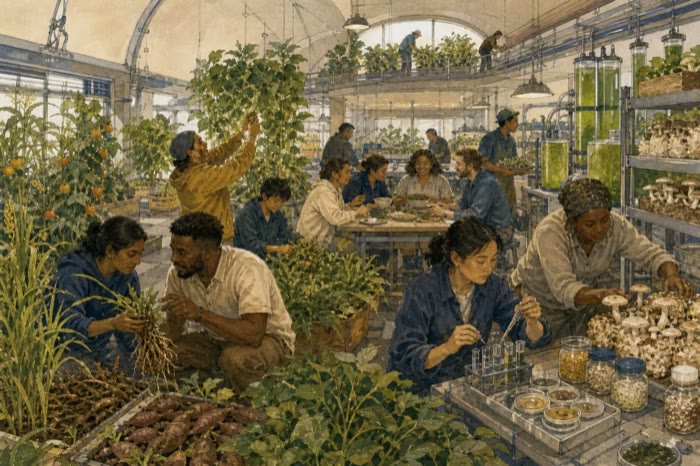
Evidence boundary: Plants have been grown and eaten in space, controlled-environment agriculture operates on Earth, and biological life-support programs study crop and microbial functions. The reviewed evidence does not demonstrate a complete, nutritionally adequate, culturally legitimate, multigenerational diet produced and regenerated in space. This lesson is not dietary, clinical, agricultural, or food-safety advice.
Plain-language summary
Growing a leafy vegetable proves something useful about a plant, chamber, light, water, crew procedure, and environment. It does not prove a food system.
A complete system must provide enough edible energy, indispensable amino acids and fatty acids, vitamins, minerals, fiber, safe water, and acceptable meals across childhood, pregnancy, illness, disability, aging, celebration, grief, work, and changing culture. It must store reserves, survive pests and crop loss, control allergens and toxins, recycle nutrients, manage wastes, preserve seeds and microbial cultures, and fit within power, heat, area, labor, and maintenance budgets.
Food is also autonomy and culture. An architecture that keeps people alive while assigning one institution permanent control over rations, seeds, kitchens, or reproduction is not socially closed or legitimate.
The useful design unit is therefore not “crop yield.” It is a resilient food portfolio with transparent nutritional, ecological, industrial, labor, and governance boundaries.
Begin with demand, not a favorite crop
For a declared population and interval, the demand model should distinguish:
- Total dietary energy and its variation with age, body, activity, health, pregnancy, temperature, and preference.
- Protein quantity, digestibility, and amino-acid profile.
- Fat quantity, essential fatty acids, and storage stability.
- Vitamins, minerals, fiber, and other required constituents.
- Absorption, processing losses, waste, and unequal access.
- Therapeutic, allergy-safe, texture-modified, religious, and culturally significant foods.
- Seed, feedstock, starter-culture, and reserve requirements.
Qualified nutrition and medical professionals must set actual targets for the people and context. A population average cannot replace individual health care or protect a minority with a different requirement.
The production side should report edible output after trimming, spoilage, processing, cooking, storage, and seed retention—not only fresh biomass. Wet mass can disguise low energy yield because water is heavy.
Use a portfolio of functions
No single production method closes every need. A resilient portfolio might include:
- Staple crops for dietary energy and some protein.
- Legumes or other protein crops for protein and nitrogen-related functions.
- Oil crops or microbial products for fats.
- Vegetables, fruits, herbs, and fungi for micronutrients, fiber, freshness, variety, and cuisine.
- Microbial or cell-based processes for selected proteins, fats, vitamins, flavors, enzymes, and feedstocks.
- Stored reserves for transition, crop loss, illness, and maintenance.
- External or mined feedstocks where full closure is not yet credible.
Every method has dependencies. Plants need light, carbon dioxide, water, nutrients, rooting support, temperature, humidity, gas exchange, pollination where applicable, disease control, harvesting, processing, and skilled attention. Microbial production needs sterile or controlled vessels, feedstock, gas transfer, sensors, separation, cleaning, and contamination management. Stored food loses quality and occupies mass and volume.
Diversity can limit common-cause failure, but it also increases expertise, equipment, spares, and complexity. The trade must be tested rather than assumed.
What space crop experiments establish
NASA’s plant research and Vegetable Production System provide operational evidence that selected plants can grow in orbit and that crews can tend and consume some produce under controlled protocols. These experiments study plant biology, food production, resource use, and psychological or habitability dimensions.
They are bounded demonstrations. Small plant chambers do not provide the energy, protein, fat, diversity, continuous succession, labor model, waste conversion, disease ecology, or dietary evidence of a complete population. Microgravity and spacecraft constraints also differ from a large rotating habitat.
The correct lesson is neither “space farming works” nor “space farming is impossible.” It is that particular plants and systems have produced measured results in particular environments, and the integration problem remains open.
Yield must include resource and labor ledgers
For each food pathway, publish:
- Edible energy, protein, fat, and relevant nutrients per time.
- Area, volume, lighting energy, other electrical energy, and rejected heat.
- Water and nutrient inputs, recovery, and residue.
- Seed, inoculum, substrate, gas, cleaning, and packaging requirements.
- Hands-on labor, expertise, training, and ergonomic access.
- Failed batches, disease, contamination, and quality variance.
- Harvest, processing, cooking, storage, and sanitation loads.
- Maintenance, sensor calibration, limited-life parts, and waste.
Photosynthetic efficiency is only one term. Lighting energy becomes heat; pumps and climate control require power; plants transpire water; high-density canopies change airflow and disease. A system can produce food and still be unacceptable because it consumes too much labor, fails unpredictably, or cannot be repaired.
Food safety and ecological safety
A closed habitat concentrates consequences. A pathogen, toxin, allergen, heavy metal, cleaning chemical, or incorrect nutrient solution can move through connected water, crop, kitchen, waste, and air systems.
Controls should include:
- Separation of high-risk streams.
- Traceable seed, culture, input, batch, and process records.
- Hazard analysis appropriate to each food pathway.
- Independent confirmatory testing.
- Quarantine capacity for plants, cultures, products, and equipment.
- Multiple kitchens or preparation paths where common-cause contamination matters.
- Accessible alerts, labeling, and safe alternatives.
- Recall and disposal plans that do not immediately return uncertain material to crops.
Sterility is not the goal for an ecology. Healthy plants and foods depend on microbial communities. The task is controlled function, monitoring, and recovery—not pretending microbes can be eliminated.
Reserves and crop failure
Agriculture has delayed output. If a crop fails today, replanted food may take weeks or months. A reserve should be sized to the longest credible diagnostic, decontamination, regrowth, and nutritional substitution interval—not only average harvest variability.
The reserve portfolio can include finished food, stable ingredients, seeds, cultures, nutrient stocks, and spare production capacity. Its quality, rotation, accessibility, and ownership must be audited. Emergency food that some residents cannot eat is not a complete reserve.
A credible test deliberately loses a major crop, an oil source, a vitamin pathway, a pollination function, and a food-processing line at different times. It observes whether nutrition, labor, mental health, and civic distribution remain acceptable.
Cuisine, choice, and power
Food carries language, memory, celebration, identity, religion, grief, and care. A founding menu cannot freeze culture for descendants. Residents need meaningful ability to experiment, grow, cook, refuse, adapt, and govern shared resources.
Questions that look “soft” are system requirements:
- Who allocates growing area and energy?
- Who owns seeds, cultures, recipes, and production data?
- Can a worker refuse unsafe agricultural labor?
- Can disabled residents reach controls and participate?
- How are scarce foods distributed?
- Who investigates illness when the food authority is also the employer or government?
- Can new communities change the portfolio without risking everyone?
Food monopoly becomes political monopoly when exit and external supply are unavailable. Independent safety authority, transparent inventories, plural preparation capacity, appeal, and resident governance are part of the architecture.
LLMs in food operations
An offline LLM could retrieve crop procedures, translate labels, help compare symptoms, or draft a schedule from controlled data. It could also confuse cultivars, invent a chemical rate, overlook an allergen, or amplify poisoned records.
The model must cite controlled agronomic, food-safety, nutritional, and configuration sources. Measurements and qualified decisions must remain distinguishable from generated suggestions. It should have no unilateral authority to change nutrient recipes, release quarantined food, diagnose a resident, or ration supplies. Deterministic alarms, human review, independent testing, and AI-off procedures remain necessary.
Earth-first test ladder
This work can support food security, controlled agriculture, remote communities, disaster logistics, and lower-waste institutions now.
- Publish a nutritional demand and inclusion specification.
- Operate a diverse portfolio through several seasons.
- Measure edible nutrients, resource use, heat, labor, wastes, and maintenance.
- Serve meals and record acceptability without coercion.
- Test allergy-safe, therapeutic, culturally varied, and accessible pathways.
- Remove one major crop or process and recover from reserve.
- Introduce a bounded contamination scenario under qualified oversight.
- Reconcile nutrients and element inventories.
- Publish failures, exclusions, tradeoffs, and external dependencies.
Success means resilient nourishment and legitimate access—not maximum lettuce per square meter.
Evidence ledger
- L06-03-A — Selected crops have been grown, studied, and consumed in space. Basis: demonstrated. Readiness: operational for bounded research systems. Confidence: strong.
- L06-03-B — A complete space-regenerated diet has not been demonstrated in the reviewed sources. Basis: bounded review. Readiness: major integration and scale-up required. Confidence: supported, not systematic proof of absence.
- L06-03-C — Food-system adequacy includes nutrients, safety, labor, reserves, culture, and governance. Basis: observed food-system functions plus normative rights and resilience requirements. Readiness: operational as a specification method. Confidence: strong about scope; exact choices require affected-public review.
- L06-03-D — Small crop chambers do not scale linearly to a changing population. Basis: modeled systems inference. Readiness: early research at settlement scale. Confidence: supported.
- L06-03-E — Controlled agriculture may create Earthside value when its full energy, labor, safety, and supply-chain burden is measured. Basis: proposed dual-use pathway. Readiness: operational in some terrestrial contexts, system-dependent. Confidence: supported.
Linked corpus claims: claim-06-01, claim-06-05, claim-06-07, and claim-06-08. See the claim registry for each record's current evidence grade and independent-review state.
Assumptions and limits
- No diet, crop portfolio, production area, population, gravity, or power budget is selected.
- Nutritional requirements and medical diets require qualified current guidance.
- NASA crop experiments are not treated as a complete-food demonstration.
- Animal agriculture is neither assumed nor excluded; its welfare, feed, resource, disease, and cultural issues need separate review.
- Food sovereignty and resident governance cannot be solved by engineering alone.
- This English-language source set is not a systematic review.
What would change this conclusion?
Readiness would rise after independently reviewed habitats produce and safely serve a nutritionally complete, culturally adaptable diet across representative residents for many seasons; disclose energy, heat, area, water, nutrients, labor, maintenance, imports, waste, illness, and variance; and recover from loss of major crops, cultures, storage, kitchens, and expertise. Evidence of persistent nutritional harm, coerced labor, unacceptable monopoly, uncontrolled contamination, or an energy and materials burden that cannot close should force redesign, external supply, a longer wait, or rejection.
Sources and locators
- NASA Science — Space Crops (opens external site in a new tab). Locator: plant research objectives, crop production context, space-environment questions, and bounded experiment descriptions; accessed 2026-07-25.
- NASA — Vegetable Production System (opens external site in a new tab). Locator: Veggie investigation record, chamber purpose, plant growth, crew interaction, and research boundary; accessed 2026-07-25.
- NASA NTRS — Advanced Life Support Baseline Values and Assumptions Document (opens external site in a new tab). Locator: crew metabolic and life-support planning values and model boundary; accessed 2026-07-25.
- ESA — MELiSSA Closed Loop Compartments (opens external site in a new tab). Locator: photosynthetic, higher-plant, microbial, waste, and crew compartments; accessed 2026-07-25.
- National Academies — Thriving in Space, chapter 8 (opens external site in a new tab). Locator: food, environment, health, habitability, behavioral factors, and evidence gaps; 2023.
- FAO and WHO — Sustainable Healthy Diets: Guiding Principles (opens external site in a new tab). Locator: health, environmental, cultural, accessibility, and food-safety principles; 2019. Used as terrestrial context, not a space diet specification.
- U.S. FDA — Food Safety Modernization Act (opens external site in a new tab). Locator: preventive-control and food-safety legal context; not asserted to govern a future interstellar habitat.
Editorial record
- Prepared by: GShips Project
- Last edited: 2026-07-25
- Status: Substantive editorial draft; not independently reviewed
- Independent domain review: Pending
- Required review: Controlled-environment agriculture, nutrition, medicine, food safety, ecology, microbiology, cultural foodways, labor, disability-led design, power and thermal engineering, and resident governance
- Conflicts: Maintainer intends to explore a commercial venture based on some GShips work; no entity, funding, customer, sponsor, or partner relationship currently exists
- Relationship boundary: Source inclusion does not imply author, institution, NASA, ESA, National Academies, FAO, WHO, or FDA endorsement or partnership
- Corrections: Suggest a correction