Evidence boundary: No archive can preserve a culture as a complete, fixed object, and no founder can authorize one canon for descendants. UNESCO instruments and human-rights treaties provide normative and legal context within defined scopes; they do not appoint GShips or any archive as a cultural authority. Archival standards preserve information under declared assumptions, not truth or meaning forever. Independent two-person review by cultural-rights, Indigenous-data, archives, linguistics, education, disability, privacy, and AI experts is pending.
Plain-language summary
A generation ship would need memory: languages, histories, science, law, art, music, ritual, craft, ecological knowledge, stories, failures, and arguments. But culture is not a crate of files delivered unchanged to the future.
People make culture by practicing, interpreting, combining, rejecting, and creating. Descendants must be free to change language, belief, art, family, institutions, and the meaning of the voyage. An archive is an inheritance, not a command.
The architecture should preserve plural sources with provenance and contested accounts, support living practice, protect cultural and privacy rights, and fund new creation. LLMs can help retrieve and translate, but can also invent sources, flatten minority language, reproduce colonial classifications, and turn one model into an invisible cultural gatekeeper.
What an archive can preserve
An archive can store recorded expressions and context:
- Text, images, audio, video, scores, diagrams, software, models, and data.
- Multiple languages, scripts, dialects, and sign languages.
- Laws, constitutions, cases, dissent, and institutional records.
- Scientific methods, uncertainty, negative results, and corrections.
- Oral histories recorded with consent and contextual metadata.
- Craft procedures paired with demonstrations and apprenticeship.
- Catalogs of objects, places, species, environments, and events.
- Provenance, rights, restrictions, and chains of custody.
The CCSDS Open Archival Information System reference model distinguishes content from the preservation information needed for a designated community to understand it. That is useful discipline. It does not decide which community counts, whether a record is true, or how meaning changes.
Bits can survive while interpretation fails. A future reader may lack the codec, language, context, scientific instrument, ritual authority, or lived relationship that made a record intelligible.
What cannot be frozen
Culture lives through people and relationships. A dance notation is not the dance; a recipe is not a meal; a dictionary is not a language community; a maintenance manual is not practiced judgment; a sacred recording may not be available for unrestricted reuse.
Founders should not try to preserve a final version of:
- Language or acceptable grammar.
- Religion, ritual, or nonbelief.
- Family, gender, kinship, or dress.
- Political identity or mission loyalty.
- Artistic value or a list of canonical works.
- The “correct” account of Earth or departure.
- Which cultures may borrow, combine, or refuse.
UNESCO’s cultural-diversity declaration connects diversity to pluralism, creativity, participation, and human rights. It also states that cultural diversity cannot be invoked to infringe internationally guaranteed rights. This matters in both directions: a majority cannot erase minorities in the name of unity, and a tradition cannot justify abuse in the name of preservation.
Build a plural archive
Selection is unavoidable. Storage, attention, translation, and teaching are limited. The response is transparent pluralism rather than false completeness.
A plural archive should:
- Publish collection policies, exclusions, conflicts, and resource limits.
- Include multiple accounts of disputed events.
- Record who described, translated, classified, and edited each item.
- Preserve minority findings and later corrections without silently overwriting history.
- Separate evidence, interpretation, fiction, simulation, and normative argument.
- Support community-defined access restrictions where legitimate.
- Avoid implying that possession transfers cultural authority or ownership.
- Provide appeals and periodic reappraisal by changing resident communities.
Indigenous, sacred, familial, and sensitive knowledge may carry collective governance, consent, or access conditions. “Open” is not always ethical. A project must not scrape, copy, translate, or train models on material merely because it can reach it.
GShips currently has no mandate from cultural rights-holders. Any future collection requires direct governance and permissions, not a generic public-interest claim.
A living cultural system
Preservation budgets should include practice:
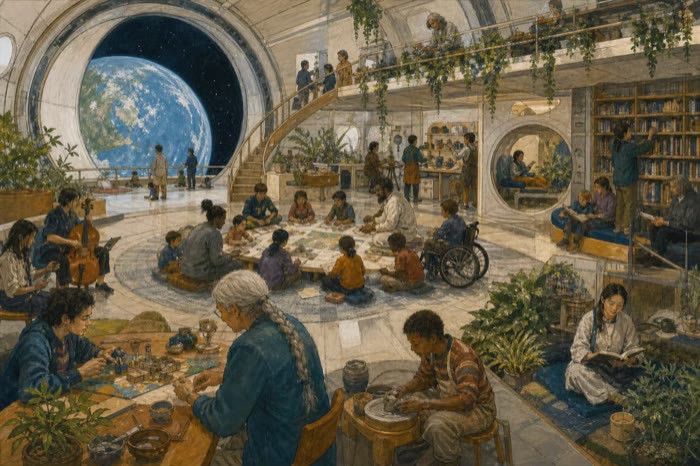
- Studios, instruments, workshops, stages, gardens, kitchens, assembly, and quiet.
- Time outside essential work.
- Teachers, apprentices, interpreters, conservators, and community historians.
- Materials and fabrication pathways for new forms.
- Festivals and rituals that residents may create, change, or decline.
- Translation across evolving languages and communication modes.
- Grants or shared resources for minority and experimental work.
- Public forums where archives are criticized.
Culture is part of resilience without being reduced to morale. It gives language to grief, conflict, love, identity, memory, and purpose. It also challenges authority.
The right to dissent includes dissent from the mission story. Art that questions founders, departure, destination, or settlement must not be treated as a systems fault.
Children inherit choices, not duties
Education should introduce many traditions without demanding cultural loyalty. Children need access to family and community inheritance, broader histories, minority perspectives, and the freedom to create new affiliations.
The CRC protects children’s expression, thought, association, information, education, play, and cultural life within its treaty framework. Those provisions support age-appropriate choice and participation in archive governance.
Children should learn how records were selected and whose voices are absent. They should be able to add, annotate, challenge, and reinterpret material. Founder recordings deserve provenance, not reverence.
Language change
Languages naturally change. Isolation, new work, mixed communities, and changing environments may accelerate new vocabulary, grammar, dialect, and sign.
Archive design should preserve historic forms while accepting current speech. Translation systems need multiple examples, community correction, dialect support, and the ability to leave terms untranslated.
A single official language may simplify some safety operations. It must not become a reason to suppress home, minority, signed, or emerging languages. Safety phrases can be standardized while cultural expression remains plural.
LLMs and cultural power
LLMs could search a large archive, translate, compare versions, generate reading paths, transcribe speech, describe images, or help recover a forgotten format. These uses may expand access for disabled residents and changing language communities.
Risks include:
- Confabulated quotations, citations, provenance, and history.
- Dominant-language bias and loss of minority distinctions.
- Smooth summaries that hide dispute and uncertainty.
- Training on restricted or sacred material.
- Style imitation that obscures authorship and consent.
- One model’s categories becoming the archive’s worldview.
- Personalized recommendations creating cultural isolation or manipulation.
- Surveillance of reading, belief, association, and creative work.
The model should never be the archival record. Retrieval must expose the underlying object, version, source, rights, and uncertainty. Generated text should be labeled and separable from originals. Community authorities need the ability to correct translations and restrict inappropriate use without becoming unreviewable censors.
AI-off access is essential: catalogs readable without a model, documented formats, human interpreters, direct teaching, physical or simple-media copies of critical works, and exercises in recovery when every model is unavailable.
Preservation architecture
A durable archive needs multiple media, copies, locations, formats, checksums, fixity audits, emulation, migration, and recovery tests. Checksums detect change; they do not establish truth, authenticity, authorization, or cultural legitimacy.
Preservation information should include:
- Source and acquisition context.
- Creator, contributor, translator, and editor.
- Dates, versions, and relationships.
- Rights, consent, access, and use restrictions.
- Technical dependencies and render instructions.
- Known disputes, corrections, and minority interpretations.
- Evidence grade and review history where factual claims are involved.
Recovery must be practiced by people who did not build the system. A pristine archive that only one aging specialist can open is already failing.
Governance and refusal
Archive councils should include librarians, educators, technical stewards, artists, young residents, disabled people, language communities, and cultural minorities. Terms, conflicts, appeals, and succession should be public.
No council can permanently define culture. Its authority is custodial and revisable. Residents need space for private collections, community archives, and lawful refusal to deposit personal or sacred material.
Minority findings should remain attached to major collection, deletion, restriction, translation, and model-training decisions.
Decision outcomes
- Launch: only with plural collections, rights and provenance, living practice, community governance, recoverability, and AI-off access.
- Wait: when one archive, language, model, donor, or founder controls cultural legitimacy.
- Redirect: build resilient community archives, language tools, apprenticeship, and preservation infrastructure for Earth.
- Do not launch: if mission cohesion requires cultural conformity, compulsory archive access, erased dissent, or descendants bound to founders’ identity.
Evidence ledger
- L08-03-A — Digital preservation requires content plus representation, provenance, context, fixity, and access information. Basis: demonstrated archival practice and standard. Readiness: operational in current repositories; major scale-up for centuries. Confidence: strong on method. Support: OAIS sections 2–4.
- L08-03-B — Cultural diversity is living, plural, creative, and bounded by human rights. Basis: normative international instrument. Readiness: operational as guidance; early research for a closed society. Confidence: strong on source, implementation unverified. Support: UNESCO Cultural Diversity Articles 1–6.
- L08-03-C — Archives do not authorize founders to bind descendants. Basis: normative. Readiness: operational as an editorial rule. Confidence: supported. Support: UN Declaration on Future Generations and ICCPR Article 27.
- L08-03-D — LLM retrieval and translation can improve access while introducing confabulation, homogenization, privacy, and provenance risk. Basis: proposed use and documented risk taxonomy. Readiness: early research. Confidence: supported. Support: NIST AI 600-1; UNESCO AI education guidance.
- L08-03-E — Archives must be recoverable without one model, vendor, expert, or medium. Basis: proposed assurance rule grounded in archival practice. Readiness: major scale-up. Confidence: supported. Support: OAIS and UNESCO documentary-heritage recommendation.
Linked corpus claims: claim-09-01, claim-09-04, claim-09-06, claim-09-10, claim-13-04, claim-13-06, and claim-13-09. Cultural, Indigenous-data, privacy, childhood, archival, and AI judgments require independent two-person review.
Assumptions and limits
- No finite archive can represent all humanity or every culture.
- Public availability is not the same as permission for preservation, translation, or model training.
- UNESCO instruments differ in legal status and scope; automatic ship jurisdiction is not claimed.
- Cultural rights do not erase individual rights or criticism.
- Storage endurance does not establish intelligibility or truth.
- Descendants will create identities and languages that founders cannot predict.
- Waiting, Earth archives, probes, reversible habitats, and non-expansion remain valid.
What would change this conclusion?
- Community-governed archive pilots with diverse rights-holders, transparent exclusions, appeals, recovery, and succession would raise readiness.
- Evidence that a proposed open-access rule harms cultural rights would require restriction or removal, not claims of universal ownership.
- Independently validated multilingual retrieval with provenance and community correction could narrow AI risks.
- Loss drills may show that different media, representation information, or teaching cadence is necessary.
- If mission cohesion requires one authorized culture or suppression of descendant reinterpretation, the correct outcome is do not launch.
Sources and locators
- UNESCO Universal Declaration on Cultural Diversity (opens external site in a new tab) — Articles 1–6 and 7–10. Accessed 2026-07-25.
- UNESCO, Convention for the Safeguarding of the Intangible Cultural Heritage (opens external site in a new tab) — Articles 1–3, 11–15, community participation, safeguarding, and scope. Accessed 2026-07-25.
- UNESCO Recommendation Concerning Documentary Heritage, Including in Digital Form (opens external site in a new tab) — definitions and sections on identification, preservation, access, policy, and cooperation. Accessed 2026-07-25.
- CCSDS, Reference Model for an Open Archival Information System (opens external site in a new tab) — sections 1–4, designated communities, information packages, preservation information, functions, and responsibilities. Accessed 2026-07-25.
- International Covenant on Civil and Political Rights (opens external site in a new tab) — Articles 17–19, 21–22, and 25–27. Accessed 2026-07-25.
- United Nations, Declaration on Future Generations (opens external site in a new tab) — principles and commitments on diversity, future interests, participation, and accountability. Accessed 2026-07-25.
- NIST AI 600-1, Generative AI Profile (opens external site in a new tab) — confabulation, harmful bias, privacy, information integrity, provenance, and human-AI risks and actions. Accessed 2026-07-25.
- UNESCO, Guidance for Generative AI in Education and Research (opens external site in a new tab) — human agency, linguistic and cultural diversity, inclusion, data protection, validation, and policy guidance. Accessed 2026-07-25.
- UNICEF, Convention on the Rights of the Child (opens external site in a new tab) — Articles 12–17, 29–31. Accessed 2026-07-25.
Editorial record
- Prepared by: GShips Project
- Last edited: 2026-07-25
- Status: Substantive editorial draft; not domain approved
- Author/reviewer: GShips Project editorial synthesis; no independent cultural-rights, Indigenous-data, archive, language, or AI reviewer has approved this lesson
- Independent domain review: Pending
- Required review: cultural rights, Indigenous data governance, archives, linguistics, education, child rights, disability, privacy, AI governance, and intergenerational ethics
- Conflicts: Maintainer intends to explore a commercial venture based on some GShips work
- Relationships: GShips Project is independent and is not affiliated with UNESCO, CCSDS, NIST, UNICEF, OHCHR, the United Nations, or any indexed organization
- Corrections: Suggest a correction