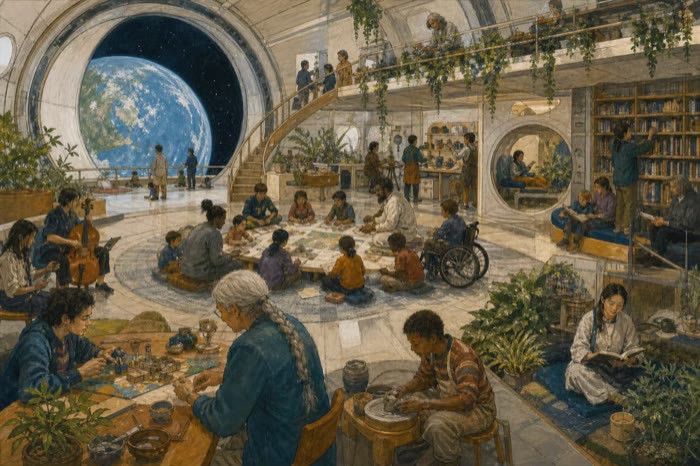
Evidence boundary: No child has been conceived, born, raised, educated, and brought to civic adulthood in an off-Earth environment. Adult isolation analogs do not validate childhood or family life across generations. Rights instruments guide this lesson within their current legal scopes and do not settle interstellar jurisdiction. This is not medical, reproductive, educational, or family-law advice. Independent two-person review by child-rights, disability, reproductive-justice, education, family-law, labor, privacy, and behavioral-health experts is pending.
Plain-language summary
A child aboard a generation ship would inherit a voyage they did not choose. That does not make the child a replacement crew member, demographic target, or carrier of a founder’s plan.
Children need care, safety, identity, privacy, play, education, culture, relationships, disability support, and a growing voice in decisions. Families need resources and freedom to evolve. Institutions need power to protect children when families cause harm, but that power must be accountable and cannot become population control.
Education should prepare young people to maintain life-critical systems and to question the mission itself. LLMs may help with tutoring, translation, and retrieval, but children need human relationships, diverse sources, protected data, and the ability to learn when AI is unavailable or wrong.
The evidence gap is unusually large
NASA analogs such as CHAPEA study selected adult crews over bounded periods with Earth support. Spaceflight behavioral evidence concerns professional adults. These programs can inform workload, isolation, communication, and habitat routines.
They do not reproduce:
- Pregnancy, birth, infancy, or child development off Earth.
- Dependence on one closed ecology from birth.
- Parents who cannot leave the institution that employs them.
- Schooling across changing languages and cultures.
- Disability and aging across a civil population.
- Political adulthood after an unchosen departure.
- Grandparents, descendants, inheritance, and institutional memory.
The absence of evidence is not proof that healthy childhood is impossible. It means a mission cannot claim readiness by scaling adult crew data.
Children are people now, not only future citizens
The Convention on the Rights of the Child organizes important obligations around nondiscrimination, best interests, survival and development, identity, voice, privacy, protection, health, education, culture, rest, and play.
Its formal obligations attach to states parties. As design material, it changes the questions:
- Can children safely complain about parents, teachers, clinicians, or officials?
- Do they receive age-appropriate information about hazards and uncertainty?
- Can they maintain identity and relationships without compulsory mission mythology?
- Does education expand future choices or narrow children into assigned roles?
- Are disability and health supports available without loss of status?
- Can a child’s views alter a decision rather than merely be recorded?
Best interests cannot become a slogan used by adults to silence children. Decisions need reasons, evidence, the child’s perspective, independent advocacy, and review.
Evolving agency
Agency develops unevenly across people and subjects. A single age line cannot answer every decision.
Young children need strong protection and understandable choices. Older children may be capable of meaningful decisions about education, privacy, associations, health information, culture, and civic issues. Adults retain full civic standing regardless of occupation, fertility, health, disability, or belief.
A staged architecture could include:
- Confidential child advocates independent of family, school, clinic, and government.
- Youth seats with real votes on education, culture, environment, and long-horizon planning.
- Protected access to public records and competing accounts.
- Age-appropriate complaint, appeal, and whistleblowing routes.
- Supported decision-making and accessible communication.
- Periodic constitutional conventions that include young residents.
- Automatic end dates for parental or institutional monitoring.
The founders’ preferences are not a curriculum standard. Descendants need authority to amend institutions, reject symbols, change destination policy, and create new family and cultural forms within a rights floor.
Family diversity and care
A closed society cannot assume one permanent model of marriage, household, gender, parenting, or kinship. Families may include single parents, multiple caregivers, blended households, adoption, guardianship, chosen family, and communal care.
Institutions should support rather than prescribe family life. Requirements include parental leave, accessible housing, child care, elder and disability care, respite, relationship counseling, reproductive health, and time together.
Care work is skilled labor. If it is treated as a private duty, system costs fall invisibly on particular families and often on women or marginalized people. Public, cooperative, and household care should be measured, resourced, and open to fair participation without turning intimacy into an employment transaction.
The family is not beyond review. Children need outside help when abuse, neglect, coercion, or exploitation occurs. Intervention should be necessary, proportionate, culturally informed, accessible, independently reviewed, and oriented toward safety and development.
Childhood must not become conscription
Life-critical skills must pass between generations. That does not justify hereditary occupation or child labor.
Education and voluntary apprenticeship can introduce agriculture, maintenance, care, fabrication, governance, and emergency response. Work should be age-appropriate, safe, limited, supervised, educational, and compatible with rest and school.
The ILO’s official explanation of Convention No. 29 describes forced labour around threatened deprivation and lack of voluntary offer, subject to its legal exceptions. Ship law remains unsettled, but threatening food, air, housing, family status, or citizenship to obtain work is a clear design failure.
No child should inherit a job because a parent held it. Staffing models should use cross-training, automation, reserve capacity, fair civic service, and genuine occupational choice. If the mission closes only when births are allocated to future roles, it does not close ethically.
Privacy inside a small family system
Children require privacy as well as protection. Parents, schools, clinics, and AI systems should not share all records by default.
Health, reproductive, disability, educational, location, and communication data need separate purposes, access logs, correction, limited retention, and independent oversight. A child’s need for confidentiality increases with capacity, while immediate safety exceptions remain narrow and reviewable.
Family size can make anonymity difficult. Institutions should provide confidential reporting rooms, non-family advocates, private clinical access, and protection against retaliation.
LLMs in childhood and education
An offline language model could tutor across subjects, translate for changing language communities, retrieve archive sources, adapt explanations, or assist a disabled learner. Those are potential tools, not teachers or guardians.
Risks are especially serious for children:
- Confabulated facts, sources, health advice, or personal histories.
- Persistent profiles that follow a child into work and politics.
- Cultural and linguistic homogenization.
- Manipulative personalization or dependency.
- Hidden bias in discipline, ability, or career recommendations.
- Exposure of family, health, disability, or dissent.
- Founder-selected archives presented as neutral truth.
- Reduced practice with people, tools, memory, and disagreement.
UNESCO’s guidance for generative AI in education emphasizes human agency, inclusion, data protection, age appropriateness, validation, and educational purpose. It is guidance, not proof of safe use aboard a ship.
Boundaries should include approved source sets with exact locators, visible uncertainty, no secret scoring, no authority over discipline or legal capacity, teacher and learner challenge, and deletion or correction of personal data. Children need AI-off classes, books and directly readable materials, laboratories, studios, workshops, peer learning, and human mentorship.
Family conflict and plural values
Families will disagree about belief, language, gender, schooling, relationships, work, and the mission. Cultural plurality deserves protection, but no tradition can erase a child’s dignity, safety, development, disability equality, or growing voice.
Schools should teach civic disagreement without enforcing one worldview. Minority schools or cultural programs may flourish within common rights, safety, science-literacy, and access requirements.
Minority findings should remain visible. If youth, family, disability, cultural, or reproductive-rights reviewers reject a policy, future residents should see their evidence and reasons.
Decision outcomes
- Launch: only with independently reviewed care, child advocacy, education, privacy, disability, family, labor, and reproductive systems—not population models alone.
- Wait: when adult analogs are used as childhood evidence, learning depends on one model, or family care is unresourced.
- Redirect: test child-centered habitat, school, care, archive, and AI-off practices in Earth communities and reversible habitats.
- Do not launch: if survival requires assigned births, hereditary work, forced reproduction, child surveillance, disability exclusion, or compulsory loyalty.
Evidence ledger
- L08-02-A — No current analog validates off-Earth childhood across a lifespan. Basis: observed program boundaries and absence in the reviewed record. Readiness: no known path. Confidence: strong on cited scope, not proof of impossibility. Support: NASA CHAPEA and behavioral-health materials.
- L08-02-B — Children hold present rights to development, identity, voice, privacy, education, culture, rest, and play. Basis: observed treaty text and normative application. Readiness: operational within current scope; early research aboard a habitat. Confidence: strong on provisions. Support: CRC Articles 2–6, 7–8, 12–17, and 28–31.
- L08-02-C — Founders cannot transmit consent or permanent mission duty to descendants. Basis: normative. Readiness: no known validated process. Confidence: supported. Support: CRC evolving capacities and UN Declaration on Future Generations.
- L08-02-D — Skill transfer cannot justify hereditary or coerced labor. Basis: normative labor and child-rights boundary. Readiness: early research. Confidence: supported. Support: ILO Convention No. 29 official explanation; CRC Article 32.
- L08-02-E — LLM education requires human agency, provenance, privacy, validation, and AI-off learning. Basis: proposed and normative guidance. Readiness: early research. Confidence: supported; long-duration evidence absent. Support: UNESCO generative-AI education guidance.
Linked corpus claims: claim-07-04, claim-08-07, claim-09-01, claim-09-05, claim-09-06, claim-09-10, and claim-10-07. Childhood, family, reproductive, disability, education, privacy, and labor judgments require independent two-person review.
Assumptions and limits
- Present rights instruments have defined legal scopes; automatic ship jurisdiction is not claimed.
- Family forms and childhood practices differ across cultures and will change.
- Protection and agency can conflict; neither eliminates the other.
- No analog can consent for future children.
- Technical developmental risks are addressed elsewhere and remain unresolved.
- AI capabilities and safeguards will change; offline operation is not automatically safe.
- Earth investment, probes, reversible habitats, waiting, and non-expansion remain valid.
What would change this conclusion?
- Long-duration voluntary family-habitat research with child advocates, disability leadership, independent ethics, and real exit could raise readiness without validating irreversible childhood.
- Demonstrated clinical and developmental safety would narrow biological uncertainty but not consent or political agency.
- Better rights frameworks or youth-led findings could revise the proposed institutions.
- Independently validated AI education with strong privacy and cultural plurality could narrow tool risks, not remove human and AI-off learning.
- Evidence that any viable plan depends on coercive reproduction, hereditary labor, or compulsory mission identity would strengthen do not launch.
Sources and locators
- UNICEF, Convention on the Rights of the Child (opens external site in a new tab) — Articles 2–6, 7–8, 12–17, 23–24, 28–32, and 40. Accessed 2026-07-25.
- United Nations, Convention on the Rights of Persons with Disabilities (opens external site in a new tab) — Articles 3–5, 7, 9, 12, 19, 21, 23–25, and 30. Accessed 2026-07-25.
- International Covenant on Economic, Social and Cultural Rights (opens external site in a new tab) — Articles 6–7, 10, and 12–15. Accessed 2026-07-25.
- ILO, Convention 029 and the Forced Labour Convention (opens external site in a new tab) — official definition, threatened deprivation examples, prohibition, and limited exceptions. Accessed 2026-07-25.
- United Nations, Declaration on Future Generations (opens external site in a new tab) — guiding principles and commitments on future interests, participation, diversity, and accountability. Accessed 2026-07-25.
- NASA, About CHAPEA (opens external site in a new tab) — adult crew, habitat, mission duration, stressors, and Earth-support boundary. Accessed 2026-07-25.
- NASA, Behavioral Health and Performance Risk (opens external site in a new tab) — current exploration risk, contributing factors, evidence, and mitigation scope. Accessed 2026-07-25.
- UNESCO, Guidance for Generative AI in Education and Research (opens external site in a new tab) — chapters 2–4 and policy framework on human agency, inclusion, data, age, validation, and educational use. Accessed 2026-07-25.
Editorial record
- Prepared by: GShips Project
- Last edited: 2026-07-25
- Status: Substantive editorial draft; not domain approved
- Author/reviewer: GShips Project editorial synthesis; no independent child-rights, family, disability, education, or reproductive reviewer has approved this lesson
- Independent domain review: Pending
- Required review: child rights, family law, disability, reproductive justice, education, labor, privacy, behavioral health, and intergenerational ethics
- Conflicts: Maintainer intends to explore a commercial venture based on some GShips work
- Relationships: GShips Project is independent and is not affiliated with UNICEF, UNESCO, NASA, ILO, OHCHR, the United Nations, or any indexed organization
- Corrections: Suggest a correction