Evidence boundary: No archive, school, apprenticeship system, standards body, spacecraft program, or AI has demonstrated autonomous knowledge continuity across centuries. Current preservation and networking standards solve bounded problems. Voyager demonstrates long-lived operation with Earth institutions, not self-sufficient expertise. This lesson proposes an assurance program, not a guarantee of civilizational continuity. Independent two-person review across education, labor, archives, maintenance, cyber, accessibility, and AI is pending.
Plain-language summary
Keeping files is not the same as keeping the ability to act. People learn surgery, fabrication, farming, debugging, teaching, care, and governance through explanation, observation, supervised practice, feedback, and judgment.
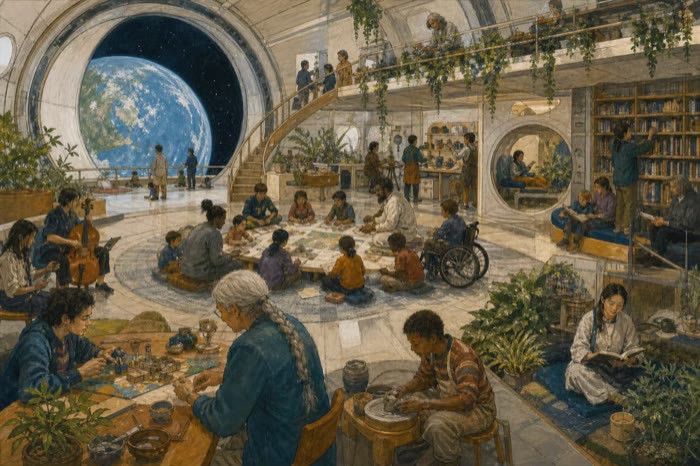
A generation ship needs both durable archives and living skill communities. Every critical capability should have multiple teachers, apprentices, tools, materials, exercises, and recovery paths. Residents should periodically rebuild knowledge from records without the original expert, cloud service, vendor activation, or generative model.
LLMs can help search, translate, tutor, and summarize. They can also invent procedures, conceal uncertainty, leak private learning records, amplify a poisoned source, and make people dependent on fluent answers. Critical learning must remain possible AI-off.
Four different things called knowledge
Recorded information
Documents, drawings, datasets, code, video, measurements, and models can be copied. They need formats, metadata, provenance, fixity, rights, and render instructions.
Procedural skill
A written procedure cannot capture every sound, resistance, smell, visual cue, tool angle, timing decision, or safe adaptation. Learners need supervised practice on representative equipment.
Judgment
Experts recognize when a case falls outside the procedure, which tradeoff is acceptable, and when to stop. Judgment develops through varied cases, error, reflection, and accountability. It cannot be reduced to confidence or seniority.
Institutional memory
Organizations remember why a rule exists, which failures shaped it, who owns authority, how evidence was disputed, and where records live. Leadership turnover can erase this memory even when files remain.
An assurance plan should identify which kind each capability requires. “It is in the archive” only addresses the first.
Why knowledge is lost
Knowledge can fail through:
- Media degradation, corruption, or loss.
- Obsolete codecs, compilers, hardware, keys, or file systems.
- Missing calibration standards and test specimens.
- Proprietary activation, cloud, or vendor dependencies.
- One expert retiring, dying, or becoming unavailable.
- A skill unused for years.
- Translation drift or loss of context.
- Procedures copied after the reason for a constraint is forgotten.
- Political suppression or a culture that punishes bad news.
- AI summaries replacing underlying evidence.
- Cyberattack, poisoned updates, or false provenance.
- Schools narrowing learning to immediate staffing needs.
Redundancy must therefore include people, practices, materials, tools, institutions, and authority—not just storage copies.
The archive as an active system
The OAIS reference model provides concepts for information packages, designated communities, preservation planning, access, and representation information. It is a reference model, not a guarantee that a future resident understands or trusts a record.
For each critical body of knowledge, preserve:
- The claim, procedure, or design.
- Source data and uncertainty.
- Versions, changes, and reasons.
- Failures, near misses, dissent, and rejected alternatives.
- Required tools, materials, environments, and calibration.
- Demonstrations and annotated examples.
- Rights, privacy, access, and safety restrictions.
- Tests showing that a learner can recover the capability.
Checksums establish whether bits changed according to an algorithm. Signatures may establish integrity and attributed origin. Neither proves truth, safety, current applicability, or authorization.
Apprenticeship without hereditary labor
Apprenticeship joins education to real practice. It should expand choice, not assign children to ancestral occupations.
A responsible program includes informed participation, compensation where work has value, safe conditions, qualified mentors, accessible instruction, defined learning outcomes, protected reporting, assessment by more than one person, and credentials that transfer between roles.
ILO’s Quality Apprenticeships Recommendation provides present-world guidance on rights, inclusion, occupational safety, remuneration, social protection, mentoring, and recognition. Its legal and institutional context does not automatically apply aboard a ship. It helps distinguish learning from extraction.
Critical roles need overlapping cohorts. A mature specialist should not train only one successor at the end of a career. People should rotate through teaching, practice, assessment, and supervised independent work while maintaining enough staffing for rest and care.
Disability is not an exception. Training needs accessible tools, multiple communication modes, adaptable work, and supported decision-making. A capability architecture should distinguish actual task requirements from inherited assumptions about bodies.
Teach-back and reconstruction
The strongest test is not whether the author can explain a procedure. It is whether a new team can recover and perform it.
A reconstruction exercise might:
- Select a bounded capability and freeze its approved evidence package.
- Use learners who did not build the system.
- Remove live access to the original experts and external services.
- Require setup, calibration, operation, fault diagnosis, safe shutdown, and documentation.
- Introduce a controlled ambiguity or degraded component.
- Compare results against independent measures.
- Record missing context, unsafe assumptions, and workarounds.
- Update the archive while preserving the old version and dissent.
Tests should include AI-off, network-off, and degraded-tool conditions. Failure is valuable if published and corrected. A culture that hides training failure destroys its own evidence.
Communication delay and local learning
Delay-tolerant networking stores and forwards data when continuous end-to-end paths are unavailable. NASA’s DTN work and IETF Bundle Protocol standards support resilient communication under delay and disruption. They do not make the content true or ensure a local community can use it.
As Earth delay grows, questions must be answered locally before an expert reply arrives. Education should therefore emphasize first principles, measurement, diagnostic reasoning, source criticism, and the ability to reconstruct tools—not merely procedural compliance.
Earth updates may still matter. Incoming material needs quarantine, provenance, compatibility testing, rights review, and a clear distinction between advice and authority.
What Voyager does and does not teach
Voyager shows that hardware and teams can sustain a mission for decades through power triage, remote diagnosis, archives, and creative recovery. NASA’s 2025 account of reviving backup thrusters illustrates use of old documentation, current expertise, and Earth-based commanding.
The inference is institutional: records, continuity, and diagnostic skill matter. Voyager does not demonstrate a spacecraft teaching new generations, manufacturing all parts, governing a society, or operating without Earth.
LLMs as bounded learning tools
Potential benefits include:
- Search across versions and formats.
- Translation and accessible explanation.
- Practice questions and simulated troubleshooting.
- Comparison of conflicting procedures.
- Draft summaries with source locators.
- Help documenting a retiring expert’s reasoning.
Risks include confabulation, invented citations, outdated procedures, automation bias, hidden training-data gaps, prompt injection, privacy leakage, cultural homogenization, and correlated failure across many roles using the same model.
Rules should require approved source revisions, exact locators, visible uncertainty, conflict display, abstention, feedback, and independent assessment. A model must not certify competence or become the only route to a procedure.
AI-off learning includes direct reading, calculation, physical demonstration, peer explanation, manuals, diagrams, simple search, and recovery exercises. Residents should practice noticing when fluent output is wrong.
Forgetting can be healthy
Not every record deserves permanent operational authority. Obsolete procedures, harmful classifications, private data, and disproven claims may need deprecation, restriction, or deletion.
Deletion should be governed: define authority, rights, safety needs, retention, appeal, and proof of action. Preserve the fact that an operational rule changed and why, without keeping unnecessary personal harm.
Descendants may also decide that a founder’s priorities no longer matter. Institutional memory should support change, not make the past sovereign.
A capability continuity record
For each critical capability, publish:
- Qualified practitioners and mentors.
- Apprentices and coverage gaps.
- Last practice and independent assessment.
- Tools, materials, spares, and calibration.
- Archive package and recovery dependencies.
- Known failure modes and prohibited shortcuts.
- AI and external-service dependencies.
- Accessibility and labor risks.
- Succession and emergency coverage.
- What evidence would lower confidence.
This is not a social ranking. Personal records require purpose limits and appeal. The public needs capability assurance without turning learners into permanently scored objects.
Decision outcomes
- Launch: only after independent teams recover critical capabilities from local records through practice, including AI-off and network-off trials.
- Wait: when one expert, vendor, model, cloud, language, medium, or toolchain is indispensable.
- Redirect: apply teach-back, archival recovery, apprenticeship, and succession methods to Earth institutions and remote industry.
- Do not launch: if knowledge continuity requires hereditary labor, hidden failure, surveillance scoring, or an archive controlled by unreviewable authority.
Evidence ledger
- L08-04-A — Explicit information and embodied skill require different preservation methods. Basis: observed practice and proposed assurance. Readiness: major scale-up. Confidence: supported. Support: OAIS scope; ILO apprenticeship guidance.
- L08-04-B — Fixity and signatures do not establish truth, currency, or safe applicability. Basis: demonstrated information-security properties. Readiness: operational. Confidence: strong. Support: OAIS preservation information and IETF Bundle Protocol Security scope.
- L08-04-C — Voyager demonstrates long-lived Earth-supported continuity, not autonomous generational continuity. Basis: observed mission record. Readiness: operational in its mission boundary. Confidence: strong. Support: NASA Voyager thruster recovery account.
- L08-04-D — Critical knowledge should be reconstructed without current experts, external services, or generative AI. Basis: normative assurance rule. Readiness: early research. Confidence: supported. Support: OAIS preservation planning; NASA systems verification concepts.
- L08-04-E — LLMs can support retrieval and tutoring only with provenance, locators, conflict handling, abstention, privacy, and AI-off practice. Basis: proposed. Readiness: early research. Confidence: supported. Support: NIST AI 600-1.
Linked corpus claims: claim-09-04, claim-09-09, claim-11-04, claim-11-09, claim-13-03, claim-13-04, claim-13-06, and claim-13-10. Education, labor, accessibility, archive, cyber, and AI conclusions require independent two-person review.
Assumptions and limits
- Present standards target bounded organizations and technologies, not centuries.
- “Tacit” does not mean mystical or unteachable; it means practice and context matter.
- Apprenticeship models can reproduce hierarchy unless rights and choice are protected.
- Open access may be limited by privacy, security, cultural rights, and safety.
- Deletion and preservation can both cause harm.
- AI will change; offline operation alone does not establish integrity or safety.
- Earth applications, reversible habitats, waiting, probes, and non-expansion remain valid.
What would change this conclusion?
- Multi-decade evidence that independent cohorts retain and reconstruct critical capabilities through leadership and technology turnover would raise readiness.
- Recovery failures should change formats, teaching, staffing, tools, or practice cadence rather than be hidden.
- Demonstrated AI systems with bounded errors and auditable provenance could narrow support risks, not remove AI-off testing.
- Labor, disability, student, or cultural review may require stronger apprenticeship constraints.
- If a critical capability cannot survive loss of one expert, vendor, model, or medium, the mission should wait.
Sources and locators
- CCSDS, Reference Model for an Open Archival Information System (opens external site in a new tab) — sections 1–4 on designated communities, representation information, packages, functions, and preservation planning. Accessed 2026-07-25.
- NASA, Delay/Disruption Tolerant Networking (opens external site in a new tab) — store-and-forward architecture, disruption and delay use cases, and implementation boundary. Accessed 2026-07-25.
- IETF RFC 9171, Bundle Protocol Version 7 (opens external site in a new tab) — sections 1–5, architecture, blocks, processing, and assumptions. Accessed 2026-07-25.
- IETF RFC 9172, Bundle Protocol Security (opens external site in a new tab) — sections 1–4 and security-consideration boundary for integrity and confidentiality. Accessed 2026-07-25.
- ILO, Quality Apprenticeships Recommendation, 2023 (No. 208) (opens external site in a new tab) — definitions and guidance on rights, inclusion, safety, compensation, mentoring, assessment, and recognition. Accessed 2026-07-25.
- NASA, Voyager 1 Revives Backup Thrusters (opens external site in a new tab) — bounded operational example of documentation, expertise, diagnosis, and delayed commanding. Accessed 2026-07-25.
- NASA Systems Engineering Handbook (opens external site in a new tab) — sections 5–6 on realization, verification, validation, operations preparation, assessment, and knowledge capture. Accessed 2026-07-25.
- NIST AI 600-1, Generative AI Profile (opens external site in a new tab) — confabulation, information integrity, privacy, provenance, human-AI configuration, and risk actions. Accessed 2026-07-25.
- UNESCO Recommendation Concerning Documentary Heritage, Including in Digital Form (opens external site in a new tab) — preservation, access, policy, cooperation, and documentary-heritage scope. Accessed 2026-07-25.
Editorial record
- Prepared by: GShips Project
- Last edited: 2026-07-25
- Status: Substantive editorial draft; not domain approved
- Author/reviewer: GShips Project editorial synthesis; no independent education, labor, archival, maintenance, cyber, or AI reviewer has approved this lesson
- Independent domain review: Pending
- Required review: education, apprenticeship, labor, archives, maintenance, accessibility, cybersecurity, AI governance, and institutional succession
- Conflicts: Maintainer intends to explore a commercial venture based on some GShips work
- Relationships: GShips Project is independent and is not affiliated with CCSDS, NASA, IETF, ILO, NIST, UNESCO, or any indexed organization
- Corrections: Suggest a correction