Evidence boundary: Evidence from spacecraft and isolation analogs concerns small groups, selected adults, bounded durations, Earth support, and possible exit. It does not validate lifelong social density, childhood, disability, aging, or governance across generations. Rights sources provide normative constraints within their legal scopes; they do not settle interstellar jurisdiction. This lesson is not a habitat standard, clinical recommendation, or launch endorsement. Independent two-person review is pending.
Plain-language summary
Privacy in a generation ship cannot mean simply closing a bedroom door. It includes control over sound, light, attention, schedule, personal information, relationships, worship, health, and the ability to be temporarily unavailable.
High density can support friendship, care, shared resources, and cultural life. Crowding begins when people cannot regulate contact, retreat, stimulation, or competing demands. A small population can intensify observation and rumor even when the habitat has generous floor area.
Design should provide private territory, varied social spaces, quiet and sensory refuges, predictable schedules, confidential services, and data minimization. Safety monitoring must be specific and challengeable. An LLM should never become a universal listener, social scorekeeper, clinician, teacher, or political informant.
Density is not the same as crowding
Density is a physical ratio: people per volume or area. Crowding is an experience shaped by control, meaning, relationships, noise, schedule, task, culture, and the ability to withdraw.
Two rooms with the same density can feel different if one has doors, acoustic separation, daylight control, storage, choice of companions, and nearby communal space. Minimum volume therefore cannot establish the spatial needs of a civil community.
NASA’s behavioral-health material identifies isolation, confinement, workload, sleep, team dynamics, and distance from support as present exploration risks. CHAPEA and other analogs can study bounded routines and stressors. They do not include birth, an entire lifespan, an unselected public, irreversible separation, or a constitutional order.
The appropriate inference is modest: controllability matters enough to test. It is not that one analog yields a universal cabin size or optimal population.
Five kinds of privacy
Spatial privacy
Residents need a place they can control: sleeping space, secure storage, changing and hygiene space, and somewhere for conversation without routine overhearing. Couples, families, roommates, and people living alone need reconfigurable options.
Private space also needs safe egress, accessible controls, ventilation, fire detection, and a clear emergency-entry rule. Privacy cannot mean abandonment during a hazard.
Sensory privacy
Sound, light, smell, vibration, screens, alarms, and proximity can be exhausting. Design should include acoustic zoning, quiet hours, local lighting control, low-stimulation routes, sensory refuges, captioning, non-audio alarms, and personal control within safety limits.
Different sensory needs can conflict. A quiet zone, music space, workshop, childcare area, and night-shift corridor should not be forced into one undifferentiated commons.
Social privacy
People need to choose when they are available, which groups they join, and whether they attend meals, worship, recreation, or civic events. Optional solitude must not be pathologized, while prolonged unwanted isolation needs supportive—not punitive—response.
Small societies need etiquette and institutions against constant access to public figures, clinicians, teachers, and technical specialists. Being useful should not erase a private life.
Informational privacy
Health, genetic, reproductive, educational, disability, family, location, communication, and political records should be separated by purpose. Collect the least data needed, limit retention, log access, support correction, and prohibit secondary use without legitimate authority.
The ICCPR protects privacy within its state-party framework. The CRC protects children’s privacy as well as their access to information and voice. The CRPD adds accessibility and equal legal agency. These sources do not provide a finished ship data code, but they rule out treating total visibility as a harmless engineering default.
Temporal privacy
Schedules can invade as thoroughly as cameras. Residents need predictable off-duty time, sleep protection, leave, family time, education, worship, play, and unstructured time. Emergency call-up must have narrow triggers and recovery periods.
Rotating shifts and scarce specialists make this hard. The answer is staffing, cross-training, automation with safeguards, and prioritization—not permanent availability.
Safety monitoring without a surveillance society
A closed habitat needs sensors for atmosphere, fire, radiation, infection, equipment, and occupancy during evacuation. Monitoring becomes political when data designed for safety is used to judge loyalty, productivity, relationships, disability, or dissent.
Every sensing system should declare:
- The hazard and evidence it addresses.
- Data fields, precision, frequency, and location.
- Whether identification is necessary.
- Who can access raw and derived data.
- Retention, deletion, correction, and audit rules.
- Emergency access and automatic expiry.
- Prohibited uses and remedies.
- A lower-surveillance alternative considered and rejected.
NIST’s Privacy Framework organizes privacy risk around identifying, governing, controlling, communicating, and protecting data processing. It is an organizational tool, not interstellar law. Its value here is making privacy a system risk rather than a promise buried in a policy page.
LLMs: private tutor or universal witness?
Language models could translate, retrieve archive material, explain procedures at different reading levels, tutor privately, summarize meetings, or help a resident draft a complaint. Those uses may expand access when specialists are scarce.
They also create serious risks:
- Prompts can reveal health, relationships, belief, disability, or dissent.
- Conversation logs can become surveillance records.
- A model may confabulate advice, citations, memories, or accusations.
- Translation can flatten dialect, irony, sacred terms, and minority meaning.
- Personalized systems can manipulate attention or reinforce authority.
- One dominant model can homogenize language and acceptable thought.
- Compromised retrieval can expose private records or poisoned archives.
Boundaries should include local processing where feasible, no default retention, purpose-separated indexes, resident-visible provenance, abstention, correction, and independent audit. No secret social scoring. No inference of criminality, fitness, reproductive eligibility, legal capacity, or political loyalty.
AI-off paths are mandatory. Residents need human teachers, clinicians, interpreters, advocates, printed or otherwise directly readable core materials, and the ability to learn and work when models are unavailable or distrusted.
Privacy for children and families
Children need protection and growing autonomy. Parents and institutions should not have unlimited access to every communication, health question, friendship, or learning record. Age, capacity, safety, and the child’s views matter.
Schools need confidential reporting and independent advocates. Educational analytics should not create lifelong rankings. Family monitoring justified for a young child must not silently persist into adulthood.
Family privacy also has limits: it cannot shield abuse or deny a child information, care, participation, or outside help. Intervention needs evidence, proportionality, accessible explanation, review, and remedy.
Privacy and disability
Accessibility often requires information sharing, personal assistance, sensors, or adaptive interfaces. That does not eliminate privacy.
Disabled residents should control disclosure where possible, choose supports, and participate in monitoring design. Systems should avoid broadcasting accommodations, diagnoses, medication, or location to people who do not need them.
Supported decision-making is different from substituted control. A communication assistant or model may help express a choice; it does not own the choice.
Social plurality and conflict
Privacy supports plural communities by giving people room to practice, associate, dissent, change belief, and form relationships. Shared space remains necessary for trust and democratic life.
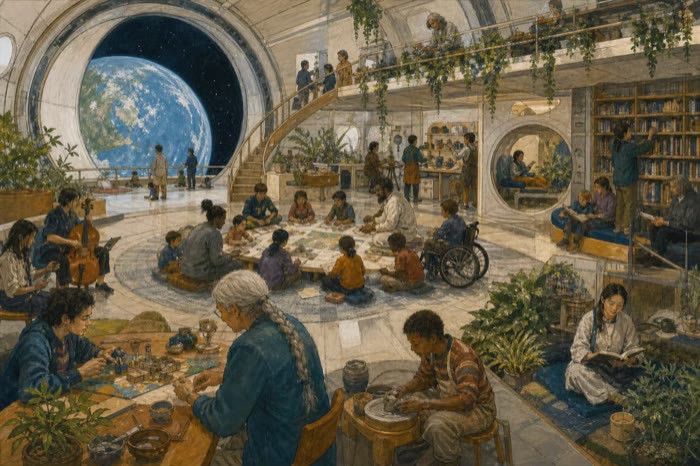
A balanced habitat offers a gradient: personal retreat, family or household space, small-group rooms, public commons, loud and quiet venues, nature contact, and civic assembly. Allocation should be transparent and appealable, not determined by rank.
Minority findings matter. If children, night workers, disabled residents, religious groups, or privacy reviewers report that a design is coercively exposed, that dissent should stay attached to the decision.
Decision outcomes
- Launch: only after diverse residents demonstrate controllable retreat, accessible circulation, confidential services, data challenge, and social choice under realistic operations.
- Wait: when minimum volume substitutes for livability, surveillance has no expiry, or privacy depends on rank.
- Redirect: apply acoustic, spatial, privacy, and AI-off design to hospitals, shelters, vessels, schools, and remote workplaces.
- Do not launch: if safety requires total surveillance, children have no confidential help, or no resident can withdraw from work, politics, or a dominant culture.
Evidence ledger
- L08-01-A — Isolation analogs provide bounded evidence, not a validated civil-density standard. Basis: demonstrated analog operations. Readiness: operational for specific studies; early research for multigenerational use. Confidence: strong on the boundary. Support: NASA behavioral-health risk and CHAPEA descriptions.
- L08-01-B — Privacy includes spatial, sensory, social, informational, and temporal control. Basis: normative synthesis and human-system guidance. Readiness: major scale-up. Confidence: supported. Support: ICCPR Article 17; NASA HIDH habitability guidance.
- L08-01-C — Minimum volume does not establish a healthy community. Basis: unknown. Readiness: early research. Confidence: supported as a limitation. Support: NASA-STD-3001 Volume 2 and HIDH scope; analog boundary.
- L08-01-D — Safety sensing requires purpose limitation, access control, audit, and remedy. Basis: proposed governance. Readiness: early research. Confidence: supported. Support: NIST Privacy Framework; ICCPR, CRC, and CRPD provisions.
- L08-01-E — LLM support must preserve provenance, abstention, privacy, and an AI-off path. Basis: proposed. Readiness: early research. Confidence: supported; multigenerational performance unverified. Support: NIST AI 600-1 risks and actions.
Linked corpus claims: claim-07-07, claim-09-01, claim-09-02, claim-09-03, claim-09-07, claim-09-10, and claim-12-06. Privacy, childhood, disability, surveillance, labor, and behavioral-health conclusions require independent two-person review.
Assumptions and limits
- Analog participants are not proxies for children or an unselected civil population.
- Privacy expectations vary across people and cultures, but coercive exposure is not cultural neutrality.
- Some immediate hazards justify narrow monitoring or entry, with records and review.
- Floor area, sound levels, and staffing require later quantitative requirements.
- Current rights instruments have defined legal scopes; automatic ship jurisdiction is not claimed.
- LLM capabilities and risks will change, requiring current evaluation.
- Reversible habitats, Earth applications, waiting, probes, and non-expansion remain valid.
What would change this conclusion?
- Long-duration, diverse, voluntary habitat trials measuring control, sleep, conflict, accessibility, privacy, and withdrawal under realistic work would raise readiness.
- Evidence that a lower-surveillance design cannot manage a specific severe hazard could justify narrow additional sensing with expiry and review.
- Child, disability, labor, cultural, or privacy reviewers may require stronger boundaries.
- Independently validated privacy-preserving AI could narrow some risks, but not remove AI-off learning and appeal.
- Failure to provide meaningful retreat or confidential help would strengthen a wait or do-not-launch decision.
Sources and locators
- NASA, Behavioral Health and Performance Risk (opens external site in a new tab) — risk description, contributing factors, evidence and mitigation scope. Accessed 2026-07-25.
- NASA, About CHAPEA (opens external site in a new tab) — habitat, crew, duration, stressors, and Earth-support boundary. Accessed 2026-07-25.
- NASA Human Integration Design Handbook (opens external site in a new tab) — sections 3–4 and habitability, privacy, lighting, acoustics, workload, and interface guidance. Accessed 2026-07-25.
- NASA-STD-3001 Volume 2 (opens external site in a new tab) — human factors, habitability, environmental health, and current crew-system scope. Accessed 2026-07-25.
- International Covenant on Civil and Political Rights (opens external site in a new tab) — Articles 17–19, 21–22, and 25–27. Accessed 2026-07-25.
- UNICEF, Convention on the Rights of the Child (opens external site in a new tab) — Articles 12–17 and 31. Accessed 2026-07-25.
- United Nations, Convention on the Rights of Persons with Disabilities (opens external site in a new tab) — Articles 9, 12, 19, 21–22, and 29–30. Accessed 2026-07-25.
- NIST Privacy Framework (opens external site in a new tab) — Core functions, privacy-risk management, profiles, and implementation resources. Accessed 2026-07-25.
- NIST AI 600-1, Generative AI Profile (opens external site in a new tab) — confabulation, privacy, information integrity, bias, human-AI configuration, and provenance risks and actions. Accessed 2026-07-25.
Editorial record
- Prepared by: GShips Project
- Last edited: 2026-07-25
- Status: Substantive editorial draft; not domain approved
- Author/reviewer: GShips Project editorial synthesis; no independent privacy, childhood, disability, architectural, or behavioral-health reviewer has approved this lesson
- Independent domain review: Pending
- Required review: privacy, child rights, disability, architecture, behavioral health, labor, cybersecurity, governance, and cultural plurality
- Conflicts: Maintainer intends to explore a commercial venture based on some GShips work
- Relationships: GShips Project is independent and is not affiliated with NASA, NIST, UNICEF, OHCHR, the United Nations, or any indexed organization
- Corrections: Suggest a correction