Evidence boundary: Current spacecraft standards and evidence focus heavily on selected professional adults and bounded missions. They do not validate pregnancy, childhood, aging, disability, neurodiversity, or lifetime adaptation in an interstellar habitat. Universal design is a rights and engineering direction, not proof that every need can be met by one interface. This lesson is not medical or accessibility certification. Independent two-person review led by disabled people and spanning childhood, aging, pregnancy, medicine, labor, education, emergency safety, and AI is pending.
Plain-language summary
No population stays young, healthy, uninjured, and uniform. People are born, grow, become pregnant, age, acquire injuries and illnesses, use different senses and communication modes, and change how they move, learn, work, and make decisions.
Universal design begins with that reality. Habitats, tools, schools, clinics, emergency systems, software, culture, and government should be usable by the widest practical range of residents without requiring everyone to prove fitness.
Individual accommodations and assistive technologies will still be necessary. They need local manufacture, repair, power, privacy, training, and user control. A mission that only works by excluding people expected to exist is not viable.
Selection is not a lifespan strategy
Space programs currently select and train small professional cohorts for specific missions. NASA standards and human-integration guidance provide valuable requirements and evidence for those contexts.
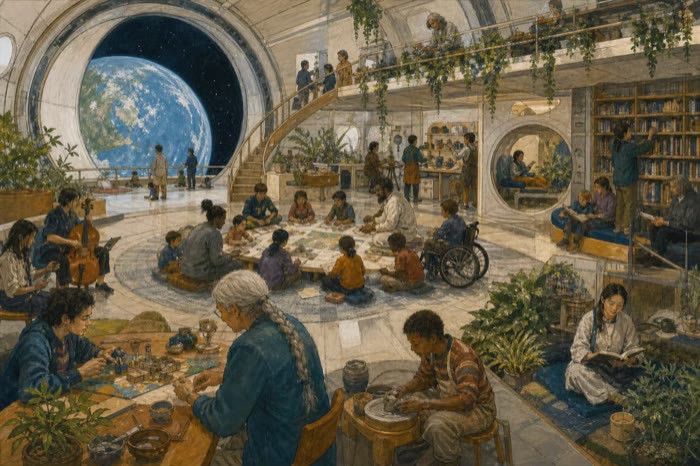
A generation ship would contain:
- Infants, children, adolescents, adults, and older people.
- Pregnant and postpartum people.
- People with congenital and acquired disabilities.
- Temporary injuries and recovery.
- Chronic conditions and rare diseases.
- Sensory, cognitive, communication, learning, and mobility differences.
- Bodies affected by altered gravity, radiation, isolation, and unfamiliar environments.
No screening process prevents this diversity across generations. Treating initial selection criteria as civil design requirements would turn occupational fitness into hereditary exclusion.
Universal design, accommodation, and care
These approaches overlap but are not identical.
Universal design makes environments and systems usable by a broad range of people from the start. Examples include step-free routes, adjustable controls, captions, clear language, multiple alarms, and flexible workstations.
Reasonable accommodation changes a general system for an individual: a personal interface, schedule, assistance, tool, communication support, or modified task.
Assistive technology includes products and systems that support functioning, communication, mobility, hearing, vision, cognition, and daily life.
Care and support involve human relationships, services, clinical practice, personal assistance, and social infrastructure.
None substitutes for the others. A ramp does not replace personal assistance; an AI captioner does not replace language access; a universal console does not supply clinical care.
The CRPD emphasizes dignity, autonomy, accessibility, equal recognition, independent living, health, education, work, culture, and political participation. Its state-party obligations do not automatically become ship law, but its principles make disability equality a system requirement rather than charity.
Design domains
Movement and reach
Provide multiple accessible routes, handholds, rest points, transfer space, adjustable work heights, usable doors and hatches, accessible hygiene, safe personal mobility devices, and evacuation methods.
Rotating habitats add uncertain gravity, gradients, motion, and transition zones. No current evidence defines safe lifetime exposure for pregnancy, development, aging, or disability. Full-scale diverse-body mockups and long-duration research are gates, not optional refinements.
Sensory access
Critical information should not depend on one sense. Combine visual, audible, tactile, and direct physical indicators where appropriate. Support captions, sign languages, audio description, contrast, magnification, hearing systems, and adjustable sensory load.
Alarm diversity must remain distinguishable. More signals can create confusion, so designs need user testing under fatigue, stress, protective equipment, and degraded conditions.
Cognitive and communication access
Use consistent controls, plain language, progressive detail, preview and undo where safe, memory supports, predictable navigation, and extra time. Provide supported decision-making without automatically substituting another person’s choice.
Neurodiversity also affects sensory regulation, attention, social interaction, and routines. Quiet space, clear expectations, flexible learning, and choice can improve design for many residents.
Work and education
Separate essential task requirements from tradition. A person may perform analysis, teaching, fabrication, agriculture, care, or governance using different tools, schedules, postures, and communication modes.
Workers need consultation, safe-work authority, accommodation, rest, and protection against essential-service threats. Students need accessible materials, laboratories, workshops, assessment, culture, and paths to multiple roles.
Health and personal support
Accessibility includes confidential clinical routes, reproductive and maternal care, rehabilitation, mental health, pharmacy, dentistry, assistive-device services, and palliative care. Clinical monitoring must not become employer or political surveillance.
WHO and UNICEF’s global assistive-technology report documents access gaps and the role of policy, services, products, personnel, and provision. It is Earth evidence, not a ship supply-chain solution.
Civic and cultural life
Meetings, voting, appeals, archives, art, worship, recreation, and public information must be accessible. A resident who cannot enter an assembly, understand a notice, or privately file a complaint does not have equal civic standing.
Accessibility should cover minority languages and communication modes without requiring disclosure of a diagnosis.
Accessibility is a maintenance requirement
An accessible feature that cannot be repaired is temporary.
The industrial plan should cover:
- Mobility and positioning devices.
- Communication hardware and software.
- Batteries, chargers, connectors, sensors, and actuators.
- Prosthetic, orthotic, seating, and pressure-management components.
- Lenses, hearing components, tactile displays, and switches.
- Consumables, cleaning, calibration, and fitting.
- Documentation, source code, materials, and fabrication files.
- Trained users, clinicians, technicians, and peer support.
Common parts and open interfaces can improve repairability. Standardization must not erase individual fit. Backup modes should include low-power and mechanical options.
Residents who rely on a system should participate in its maintenance priorities. An operator cannot classify accessibility as optional during every shortage.
Emergency design
Emergencies expose exclusion quickly. Plans need accessible alarms, assisted and independent evacuation options, refuge areas, medication and power continuity, communication support, family reunification, and backup personal assistance.
Do not assume one helper is always available. Distribute support skills and provide user-controlled emergency profiles with strict privacy.
Fire, pressure loss, contamination, and cyber recovery drills should include diverse residents as co-designers and evaluators. Record minority findings. A successful average evacuation can hide a person left behind.
LLMs and adaptive interfaces
LLMs may provide translation, captions, plain-language explanations, alternative formats, communication drafting, tutoring, or retrieval. These uses can improve access when locally validated.
They can also:
- Confabulate instructions or descriptions.
- Misinterpret speech, sign, disability, or distress.
- Infer diagnoses or capacity without authority.
- Leak health and accommodation data.
- Normalize one language or cognitive style.
- Make access depend on a model, runtime, or vendor.
- Manipulate choices through personalized output.
An adaptive system should disclose what it changes, preserve source material, show provenance, allow correction, and abstain when uncertain. It must not decide legal capacity, employment, treatment, reproduction, discipline, or civic rights.
AI-off access remains mandatory: human interpreters and assistants, stable non-generative interfaces, captions created or reviewed by people, tactile and printed materials, physical controls, and direct teaching.
Testing with—not merely for—people
Universal design requires diverse participation from requirements through acceptance. A late accessibility review can identify defects but may not overcome an architecture built around exclusion.
Test teams should include people with mobility, sensory, cognitive, communication, and chronic-health differences; children and older adults; pregnant people where ethical; caregivers; and workers using real equipment.
Participation needs compensation, accessible materials, privacy, safety, power to stop a test, and influence over results. One disabled reviewer cannot represent all disability.
Metrics should combine task performance, error and recovery, fatigue, pain, dignity, privacy, learning, maintenance, and user preference. Passing a technical task while causing avoidable harm is not success.
Scarcity and triage
Scarcity may force difficult choices. Universal design does not promise unlimited resources. It prevents planners from hiding predictable needs outside the mission budget.
Allocation should distinguish immediate clinical triage from long-term worth. Disability, age, productivity, or support needs must not become automatic proxies for whose life counts.
Independent review, reasons, appeal where possible, and public criteria are essential. If reserves are too small to support predictable population diversity, the architecture is too small.
Decision outcomes
- Launch: only after diverse-body mockups, rotating-environment evidence, accessible emergency trials, assistive-technology repair, privacy, education, work, and civic participation pass independent review.
- Wait: when standards for selected crews are treated as population evidence or access depends on one model or specialist.
- Redirect: apply accessible interfaces, resilient assistive technology, inclusive drills, and reconfigurable spaces to Earth facilities.
- Do not launch: if feasibility requires disability exclusion, loss of agency, inaccessible refuge, reproductive discrimination, or abandonment during scarcity.
Evidence ledger
- L08-05-A — Current crew standards do not validate a diverse civil population across a lifespan. Basis: observed scope boundary. Readiness: operational for current missions; no known path for lifetime evidence. Confidence: strong. Support: NASA-STD-3001 Volume 2 and HIDH scope.
- L08-05-B — Disability is expected across birth, injury, illness, aging, and environmental exposure. Basis: observed human population reality and normative inclusion. Readiness: major scale-up. Confidence: strong. Support: CRPD; WHO-UNICEF assistive-technology report.
- L08-05-C — Universal design does not eliminate accommodation, assistive technology, or care. Basis: normative and operational practice. Readiness: major scale-up. Confidence: supported. Support: CRPD Articles 2, 9, 19, 20, 21, 24–27.
- L08-05-D — Accessibility must survive maintenance, power loss, emergency, and technology turnover. Basis: proposed assurance rule. Readiness: early research. Confidence: supported. Support: NASA systems and human-integration guidance; WHO-UNICEF provision model.
- L08-05-E — AI accessibility requires provenance, privacy, correction, abstention, and AI-off access. Basis: proposed. Readiness: early research. Confidence: supported. Support: NIST AI 600-1 and WCAG 2.2 principles for stable digital access.
Linked corpus claims: claim-04-04, claim-04-05, claim-04-08, claim-04-10, claim-07-01, claim-07-02, claim-09-10, and claim-11-09. Disability, medical, pregnancy, childhood, labor, education, emergency, and AI conclusions require independent two-person review.
Assumptions and limits
- Disability is diverse; no feature works for everyone.
- Current rights instruments have defined legal scopes; automatic ship jurisdiction is not claimed.
- Quantitative altered-gravity and developmental requirements remain unknown.
- Participation must be ongoing because bodies, technology, work, and culture change.
- Some accommodations conflict and require transparent, rights-preserving resolution.
- Medical details require clinical evidence and are not supplied here.
- Earth applications, reversible habitats, probes, waiting, and non-expansion remain valid.
What would change this conclusion?
- Long-duration evidence across diverse ages, bodies, senses, cognition, pregnancy, work, and emergencies would narrow specific design uncertainty.
- Disabled-led testing may reject proposed interfaces or require different requirements.
- Demonstrated local manufacture, fitting, repair, and low-power fallback for assistive technology would raise readiness.
- Independently validated adaptive AI could narrow access risks but would not remove privacy, appeal, or AI-off paths.
- If representative tests show predictable residents cannot evacuate, learn, work, receive care, or participate politically, the mission should wait or not launch.
Sources and locators
- United Nations, Convention on the Rights of Persons with Disabilities (opens external site in a new tab) — Articles 2–5, 7, 9, 11–12, 19–21, and 24–30. Accessed 2026-07-25.
- NASA-STD-3001 Volume 2 (opens external site in a new tab) — human factors, habitability, environmental health, and current crew-system requirements and scope. Accessed 2026-07-25.
- NASA Human Integration Design Handbook (opens external site in a new tab) — sections 3–4 and anthropometry, habitability, interfaces, workload, and human-performance guidance. Accessed 2026-07-25.
- WHO and UNICEF, Global Report on Assistive Technology (opens external site in a new tab) — executive summary and policy, people, products, provision, personnel, and access-gap sections. Accessed 2026-07-25.
- W3C, Web Content Accessibility Guidelines 2.2 (opens external site in a new tab) — principles, guidelines, success criteria, conformance, and technology-neutral digital-access boundary. Accessed 2026-07-25.
- UNICEF, Convention on the Rights of the Child (opens external site in a new tab) — Articles 2–6, 12–17, 23–24, and 28–31. Accessed 2026-07-25.
- ILO, Occupational Safety and Health Convention No. 155 Framework (opens external site in a new tab) — prevention framework, worker and employer roles, consultation, and implementation context. Accessed 2026-07-25.
- NIST AI 600-1, Generative AI Profile (opens external site in a new tab) — confabulation, bias, privacy, information integrity, human-AI configuration, and provenance risks and actions. Accessed 2026-07-25.
Editorial record
- Prepared by: GShips Project
- Last edited: 2026-07-25
- Status: Substantive editorial draft; not domain approved
- Author/reviewer: GShips Project editorial synthesis; no independent disabled-led, medical, childhood, aging, pregnancy, labor, or AI review has approved this lesson
- Independent domain review: Pending
- Required review: disability rights, universal design, medicine, childhood, aging, pregnancy, labor, education, emergency safety, human factors, and AI governance
- Conflicts: Maintainer intends to explore a commercial venture based on some GShips work
- Relationships: GShips Project is independent and is not affiliated with the United Nations, NASA, WHO, UNICEF, W3C, ILO, NIST, or any indexed organization
- Corrections: Suggest a correction