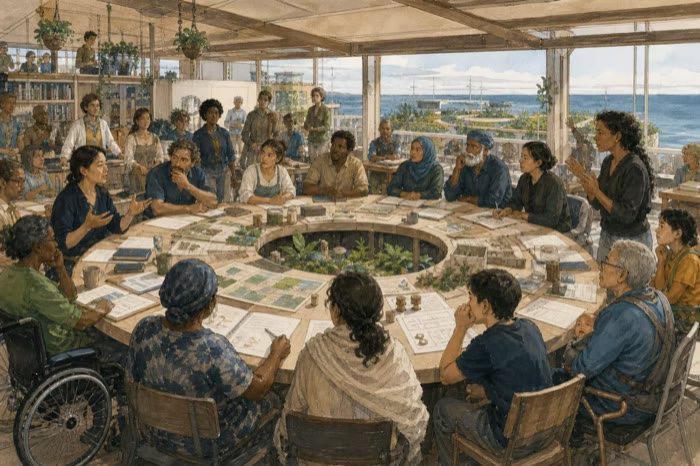
Evidence boundary: No society has experienced planned birth into an irreversible interstellar voyage. Current human-rights and labor instruments provide essential design material but do not settle their own jurisdiction aboard a future vessel. Population simulations do not supply consent or moral permission. This lesson is not medical, reproductive, genetic, educational, or legal advice, and it does not endorse launch. Independent two-person review across childhood, disability, reproductive justice, labor, education, law, and ethics is pending.
Plain-language summary
People born aboard a generation ship did not choose departure, destination, risk, founders, or mission. They would inherit a constrained world whose air, work, health care, education, family life, and political order were shaped before they existed.
That fact does not make every birth unethical. No child chooses the starting conditions of life. The difference is the scale of imposed confinement, the absence of ordinary exit, and the possibility that founders deliberately design children as future labor or demographic replacements.
The minimum response is to treat shipborn people as full rights-holders whose lives have value beyond continuing the mission. They need care, privacy, education, disability support, culture, meaningful choice, political voice, and routes to revise inherited institutions. A mission that depends on forced reproduction, hereditary occupation, disability exclusion, or compulsory loyalty fails before launch.
Consent cannot be inherited
Adults may consent to participate in research or depart on a dangerous mission within the limits of applicable law. Their consent does not travel through generations.
Parents routinely make decisions for children, but parental authority is bounded by children’s interests and evolving capacities. The Convention on the Rights of the Child emphasizes best interests, identity, development, privacy, education, protection, and the right of children capable of forming views to be heard in matters affecting them.
That does not create a simple age at which a resident may cancel the voyage. Physics may make return impossible. It does create obligations:
- Do not call ancestral consent the child’s consent.
- Provide age-appropriate truth about risk, history, alternatives, and uncertainty.
- Let young people influence decisions before adulthood, not only afterward.
- Preserve the ability to criticize founders and founding stories.
- Never condition care or status on mission loyalty.
- Provide remedy for decisions made negligently or abusively on a child’s behalf.
Where reversal is physically impossible, political and personal alternatives become more important: changing destination, declining settlement, choosing different work, amending institutions, preserving private life, or remaining in an orbital habitat if feasible.
Childhood is not workforce preparation
Education must transfer survival skills, but a school designed only to produce maintenance labor is a form of mission capture.
A civil education includes literacy, science, engineering, arts, history, philosophy, health, ecology, civic practice, languages, physical activity, play, relationships, and critical examination of the mission. It supports multiple occupations and non-occupational lives. Children should encounter minority accounts, project failures, Earth histories, and reasons a future generation might wait or refuse settlement.
Apprenticeship is necessary for embodied skills. It becomes exploitative when work is dangerous, coerced, excessive, unpaid without justification, assigned by lineage, or allowed to displace education and development.
The ILO Forced Labour Convention defines forced or compulsory labour around work exacted under menace of penalty without voluntary offer, subject to defined exceptions within its legal system. Its direct application aboard a future vessel requires legal analysis. The design warning is clear: threatening loss of food, air, housing, health care, family status, or citizenship to obtain work destroys meaningful consent.
Essential labor must be shared fairly without making people property. Options include compensated civic service with narrow scope, trained voluntary rotations, professional careers with collective bargaining, automation, reserve teams, and democratically approved emergency duties. Every option needs disability accommodation, conscientious-objection procedures where safety permits, and appeal.
Reproduction cannot become population control
Demographic models can estimate outcomes under assumptions. They cannot authorize pregnancy, abortion, contraception, partner selection, gamete use, genetic intervention, or childbearing quotas.
A generation-ship population may face real constraints: limited clinical capacity, kinship, genetic diversity, caregiving, housing, food, radiation, and age structure. Those constraints make rights protection harder, not optional.
The GShips boundary rejects architectures requiring:
- Forced pregnancy, abortion, sterilization, contraception, or embryo use.
- Assigned partners or reproduction tied to occupation or status.
- Nonconsensual genetic testing or intervention.
- Disability exclusion presented as efficiency.
- Unequal access to contraception, abortion care, fertility care, parenting, counseling, or child support.
- Secret demographic algorithms that determine personal eligibility.
- Hereditary caste or differential citizenship.
UNFPA describes reproductive rights as grounded in decisions about reproduction free of discrimination, coercion, and violence. That guidance does not validate any particular closed-population plan. It makes clear that a plan which closes only through coercion is not ethically closed.
Disability is part of the population
Disability will occur through birth, injury, illness, aging, radiation exposure, changing environments, and ordinary human variation. Selecting an initial crew does not create a permanently nondisabled society.
The Convention on the Rights of Persons with Disabilities emphasizes dignity, autonomy, accessibility, equal recognition before the law, supported decision-making, health without discrimination, education, independent living, work, culture, and political participation.
Ship requirements should include accessible routes and shelters, redundant sensory interfaces, communication access, adaptable work, assistive-device manufacturing and repair, personal assistance, privacy, and disability-led review. Medical triage may confront tragic scarcity, but disability must not be used as a proxy for lesser civic worth.
Supported decision-making is especially important. A person who needs communication or cognitive support does not automatically lose legal agency, reproductive autonomy, voting rights, or control of personal information.
Family and care must not become infrastructure debt
Families may take many forms. A founding design cannot freeze one model of marriage, parenting, kinship, gender, or caregiving for centuries.
Care work needs time, resources, respite, training, and social recognition. If child care, elder care, disability support, and emotional labor are treated as invisible private obligations, the system transfers mission costs onto particular families—often women or marginalized groups.
Possible institutions include universal child support, public and cooperative care services, parental leave, multiple legal guardians with safeguards, respite pools, and independent child advocates. Each has failure modes, including surveillance, institutional capture, family separation, and unequal access.
Privacy matters even in a small population. Health, genetic, reproductive, educational, and family records should be separated by purpose, minimized, access-logged, correctable, and protected from employers and political campaigns.
Political voice grows with the person
Children need both protection and participation. A youth council with no power is not enough.
A staged civic design could include:
- Child advocates independent of parents, schools, clinicians, and government.
- Age-appropriate access to public records and competing explanations.
- Youth representation on education, environment, culture, and long-term planning bodies.
- Protected complaints without family or school retaliation.
- Graduated participation based on capacity and subject, not one universal threshold.
- Full adult status not conditioned on occupation, fertility, health, or belief.
- Constitutional conventions in each generation rather than symbolic ratification of a fixed charter.
Minority findings should be preserved. If young residents, disabled residents, reproductive-rights reviewers, or cultural minorities reject a policy, their reasons should remain attached to the decision and available to later generations.
The right to question arrival
Shipborn residents must be able to ask whether arrival remains desirable, lawful, safe, and respectful of possible indigenous life. A founding promise to settle cannot override new evidence.
Meaningful options depend on architecture. A vehicle with no reserve, no loiter capability, no alternative target, and no viable continuing habitat turns “choice” into rhetoric. Technical design should preserve options where feasible, while governance makes their exercise real.
At decision gates, outcomes include:
- Launch: only with independently reviewed rights, care, education, reproductive, disability, and labor architectures.
- Wait: when models substitute for consent or care capacity remains untested.
- Redirect: test institutions in reversible habitats with exit, outside courts, and rescue.
- Do not launch: if survival requires coercive reproduction, hereditary work, disability exclusion, permanent confinement without political revision, or the sacrifice of children to mission continuity.
Evidence ledger
- L09-02-A — Founders cannot consent on behalf of future children or permanently bind descendants. Basis: normative rights analysis. Readiness: no known validated process. Confidence: supported, with future interstellar jurisdiction unsettled. Support: CRC Articles 3, 5, and 12–17; UN Declaration on Future Generations.
- L09-02-B — Children need development, education, privacy, culture, play, and voice beyond mission training. Basis: observed treaty text and normative application. Readiness: operational as current rights commitments; major scale-up for a closed habitat. Confidence: strong on the source provisions, tentative on implementation. Support: CRC Articles 6, 12–17, and 28–31; ICESCR Articles 13–15.
- L09-02-C — Population constraints do not authorize reproductive coercion. Basis: normative. Readiness: early research for closed-population governance. Confidence: supported; clinical architecture unverified. Support: UNFPA reproductive-rights framework; ICCPR privacy and family provisions.
- L09-02-D — Disability exclusion cannot be a hidden feasibility assumption. Basis: normative rights and human-system requirement. Readiness: early research. Confidence: supported. Support: CRPD Articles 3–5, 9, 12, 19, 21, 24–25, and 27–30.
- L09-02-E — Work obtained through threats to essential services is not meaningful consent. Basis: observed labor standard and normative extension. Readiness: early research for ship labor. Confidence: supported as a design boundary; legal application unsettled. Support: ILO Convention No. 29 official summary and coercion examples.
Linked corpus claims: claim-08-07, claim-08-10, claim-09-01, claim-09-10, claim-10-07, and claim-10-10. Medical, reproductive, childhood, labor, disability, and governance conclusions require independent two-person review.
Assumptions and limits
- Current treaties bind within defined legal scopes; this lesson uses them as requirements inputs, not automatic interstellar jurisdiction.
- “Shipborn” describes place of birth, not a separate caste, nationality, or destiny.
- No demographic model proves ethical permission, clinical safety, or institutional legitimacy.
- Reproductive and disability questions require leadership by affected experts and communities.
- Physical constraints may limit choices, but engineered scarcity and avoidable lock-in remain design decisions.
- The cited sources do not solve kinship, family law, citizenship, or return rights across centuries.
- Probes, Earth investment, reversible habitats, waiting, and non-expansion remain valid.
What would change this conclusion?
- A legally and ethically legitimate process that preserves descendants’ amendment, refusal, care, and remedy could narrow the no-known-path assessment for intergenerational consent.
- Long-duration, voluntary habitat trials with independent child, labor, disability, and reproductive-rights oversight could raise institutional readiness, though they could not reproduce shipborn life.
- Evidence that a demographic architecture requires coercion, exclusion, or hereditary work would convert a wait decision into do not launch.
- Better rights instruments or affected-community findings could strengthen or revise the proposed floor.
- Demonstrated technical options for exit, loiter, alternative destination, or continued habitat life would make later choice more substantive.
Sources and locators
- UNICEF, Convention on the Rights of the Child (opens external site in a new tab) — Articles 2–6, 7–8, 12–17, 23–24, 28–32, and 40. Accessed 2026-07-25.
- United Nations, Convention on the Rights of Persons with Disabilities (opens external site in a new tab) — Articles 3–5, 9, 12–13, 19, 21, 24–25, and 27–30. Accessed 2026-07-25.
- International Covenant on Civil and Political Rights (opens external site in a new tab) — Articles 17–19, 23–24, 25–27. Accessed 2026-07-25.
- International Covenant on Economic, Social and Cultural Rights (opens external site in a new tab) — Articles 6–7, 10, and 12–15. Accessed 2026-07-25.
- ILO, Convention 029 and the Forced Labour Convention (opens external site in a new tab) — official definition, prohibition, limited exceptions, and examples of threatened deprivation. Accessed 2026-07-25.
- UNFPA, Supporting the Constellation of Reproductive Rights (opens external site in a new tab) — definitions and coercion, discrimination, health, and decision-making framework. Accessed 2026-07-25.
- United Nations, Declaration on Future Generations (opens external site in a new tab) — guiding principles and commitments on future interests, participation, and accountability. Accessed 2026-07-25.
Editorial record
- Prepared by: GShips Project
- Last edited: 2026-07-25
- Status: Substantive editorial draft; not domain approved
- Author/reviewer: GShips Project editorial synthesis; no independent rights, medical, labor, or legal reviewer has approved this lesson
- Independent domain review: Pending
- Required review: child rights, disability rights, reproductive justice, medicine, labor, education, human factors, law, and intergenerational ethics
- Conflicts: Maintainer intends to explore a commercial venture based on some GShips work
- Relationships: GShips Project is independent and is not affiliated with UNICEF, OHCHR, UNFPA, ILO, the United Nations, or any indexed organization
- Corrections: Suggest a correction