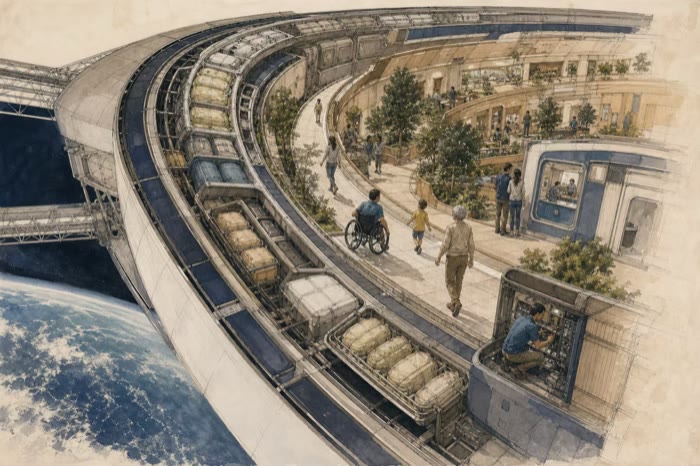
Evidence boundary: Centripetal acceleration and rotating-frame dynamics are well-established physics. Human centrifuges and rotating rooms provide bounded evidence about short exposures and adaptation in selected adults. No rotating habitat has supported conception, childhood, lifelong residence, aging, disability, surgery, agriculture, or multigenerational maintenance. This lesson is not medical guidance or a design certification. Its health and life-stage conclusions are high consequence and require independent two-person review.
Plain-language summary
A rotating habitat can press people and objects toward an outer floor. The apparent “gravity” depends on the rotation rate and distance from the axis. A larger radius can provide the same acceleration at a slower rotation rate, reducing gravity variation across the body and many motion effects. But radius adds structure, mass, alignment, and maintenance burdens.
The physics is not the central unknown. The unknown is which combinations of acceleration, rotation rate, gradient, exposure schedule, and environment allow a diverse civil population to thrive throughout life. Existing astronauts are carefully selected adults on finite missions. A generation ship would include pregnancy, infancy, childhood, older age, illness, different statures, vestibular conditions, mobility and sensory disabilities, and people who did not volunteer for the architecture.
Artificial gravity should therefore be treated as a testable environmental system—not a picture of a wheel with “1 g” written beside it. A responsible program preserves alternatives, measures individual outcomes, provides accessible non-rotating and lower-gradient spaces where useful, and never makes participation in an inadequately tested gravity regime compulsory.
The basic rotation equations
At radius r from an axis rotating at angular speed ω, centripetal acceleration is:
a = ω²r
If rotation is expressed in revolutions per minute N:
ω = 2πN / 60
For an illustrative 1 g = 9.80665 m/s² at 4 rpm, ω ≈ 0.419 rad/s and:
r = a / ω² ≈ 55.9 m
At 2 rpm, the radius for the same acceleration is about 223.5 m. At a 10 m radius, reaching 1 g requires about 9.46 rpm. These are kinematic results, not comfort limits. The statement “humans can tolerate four rpm” is not a universal law: tolerance depends on adaptation, head motion, task, duration, health, visual cues, and individual variation.
Rotation produces a gradient because a person’s feet and head are at different radii. If the floor is at r_f and the head is height h inward:
a_head / a_feet = (r_f - h) / r_f
For a two-meter body at a 56 m floor radius, head acceleration is about 3.6% lower than foot acceleration. At a 10 m radius, it is 20% lower. A gradient changes balance, fluid distribution, lifting, locomotion, and equipment behavior. Children and wheelchair users experience different body geometries and contact points than a standing reference adult.
Coriolis effects are task-dependent
Movement relative to the rotating habitat produces Coriolis acceleration:
a_c = 2ω × v
The vector direction matters. Moving radially, turning the head, climbing toward the axis, throwing an object, or moving a patient can create sideways apparent forces. Tangential walking differs depending on direction: with or against rotation. Dropped objects do not trace the straight path expected in a non-rotating room.
People can adapt to some rotating environments. Historical ground experiments have measured posture, reaching, locomotion, and task performance at various rates. NASA’s artificial-gravity evidence report nevertheless called for a research program to determine gravity level, gradient, rotation, frequency, and exposure duration before implementation. Short tests do not establish lifetime comfort, and adaptation by an able participant does not establish accessibility for everyone.
An ISS study compared adult male mice housed in centrifuge-generated artificial 1g with adult male mice in microgravity. That experiment helps separate some adult-animal microgravity and spaceflight effects. It does not reproduce a rotating human habitat, head-to-foot gradient in a human body, cross-coupled motion, pregnancy, childhood, aging, disability, or a lifetime exposure. Its proper role is a bounded precursor, not a safety certificate.
Design consequences include:
- handrails, seating, carts, and tools that tolerate direction-dependent loads;
- visual and tactile orientation cues that remain useful during smoke or power loss;
- restrained medical equipment and procedures validated in rotation;
- elevators, ladders, and transit between different radii;
- transition protocols between rotating and non-rotating zones;
- control of vibration, wobble, and changing mass distribution;
- sufficient clearances for mobility devices, assistants, and patient transport.
Gravity is a dose, not just a label
“Mars gravity,” “half g,” and “one g” identify acceleration, but not exposure. A person could receive continuous partial gravity, intermittent centrifugation, varying gravity by neighborhood, or a daily countermeasure dose. Each choice changes physiology and architecture.
Current evidence documents health risks from reduced gravity and physiological deconditioning during spaceflight. It does not identify a minimum safe lifetime gravity for every organ system. Bone, muscle, cardiovascular, neurovestibular, ocular, immune, reproductive, and developmental outcomes may have different thresholds. An acceleration adequate for an adult’s musculoskeletal maintenance might not establish safe embryonic development or childhood growth.
The evidence gap grows across generations. There is no human dataset for conception or an entire childhood in partial or rotating gravity. Animal research can identify mechanisms but cannot settle human clinical, developmental, or ethical questions by itself. The valid evidence label is unknown, not “probably Earth-like.”
A rotating habitat is also a machine
The ring or cylinder must carry pressure, self-weight in rotation, docked masses, moving vehicles, machinery, fluid slosh, and asymmetric inventories. Bearings, tethers, hubs, seals, rotary electrical and fluid interfaces, or free-flying arrangements introduce different failure modes. A “stationary hub plus rotating rim” is not one component; it is an interface architecture that must transfer people, data, power, heat, and materials safely.
Mass redistribution changes balance. Farms grow and harvest biomass; tanks empty; factories move feedstock; neighborhoods change. Control systems may counter imbalance, but sensors, actuators, software, and authority can fail. Passive stability, bounded spin-down, inspection access, and safe operating envelopes matter more than a perfect nominal simulation.
Rotation stores energy:
E_rot = ½Iω²
where I is moment of inertia. A large rotating habitat cannot stop instantly during a fire or structural alarm. Spin-down may take substantial time and may itself disrupt fluids, air circulation, power, docking, and medical care. Emergency plans must work while rotation continues and after it changes.
Human factors and accessibility are requirements
NASA-STD-3001 Volume 2 and the Human Integration Design Handbook provide current requirements and lessons for professional crews, including anthropometry, translation, restraints, lighting, acoustics, privacy, and assisted egress. They are essential starting points, but NASA explicitly scopes them to spacefaring crews and human-rated systems—not an entire diverse society.
A civil habitat should design for:
- independent travel by people using wheels, prostheses, canes, or assistance;
- redundant visual, audible, and tactile alarms;
- reachable controls from standing, seated, and restrained positions;
- rest points and low-stimulation routes for vestibular or sensory needs;
- private care, hygiene, and reproductive-health spaces;
- evacuation that does not assume sight, hearing, grip strength, or unassisted walking;
- adaptable homes as bodies, families, and support needs change.
Terrestrial ADA standards offer useful dimensions and operability concepts, but cannot simply be copied into altered gravity. A wheelchair’s traction, braking, and stability change with gradient and Coriolis force. The correct transfer method is to preserve the accessibility objective, test with diverse users, and derive geometry for the actual acceleration environment.
Separate habitat evidence from medical claims
Three statements must remain distinct:
- Rotation can create a predictable centripetal acceleration.
- Selected adults can perform and adapt in bounded rotating-room or centrifuge experiments.
- A chosen rotating habitat is safe and livable for a whole population over generations.
The first is established physics. The second has experimental support with protocol-specific limits. The third is unverified. No simulation, expert consensus, or attractive interior rendering can move evidence directly from the first two to the third.
LLMs can help compare studies, generate test cases, explain equations, and find overlooked user groups. They must not invent a safe gravity threshold, convert sparse adult studies into pediatric guidance, or optimize a population around an assumed “average” body. Medical source provenance, subgroup uncertainty, dissent, and independent review must remain visible.
A responsible test ladder
Near-term work can produce value without committing anyone to a voyage:
- validate rotating-room models against measured forces and object trajectories;
- conduct accessible, consent-based human-factors trials across broader adult bodies and abilities;
- test mobility, work, sleep, hygiene, caregiving, medical response, and evacuation—not only exercise;
- operate long-duration rotating biological experiments with explicit limits on human inference;
- build large ground demonstrators that reproduce geometry, noise, vibration, lighting, and moving loads;
- fly uncrewed rotating structures and measure deployment, balance, fatigue, interfaces, and repair;
- conduct crewed Solar System tests with independent medical monitoring and genuine withdrawal options;
- require lifecycle evidence before exposing pregnancy, children, or dependent residents.
Stopping is a valid result. If acceptable gravity requires an infeasible radius, causes persistent harm, or cannot provide equitable access and refuge, the architecture should change rather than redefining harm as adaptation.
Evidence ledger
- L04-01-A — Rotation produces calculable acceleration, gradient, and Coriolis effects. Basis: demonstrated physics. Readiness: operational for calculation and ground centrifuges. Confidence: strong.
- L04-01-B — Adult rotating-room and centrifuge studies provide bounded evidence of performance and adaptation. Basis: observed. Readiness: demonstrated in limited protocols. Confidence: supported.
- L04-01-C — No reviewed evidence establishes a safe lifetime gravity level, rotation rate, gradient, and exposure regime spanning pregnancy, childhood, aging, and disability. Basis: bounded evidence-gap assessment. Readiness: early research. Confidence: supported pending independent two-person review.
- L04-01-D — Large crew-bearing rotating pressure interfaces integrated with habitation utilities, changing mass distributions, civil evacuation, and locally sustained century-scale maintenance remain unvalidated. Basis: observed precursors plus modeled and proposed integration. Readiness: early research at integrated scale. Confidence: strong for the present validation gap.
- L04-01-E — Diverse-body mockups and long-duration rotating evidence are mandatory before an irreversible civil habitat decision. Basis: normative safety gate. Readiness: implementable now as a test rule. Confidence: supported. High consequence: medical, developmental, disability, and spacecraft safety; two-person review required.
Linked corpus claims: claim-04-03, claim-04-04, claim-04-05, claim-04-06, claim-04-10, and claim-09-05. See the claim registry for each record's current evidence grade and independent-review state.
Assumptions and limits
Worked examples use rigid-body rotation, constant angular speed, a simplified standing body, and nominal g. They omit vibration, structural deflection, atmospheric circulation, transient acceleration, relativistic effects, and control dynamics. Human studies differ in protocol, subject selection, adaptation, and duration. Terrestrial accessibility rules are reference objectives, not certified rotating-habitat dimensions. This lesson makes no diagnosis or individual exposure recommendation.
What would change this conclusion?
Confidence would rise with independently replicated, long-duration studies across diverse adults; validated developmental evidence; full-scale human-in-the-loop habitats measuring daily life, care, and evacuation; and flight demonstrations of stable, repairable rotating structures. A safe population-level conclusion would require separately reviewed evidence for pregnancy, childhood, aging, disability, illness, and transitions between gravity zones. Persistent vestibular injury, unequal access, structural instability, or inability to recover after faults would lower readiness or rule out the architecture.
Sources and locators
- S01 — NASA NTRS, “Physics of Artificial Gravity” (opens external site in a new tab). Locator: definitions, centripetal and Coriolis equations, gravity gradient, human-factors considerations, and vehicle options; 2006; accessed 2026-07-25.
- S02 — NASA Human Research Program, “Evidence Report — Artificial Gravity” (opens external site in a new tab). Locator: evidence summary and recommendation to determine gravity level, gradient, rotation rate, frequency, and exposure duration; 2015; accessed 2026-07-25.
- S03 — NASA-STD-3001 Volume 2, Revision E (opens external site in a new tab). Locator: active 2025 standard; Sections 6–8 on environmental health, habitability, translation, restraints, lighting, privacy, and emergency paths; accessed 2026-07-25.
- S04 — NASA, “Human Integration Design Handbook” (opens external site in a new tab). Locator: Revision 1 handbook and companion design-process resources on human-system integration; page updated 2026-02-18; accessed 2026-07-25.
- S05 — NASA NTRS, “Effects of Simulated Artificial Gravity on Human Performance” (opens external site in a new tab). Locator: tested rotation rates, radius, posture, locomotion, task performance, visual conditions, and subject boundary; NASA-CR-2129, 1972; accessed 2026-07-25.
- S06 — U.S. Access Board, “ADA Accessibility Standards” (opens external site in a new tab). Locator: Chapters 3–4 on clear space, accessible routes, doors, reach ranges, and operable parts; terrestrial scope explicitly noted; accessed 2026-07-25.
- S07 — Matsumura et al., adult male mice under artificial 1g and microgravity aboard ISS (opens external site in a new tab). Locator: adult male mouse centrifuge and microgravity comparison, exposure configuration, outcomes, and explicit nonhuman/adult boundary; *Scientific Reports*, 2019; accessed 2026-07-26.
- S08 — NASA NTRS, “Space Station Solar Alpha Rotary Joint Investigation” (opens external site in a new tab). Locator: bounded evidence from a large unpressurized rotary mechanism, anomaly investigation, lubrication, inspection, and on-orbit maintenance; it is not a crew-bearing rotating pressure interface; 2011; accessed 2026-07-26.
Editorial record
- Prepared by: GShips Project
- Last edited: 2026-07-26
- Status: Substantive editorial draft
- Independent domain review: Pending
- Last independently reviewed: Not yet reviewed; no review date
- High-consequence review: Medical, developmental, disability, and spacecraft-safety conclusions require independent two-person review
- Required review: rotating structures and dynamics; aerospace medicine; developmental biology; vestibular science; disability access; safety engineering
- Reviewer: No independent reviewer assigned
- Conflicts: Maintainer intends to explore a commercial venture based on some GShips work; no entity, funding, customer, sponsor, or partner relationship currently exists
- Relationship boundary: GShips is independent; citations do not imply affiliation, endorsement, sponsorship, or partnership with any source organization
- Corrections: Suggest a correction