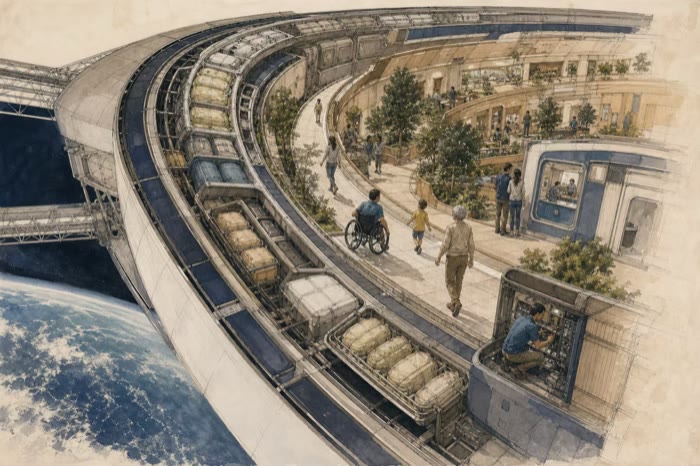
Evidence boundary: Spacecraft material tests, International Space Station combustion investigations, uncrewed Saffire experiments, alarms, extinguishers, pressure modules, and emergency-route requirements provide bounded evidence. No test reproduces a rotating civil habitat with children, older and disabled residents, farms, factories, long-lived contamination, and no external rescue. Fire, toxic exposure, medical triage, pressure isolation, structural safety, and dual-use conclusions are high consequence and require independent two-person review. This lesson excludes weaponization, deliberate ignition, and offensive use.
Plain-language summary
On Earth, people can often leave a burning building and wait outside. A space habitat has no harmless outside. Egress moves residents from one pressure cell to another, and the receiving refuge must still provide air, cooling, sanitation, medical care, power, communication, privacy, accessibility, and enough capacity.
Fire behavior depends on gravity, airflow, oxygen concentration, pressure, material geometry, temperature, and enclosure. Microgravity experiments show that familiar terrestrial intuitions can fail. A rotating habitat adds a gravity gradient and Coriolis effects; ventilation and smoke may behave differently near the rim, spokes, and hub. Current tests inform design but do not validate a generation-scale settlement.
The strategy is layered: prevent ignition, limit fuel and toxicity, detect early, isolate energy and airflow, suppress appropriately, protect routes, shelter people equitably, preserve communication, and recover without spreading hidden damage.
Fire is a coupled system
A habitat contains combustion’s necessary ingredients: oxygenated atmosphere, polymers, fabrics, food, oils, solvents, dust, batteries, wiring, hot surfaces, machinery, and industrial processes.
The question “is this material flammable?” is incomplete. NASA-STD-6001 requires testing in defined worst-case use environments because behavior changes with:
- oxygen concentration and total pressure;
- gas flow and orientation;
- sample thickness, edges, backing, and mounting;
- nearby materials and spacing;
- ignition source and duration;
- temperature, contamination, aging, and wear;
- configuration at component and assembly scale.
A coupon that self-extinguishes in one test may burn in an assembly. Offgassing and combustion products also matter. Smoke and corrosive particles can disable people and equipment beyond the flame zone.
What space experiments establish
NASA’s ISS combustion program studies flame spread, solid and liquid fuels, suppression, soot, and confinement in controlled facilities. Saffire used uncrewed Cygnus vehicles after departure from the station to test larger fires without exposing a crew. NASA reports that microgravity changes buoyant flow and flame geometry; suppression effective on Earth can behave differently; pressure and confinement alter spread.
This is strong evidence that spacecraft fire safety requires relevant-environment testing. It is not evidence for:
- a kilometer-scale rotating atmosphere;
- mixed residential, agricultural, and industrial fuels;
- aging materials repaired many times;
- simultaneous ventilation, power, and pressure failures;
- smoke movement between neighborhoods;
- months of post-fire displacement;
- recovery without Earth laboratories or replacement shipments.
Rotation does not simply restore Earth fire behavior. Apparent gravity varies with radius, rotating air has complex circulation, and machinery creates forced flows. Full-scale computational fluid dynamics can guide tests but cannot replace validation.
Prevention starts with inventories and interfaces
Fire prevention combines low-flammability and low-toxicity materials, protected wiring, current limiting, thermal management, battery containment, dust and lint control, hot-work governance, housekeeping, leak prevention, and separation of incompatible materials.
Every penetration needs a documented rating and failure state:
- cables and pipes can conduct heat and smoke;
- ventilation ducts can spread products unless isolated;
- doors and hatches can jam under pressure differential or thermal distortion;
- insulation can conceal smoldering;
- temporary repairs can introduce new fuel or block sensors;
- a fire-safe wall can fail if the surrounding structure loses strength.
Agriculture and industry deserve their own hazard analyses. Dry biomass, oxygen production, fertilizers, powders, lubricants, solvents, furnaces, and additive manufacturing cannot share residential assumptions. GShips’ civil-and-defensive boundary prohibits designing these systems for coercive or offensive use.
Detect the event and its extent
Early detection may combine particulate, gas, optical, thermal, electrical, pressure, and airflow measurements. Each sensor has false positives, contamination, aging, and blind spots. A distributed system should answer:
- Where is the likely source?
- Is it flame, smoldering, overheating, arcing, leak, dust, or sensor fault?
- Which airflow and utility paths can carry harm?
- Who is present and who may need assistance?
- Which actions remain reversible?
Alarm signals must be audible, visible, tactile, and understandable without one language or color distinction. Local alarms should work when the central network fails. Residents need a clear difference between investigate, prepare, relocate, shelter, and evacuate commands.
LLMs may summarize telemetry or retrieve procedures, but smoke, damaged sensors, and adversarial or malformed inputs make confident fabrication dangerous. Deterministic alarms, physical interlocks, authenticated commands, trained teams, and local displays remain primary. An AI must not silently delay an alarm or decide whose evacuation is “efficient.”
Compartmentation
Compartmentation limits smoke, flame, toxic products, pressure loss, and cascading utility failure. A credible design defines the largest tolerable fire and the smallest independently survivable refuge.
Isolation can include:
- fire- and pressure-capable hatches;
- automatically and manually closable ventilation dampers;
- sectional power and fluid shutoff;
- protected cross-connections for emergency air, cooling, and communication;
- local suppression and breathing protection;
- pressure and smoke boundaries around routes;
- redundant controls on both sides of a closure.
Automatic isolation can save time but can also trap people. Closure logic needs occupancy evidence, obstruction detection, local override, safe timing, and a way to reopen or bypass a failed hatch. A pressure door’s opening force under differential pressure must be included in accessible egress tests.
Compartment boundaries should align neither all utilities nor all community services. If one fire cuts both normal and emergency power, the paper redundancy is false. If every route crosses an industrial zone, housing is not protected.
Egress and refuge
NASA-STD-3001 Volume 2 requires visible, unimpeded emergency escape routes tied to hazard analysis and response concepts, assisted ingress and egress, and emergency lighting under general power failure. Those are current crew requirements, not complete civil-community evidence.
An accessible route must work for people who are:
- asleep, injured, ill, pregnant, very young, or older;
- using a wheelchair, prosthesis, cane, respiratory device, or human assistance;
- blind, low-vision, Deaf, hard of hearing, or sensory-sensitive;
- unable to read the dominant language;
- carrying a child, patient, or essential medication;
- moving through smoke, noise, darkness, or altered rotation.
Routes need redundant cues, adequate width and turning space, low operating forces, handholds or restraints, rest or transfer points, communication, and no single lift or powered door dependency. Drills should include realistic mobility, but never require participants to inhale smoke or abandon essential support.
Refuge capacity is not standing-room headcount. It includes duration, metabolic load, heat rejection, carbon-dioxide control, water, toilets, medication, infection control, sleep, accessibility, privacy, and staff. The largest credible displacement may last until inspection, decontamination, repair, and requalification finish.
Suppression and atmosphere management
The appropriate suppressant depends on fuel, electrical state, atmosphere, residue, toxicity, equipment, and gravity. Water mist, gases, foam, or other methods have different limitations. This lesson does not select a suppressant.
Response may involve stopping airflow, but occupied zones still need breathable air and heat removal. Depressurizing a burning cell can suppress combustion in some cases while creating structural, material, evacuation, and re-ignition hazards. Repressurization can reintroduce oxygen to hot material. These actions require tested procedures and bounded authority.
Fire crews need protected equipment, breathing supply, communication, medical backup, and exposure tracking.
Recovery is part of fire safety
“Flame out” begins recovery. Hidden heat, smoldering, battery propagation, toxic residue, corrosive gases, soot, water or suppressant, damaged insulation, weakened structure, and compromised wires may remain.
A recovery gate should require:
- independent confirmation that combustion has stopped;
- atmosphere sampling and toxicology limits;
- structural, pressure, electrical, thermal, and ventilation inspection;
- removal or containment of contaminated materials;
- accounting for suppressant and cleanup waste;
- repair records and configuration update;
- staged re-energization and airflow;
- post-event medical and psychological support;
- transparent incident review without retaliation;
- criteria for reoccupation, restricted use, or permanent abandonment.
Near misses belong in the knowledge system. Accountability should distinguish error, reckless conduct, design failure, and concealed risk.
A responsible test program
Test progressively:
- material coupons under representative oxygen, pressure, temperature, aging, and flow;
- assemblies with wires, connectors, seams, contamination, and backing;
- full-room smoke, detection, suppression, ventilation, and visibility;
- compartment closure with occupants, obstacles, pressure differential, and power loss;
- accessible egress and assisted movement with diverse participants;
- refuge operation through peak population and heat loads;
- post-fire inspection, cleanup, repair, and requalification;
- combined faults such as fire plus network, cooling, or sensor loss.
Uncrewed orbital experiments and large ground rotating demonstrators can address regimes unsafe for participants. All tests need ethical review, exposure limits, withdrawal, and public failure reporting.
Evidence ledger
- L04-05-A — Spacecraft material tests and orbital combustion experiments demonstrate that pressure, oxygen, flow, gravity, confinement, and configuration affect fire. Basis: observed. Readiness: operational tests in bounded regimes. Confidence: strong.
- L04-05-B — Current crew standards require material evaluation, emergency routes, assisted egress, and emergency lighting. Basis: standardized current practice. Readiness: operational in defined programs. Confidence: strong.
- L04-05-C — Rotating-habitat fire, mass evacuation, and century maintenance remain unproven. Basis: modeled and unknown. Readiness: early research. Confidence: strong that the integrated gap exists.
- L04-05-D — Compartmentation can limit propagation only if doors, ventilation, utilities, occupancy logic, and receiving refuge remain functional. Basis: demonstrated terrestrial/spacecraft principle and systems assessment. Readiness: major scale-up. Confidence: supported.
- L04-05-E — Refuge must sustain the largest credible displaced population through inspection and repair, not merely evacuation time. Basis: normative safety requirement. Readiness: architecture-specific. Confidence: supported.
- L04-05-F — Full-scale fire, refuge, diverse-body egress, and recovery tests are required before reliance. Basis: normative safety gate. Readiness: implementable now. Confidence: strong. High consequence: fire, toxicology, medical, disability, pressure, structural safety, and dual use; two-person review required.
Linked corpus claims: claim-04-01, claim-04-02, claim-04-06, claim-04-10, claim-03-10, and claim-09-10. See the claim registry for each record's current evidence grade and independent-review state.
Assumptions and limits
Fire behavior is atmosphere-, material-, geometry-, gravity-, and flow-specific. No suppressant, oxygen level, hatch timing, refuge duration, or occupancy is prescribed. Current standards apply to defined programs and professional crews. Terrestrial accessible-route rules preserve important objectives but require validation in altered gravity and pressure. No offensive ignition, weapon effect, or coercive crowd-control information is provided.
What would change this conclusion?
Readiness would rise after full-scale representative compartments demonstrated prevention, early detection, bounded spread, multimodal alarms, accessible evacuation, refuge endurance, suppression, structural inspection, decontamination, repair, and reoccupation through combined failures. Evidence must include diverse residents and rotating conditions. Undetected smoldering, toxic persistence, trapped occupants, common utility loss, inadequate refuge heat rejection, or inability to reproduce sensors and suppressant locally would lower readiness or require a different architecture.
Sources and locators
- S01 — NASA, “Studying Combustion and Fire Safety” (opens external site in a new tab). Locator: ISS combustion facilities, FLEX, ACME, BASS, SoFIE, Saffire, confined combustion, suppression, pressure, and microgravity limits; 2023; accessed 2026-07-25.
- S02 — NASA-STD-6001B with Change 3 (opens external site in a new tab). Locator: Sections 4–7 and appendices on material evaluation, upward flame propagation, smoke and heat release, wiring, offgassing, and configuration-specific tests; active change dated 2025-06-09; accessed 2026-07-25.
- S03 — NASA-STD-3001 Volume 2, Revision E (opens external site in a new tab). Locator: Section 8.3.2 emergency escape paths, 8.3.3 assisted ingress/egress, 8.4 hatches and doors, 8.7.5 emergency lighting, and relevant atmospheric and acoustic requirements; 2025; accessed 2026-07-25.
- S04 — NASA, “Human Integration Design Handbook” (opens external site in a new tab). Locator: Revision 1 guidance on habitability, translation, controls, alarms, emergency operations, maintainability, and human-in-the-loop evaluation; updated 2026-02-18; accessed 2026-07-25.
- S05 — NASA Systems Engineering Handbook (opens external site in a new tab). Locator: requirements, interfaces, hazard and technical risk, verification, validation, configuration control, and decision analysis; NASA/SP-2016-6105 Rev 2.
- S06 — U.S. Access Board, “ADA Accessibility Standards” (opens external site in a new tab). Locator: Sections 206, 309, 404, and 702 on routes, operable parts, doors, power-off egress, and alarms; terrestrial scope noted; accessed 2026-07-25.
Editorial record
- Prepared by: GShips Project
- Last edited: 2026-07-25
- Status: Substantive editorial draft
- Independent domain review: Pending
- Last independently reviewed: Not yet reviewed; no review date
- High-consequence review: Fire, toxicology, medical, disability, pressure, structural-safety, and dual-use conclusions require independent two-person review
- Required review: spacecraft fire science; materials and toxicology; pressure and ventilation systems; emergency medicine; accessible egress; human factors; safety and recovery engineering
- Reviewer: No independent reviewer assigned
- Conflicts: Maintainer intends to explore a commercial venture based on some GShips work; no entity, funding, customer, sponsor, or partner relationship currently exists
- Relationship boundary: GShips is independent; citations do not imply affiliation, endorsement, sponsorship, or partnership with any source organization
- Corrections: Suggest a correction