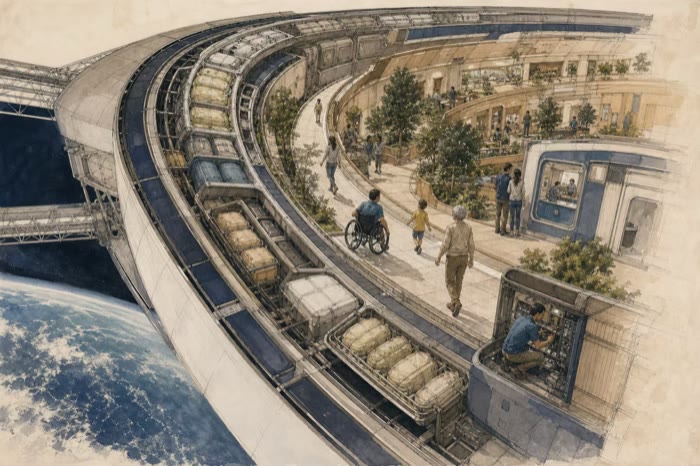
Evidence boundary: Heat pipes, fluid loops, radiators, heaters, insulation, thermal storage, temperature sensors, and load shedding are operational at current spacecraft scales. No crewed space system has demonstrated a maintainable megawatt-class electrical source with matching heat rejection, let alone a city-scale system operating through generations. Equations below are first-order models, not radiator designs. Nuclear, thermal-safety, and dual-use conclusions are high consequence and require independent two-person review; offensive applications are excluded.
Plain-language summary
Energy does not disappear after useful work. Electricity that runs lights, computers, pumps, motors, kitchens, medical equipment, farms, and factories mostly ends as heat inside the habitat. A motor can move a load or store energy temporarily; friction, electronics, and later use eventually return much of it as heat. Energy deliberately exported in a propulsion plume, beam, hot discarded mass, chemical product, or stored battery must be counted separately.
On Earth, buildings dump heat into a vast atmosphere, water system, and ground. A spacecraft in vacuum must move internal heat to an external surface and radiate it away. Radiator area, temperature, emissivity, orientation, contamination, plumbing, and survivability therefore constrain power and habitat layout.
A credible energy proposal always has a matching heat path. “A compact reactor supplies abundant power” is incomplete without conversion efficiency, crew shielding, distribution losses, radiator temperature and area, maintenance, black start, and safe behavior after pipe, pump, sensor, or panel failure.
Begin with an energy ledger
For a defined boundary and time interval:
energy in = stored energy change + useful exported energy + rejected heat
At steady state, stored energy does not keep increasing. If P_e of electrical power is consumed inside the boundary and no lasting product or beam carries energy out, approximately P_e eventually becomes heat. “Efficient” equipment can reduce losses for a task, but the task’s delivered energy also has a destination.
A useful ledger separates:
- primary thermal, chemical, solar, or other energy input;
- conversion to electricity and conversion losses;
- distribution and power-electronics losses;
- loads by location and duty cycle;
- mechanical, chemical, or thermal storage;
- energy exported in propulsion, radiation, products, or discarded mass;
- heat transferred between zones;
- heat finally radiated to space;
- transient reserves during peak loads or failures.
Do not add nameplate ratings and call the sum a thermal design. Farms and factories have schedules; motors cycle; medical loads can be urgent; sunlight changes; equipment ages. The design needs normal, peak, maintenance, emergency, restart, and degraded-mode cases.
Move heat before rejecting it
Heat reaches a radiator through conduction, fluid flow, phase change, or combinations.
Conduction is passive but depends on material, geometry, contact resistance, and temperature difference. Thermal straps and spreaders connect smaller sources.
Heat pipes and loop heat pipes move heat through evaporation and condensation of a working fluid. They can be passive and reliable within a designed temperature, orientation, inventory, and heat-flux range. Freezing, dry-out, gas generation, leaks, wick damage, and start-up remain relevant.
Pumped loops can collect heat from many zones and control it actively. Pumps, valves, accumulators, filters, seals, sensors, fluid chemistry, and power become maintenance items. A common loop can be efficient while also creating a common failure path.
Phase-change storage absorbs a transient load by melting or another transition, then must later reject that energy and reset. Storage shifts heat in time; it is not a permanent sink.
Heat exchangers keep fluids or pressure domains separated. Their walls can foul, corrode, crack, or leak across boundaries. A heat exchanger near life support, agriculture, industry, or a reactor needs detection and isolation appropriate to the consequence.
NASA’s small-spacecraft state-of-the-art survey documents flown and developing examples. Its scale boundary matters: a CubeSat thermal architecture does not establish a habitat loop, but it provides component evidence and test methods.
Radiation to space
An ideal gray radiator emits:
P = εσA(T⁴ - T_space⁴)
where ε is emissivity, σ = 5.670374419 × 10⁻⁸ W/m²K⁴, A is emitting area, and T is absolute radiator temperature. For most practical deep-space estimates, the background term is small relative to a warm radiator, although absorbed sunlight and view of other warm structures must be included.
At 300 K and ε = 0.9, an ideal surface emits about 413 W/m². Rejecting 1 MW would require about 2,420 m² of unobstructed emitting area under those ideal assumptions. At 400 K, ideal flux rises to about 1,306 W/m², reducing area to about 766 m².
The higher temperature is not free. Electronics, crops, crew, lubricants, polymers, seals, working fluids, and power-conversion equipment have limits. Raising loop temperature may improve radiator mass while increasing insulation, degradation, burn, leak, and material problems. Real area also reflects two-sided geometry, view factors, fins, manifolds, micrometeoroid margins, fouling, degradation, reserve capacity, and orientation.
Radiator surfaces must see cold space. In a rotating habitat, large panels may be fixed to a non-rotating structure, rotate with the rim, deploy edge-on to hazards, or use rotary fluid or electrical interfaces. Each choice couples thermal control to attitude, propulsion, structural dynamics, and maintenance.
Heat shapes the city
Low-temperature habitat heat, medium-temperature industrial heat, and high-temperature conversion waste should not automatically share one loop. Temperature “cascades” can use high-grade heat before final rejection, but every exchanger and dependency needs isolation.
Zoning can:
- keep hot, toxic, or high-pressure equipment away from homes;
- give hospitals, refuge cells, archives, and controls independent cooling;
- prevent one pipe rupture from draining the whole system;
- let farms use appropriate heat while preventing biological contamination;
- place repair access outside occupied rooms;
- limit fire and smoke transport through ventilation and utility penetrations.
Residents experience thermal design as air temperature, humidity, radiant temperature, airflow, noise, touch temperature, sleep quality, and ability to control their local environment. A numerically acceptable average can hide overheated workstations, cold surfaces, condensation, stagnant pockets, or inequitable exposure. NASA human-system standards provide bounded crew requirements; a civil habitat needs wider body, age, illness, pregnancy, and disability evidence.
Failure is the real architecture
Common thermal failures include loss of power, pump seizure, valve misposition, gas lock, freezing, leak, sensor drift, control instability, radiator puncture, contamination, fouling, insulation damage, and incorrect maintenance. A single bad temperature sensor can command the wrong response if the control system lacks physical cross-checks.
Thermal inertia buys time, not safety. A warm structure, water inventory, or phase-change store can buffer an outage. The safety case should calculate time to:
- electronics shutdown;
- crop or microbial harm;
- medication or food loss;
- unsafe touch or air conditions;
- pressure rise or fluid boiling/freezing;
- reactor or industrial safe state;
- refuge evacuation.
Load shedding should follow published, rights-aware priorities. It must not invisibly sacrifice a neighborhood, disability support, medical device, sanitation system, or nursery because software ranked it “noncritical.” Local displays, manual controls, appeal, drills, and independent instrumentation are part of thermal safety.
For nuclear sources, decay heat and shutdown cooling remain after fission power falls. The exact case depends on reactor design; “scram” does not mean zero heat. Any nuclear integration requires its own independently reviewed safety, radiation, maintenance, launch, and end-of-life case. This lesson offers no reactor or weapon design.
Inspection, repair, and black start
Century-scale claims require a replacement ecosystem for pumps, seals, electronics, sensors, insulation, coatings, working fluids, and radiator panels. A design should declare which items are:
- inspectable in place;
- replaceable without stopping the whole loop;
- manufacturable from carried feedstock;
- recoverable from contamination;
- calibrated against local standards;
- safe to test under load.
Black start means rebuilding power and heat-rejection operation from a shutdown state without relying on the systems that are off. Controls, communications, valve actuation, heaters, lubrication, and pumps need starter power and an ordered sequence. Multiple “independent” power islands are not independent if they share cooling, software, a fluid reservoir, or one inaccessible radiator manifold.
LLMs can retrieve procedures, compare telemetry, and propose diagnostic branches. They should not directly command safety valves, hide uncertainty, or replace deterministic interlocks and trained operators. Recovery exercises should remove the network, vendor, original expert, one sensor class, and one thermal branch.
An Earth-first test program
Near-term work should build representative thermal islands:
- meter every input, output, storage term, and uncertainty;
- operate through seasonal loads, fouling, aging, and maintenance;
- puncture or isolate radiator segments and measure graceful degradation;
- swap pumps, valves, sensors, and controls while neighboring zones remain safe;
- black-start after extended cold and hot soak;
- test fault detection against drifting and mutually inconsistent sensors;
- include accessible alarms, manual controls, and diverse operators;
- publish mass, area, temperature, energy, water, spares, and recovery ledgers.
The same work benefits data centers, hospitals, remote microgrids, industrial heat recovery, and resilient buildings.
Evidence ledger
- L04-03-A — Nearly all electricity consumed inside a steady-state habitat becomes heat unless energy is stored or exported. Basis: demonstrated conservation law. Readiness: operational. Confidence: strong.
- L04-03-B — Heat pipes, pumped loops, radiators, thermal storage, segmented buses, and load shedding are mature at bounded spacecraft or terrestrial scales. Basis: observed. Readiness: operational to major scale-up. Confidence: strong.
- L04-03-C — Radiator area falls strongly with higher temperature, while material, crew, fluid, geometry, and reliability limits constrain that trade. Basis: demonstrated physics and engineering. Readiness: operational within validated regimes. Confidence: strong.
- L04-03-D — No crewed space system has demonstrated an integrated megawatt-class source and matching heat rejection. Basis: evidence-boundary assessment. Readiness: major scale-up. Confidence: supported.
- L04-03-E — Century-scale conversion, working fluids, coatings, power electronics, and black start require a replacement ecosystem. Basis: systems assessment. Readiness: early research. Confidence: supported.
- L04-03-F — Representative isolated power trains must black-start, reject heat, and recover through injected failures before reliance. Basis: normative safety gate. Readiness: implementable now. Confidence: supported. High consequence: nuclear, thermal safety, and dual use; two-person review required.
Linked corpus claims: claim-03-01, claim-03-02, claim-03-04, claim-03-05, claim-03-06, claim-03-10, and claim-04-09. See the claim registry for each record's current evidence grade and independent-review state.
Assumptions and limits
Radiator calculations assume ideal gray emission, stated emissivity and temperature, unobstructed cold-space view, no absorbed external heat, and no plumbing or structural mass. They are not sizing recommendations. “Megawatt-class” describes electrical scale, not a selected habitat requirement. Terrestrial and small-spacecraft evidence does not validate multigenerational scale. Nuclear remarks are safety boundaries only.
What would change this conclusion?
Readiness would rise after a crewed or representative habitat demonstrated complete energy accounting, megawatt-class conversion and heat rejection, zonal isolation, maintainable radiators, safe nuclear shutdown where applicable, local fabrication, and repeated black starts through injected failures. Independently verified lifetime data for fluids, seals, coatings, electronics, and rotating interfaces would narrow spares uncertainty. Hidden common cooling dependencies, unbounded decay heat, poor accessibility, or recovery that requires vendor cloud services would lower readiness.
Sources and locators
- S01 — NASA Small Spacecraft Systems Virtual Institute, “Thermal Control” (opens external site in a new tab). Locator: thermal balance, coatings, insulation, heat pipes, phase-change storage, multifunctional structures, pumped loops, and radiators; accessed 2026-07-25.
- S02 — NASA Small Spacecraft Systems Virtual Institute, “Power Subsystems” (opens external site in a new tab). Locator: power generation, storage, conversion, distribution, protection, and bounded spacecraft performance; accessed 2026-07-25.
- S03 — NASA Systems Engineering Handbook (opens external site in a new tab). Locator: Chapters 4–6 on requirements, interfaces, technical risk, verification, validation, configuration, and decision analysis; NASA/SP-2016-6105 Rev 2.
- S04 — NASA-STD-3001 Volume 2, Revision E (opens external site in a new tab). Locator: Section 6 environmental health and Sections 7–8 habitability, lighting, acoustics, maintainability, and emergency paths; 2025; accessed 2026-07-25.
- S05 — NASA JPL, “Space Technology 8 Thermal Loop” (opens external site in a new tab). Locator: loop-heat-pipe transport, radiator coupling, passive operation, and technology-demonstration scope; accessed 2026-07-25.
- S06 — National Academies, “Space Nuclear Propulsion for Human Mars Exploration” (opens external site in a new tab). Locator: Chapters 2–4 on nuclear systems, heat, power conversion, technology gaps, safety, and development; 2021; accessed 2026-07-25.
Editorial record
- Prepared by: GShips Project
- Last edited: 2026-07-25
- Status: Substantive editorial draft
- Independent domain review: Pending
- Last independently reviewed: Not yet reviewed; no review date
- High-consequence review: Nuclear, radiation-adjacent, thermal-safety, and dual-use conclusions require independent two-person review
- Required review: spacecraft thermal control; heat transfer; power systems; rotating-fluid systems; human environmental health; maintainability; nuclear safety
- Reviewer: No independent reviewer assigned
- Conflicts: Maintainer intends to explore a commercial venture based on some GShips work; no entity, funding, customer, sponsor, or partner relationship currently exists
- Relationship boundary: GShips is independent; citations do not imply affiliation, endorsement, sponsorship, or partnership with any source organization
- Corrections: Suggest a correction