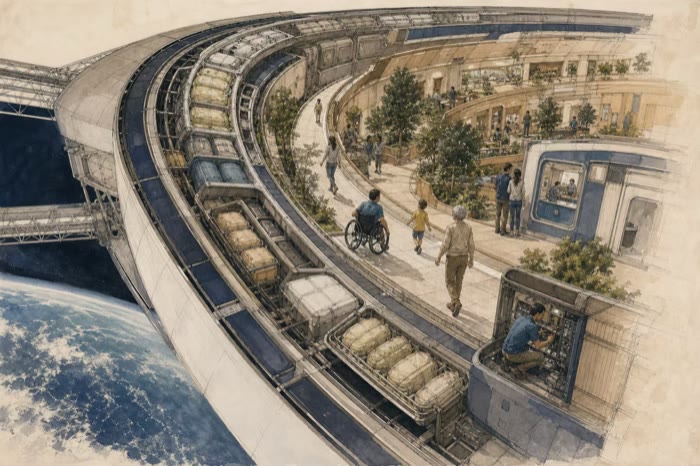
Evidence boundary: Crewed pressure modules, expandable structures, micrometeoroid and orbital-debris shields, dosimetry, material tests, and fracture-control methods operate in current space programs. Their evidence covers particular pressures, loads, orbital particle environments, mission durations, crews, and repair support. Relativistic interstellar gas and dust effects remain model-dependent, and no shield has protected a civil population through generations. Radiation, impact, structural-safety, nuclear-adjacent, and dual-use conclusions are high consequence and require independent two-person review. Weapon design and offensive use are excluded.
Plain-language summary
A habitat wall is not one wall. It may hold atmosphere; survive rotation and docking; limit cracks; manage impact and radiation; transport heat; route utilities; control fire; detect damage; and remain inspectable. Combining functions saves mass but creates coupled failures: a shielding water tank may leak, an impact layer may block inspection, or a thermal channel may spread a local loss.
Current spacecraft demonstrate pressure modules, external shielding, sensors, avoidance, and crew procedures. BEAM demonstrated an expandable human-rated volume. NASA and ECSS maintain structural, fracture-control, material, health, pressure-hardware, and impact standards. This bounded standards survey did not identify one standard covering the combined pressure vessel, rotating machine, city, hospital, school, farm, factory, and refuge—or a generation ship’s scale, duration, closed repair economy, and interstellar regime.
The correct design question is not “how thick is the hull?” It is “what hazards act where, how are they detected, what fails next, and can residents isolate and repair the damage without losing the city?”
Pressure containment
Internal atmosphere stores energy and continuously loads the pressure boundary. For an ideal thin-walled cylindrical vessel under pressure p, radius r, and wall thickness t, hoop stress is approximately:
σ_h = pr / t
Longitudinal stress is approximately:
σ_l = pr / (2t)
A thin spherical shell has membrane stress near pr/(2t). These teaching equations assume uniform material, simple geometry, a wall thin relative to radius, no openings, no welds, no defects, and static pressure. A real habitat has windows, hatches, penetrations, joints, local loads, temperature cycles, manufacturing variation, radiation aging, corrosion or contamination, and accidental damage. Detailed analysis, proof testing, fracture control, leak-before-burst reasoning where valid, and qualified inspection replace the simple formula.
Scaling radius while holding pressure, allowable stress, and material constant tends to increase required thickness. Total shell mass then grows rapidly with size. Dividing a settlement into multiple pressure cells can limit a decompression, support phased maintenance, and avoid one enormous pressure boundary. It adds hatches, seals, connectors, circulation constraints, and more components that can fail.
Fracture control is a lifecycle
NASA-STD-5019 treats flaws, cracks, damage, and catastrophic consequences through a fracture-control program. The logic begins before fabrication:
- classify critical parts and credible failure consequences;
- define materials, loads, environments, and service life;
- control fabrication and workmanship;
- assume relevant initial flaws instead of perfect material;
- verify by analysis, proof, damage-tolerance testing, and qualified nondestructive evaluation;
- track cycles, repairs, configuration, and life limits.
A multigenerational habitat must continue that process after original factories and experts are gone. Inspection needs calibration artifacts, consumables, procedures, and trained interpreters. Repairs must restore strength, pressure integrity, thermal function, and inspectability—not merely stop a leak.
Acoustic emission, pressure decay, strain, temperature, radiation, and impact sensors each have blind spots. A safe architecture combines monitoring, inspection, local access, independent methods, and isolation. LLMs may retrieve procedures or compare signals, but cannot be the sole crack classifier or authority to repressurize a cell.
Orbital debris is not interstellar dust
NASA’s MMOD handbook records design and operational protection for the ISS, Shuttle, and science spacecraft. Whipple-type shields place a bumper at a standoff distance from the pressure wall. An orbital particle striking the bumper breaks up and spreads, allowing following layers to absorb a distributed cloud. Performance depends on particle size, speed, angle, shape, density, bumper, spacing, intermediate fabric or mesh, and rear-wall material.
That evidence is specific to modeled and tested Solar System environments. A relativistic vehicle meets interstellar gas and dust at much higher relative speed. Relativistic kinetic energy is:
E_k = (γ - 1)mc²
with γ = 1 / sqrt(1 - v²/c²). At high speed, impact can produce ionization, vaporization, plasma, cratering, erosion, and secondary radiation. Published models by Hoang and colleagues estimate effects for thin fast probes under assumed gas and grain distributions. Those models are valuable warnings, not qualification data for a large inhabited ship.
Rare large grains matter because a few events may dominate risk. Frontal area, speed, route, pointing, sacrificial mass, repair rate, and maneuverability are coupled. An orbital-debris shield is not thereby “interstellar rated.”
Radiation is a transport problem
Outside Earth’s protection, solar energetic particles and galactic cosmic rays expose tissue, crops, microbes, electronics, polymers, and sensors. NASA’s Space Radiation Element states that human effects and risk projections remain uncertain. Standards address astronaut careers and specific mission classes, not conception through old age across generations.
Shield performance depends on particle species and energy, geometry, material composition, areal density, and secondary products. Low-atomic-number, hydrogen-rich materials such as water and polyethylene can be advantageous for selected spectra. That does not produce one optimal material or thickness. High-energy ions interacting with shielding can fragment nuclei and create secondary particles; adding dense material can have diminishing or adverse returns for some GCR conditions.
Multifunctional arrangements might place water, food, polymers, waste awaiting processing, or other hydrogen-rich inventory around occupied zones. But inventory moves and is consumed. A radiation model must use minimum credible coverage, not a fully stocked marketing diagram. It must also address contamination, fire, access, leaks, thermal gradients, and replacement.
Active magnetic shielding remains experimental. It introduces field exposure, cryogenic hardware, stored energy, quench, maintenance, and new particle trajectories. Electrostatic concepts add high voltage, arcing, plasma interaction, and power. These are research topics—not substitutes for validated passive architecture.
Layering without hiding failures
A conceptual stack might include:
- replaceable sacrificial or erosion layer;
- spaced impact bumpers and dispersive layers;
- debris capture and contamination control;
- radiation-moderating inventory or dedicated shielding;
- pressure boundary with crack arrest and leak detection;
- thermal spreaders and independently isolatable fluid channels;
- utilities in accessible raceways;
- fire-, smoke-, and toxin-conscious interior panels.
The order cannot be universal. A rotating rim, non-rotating hub, farm, reactor bay, observation port, and refuge have different hazards. Some shielding belongs far from the pressure wall; some mass belongs close to people. A design should publish interfaces, inspection paths, replaceable units, and what happens after each layer is breached.
Multifunctionality earns its place only if failure remains understandable. A panel that carries load, water, heat, data, and shielding may reduce nominal mass while making one puncture disable five systems. Alternatives include functional separation, local redundancy, standardized removable tiles, and accessible backing spaces. The trade should be tested, not decided by the shortest parts list.
Compartmentation and repair
Multiple pressure cells, isolation valves, fire doors, local ventilation, and protected cross-connections can stop propagation. Residents still need enough habitable refuge after losing the largest credible compartment. Critical farms, medical care, sanitation, power, controls, data, and repair shops should not all share one failure domain.
Repair planning begins with detection thresholds and time:
- How quickly does atmosphere escape through each credible hole or crack?
- Can occupants locate damage through smoke, noise, or power loss?
- Can a cell depressurize without collapsing adjacent layers?
- Can robots inspect exterior or inaccessible surfaces?
- Is a temporary patch inspectable and replaceable?
- Can material and tooling be reproduced locally?
- What evidence permits reoccupation and repressurization?
Pressure integrity is not the only recovery criterion. An impact may seed hidden cracks, contaminate air, damage wiring, compromise radiation coverage, or overload another structure after load redistribution.
A responsible test ladder
Earth and Solar System tests should progressively combine hazards:
- cycle full-scale pressure cells with representative penetrations, repairs, and aging;
- inject known defects and verify probability of detection;
- impact layered coupons, subassemblies, and pressure articles inside qualified test regimes;
- expose shielding and electronics to representative mixed radiation and measure secondaries;
- operate water, thermal, structural, and sensing functions through leaks and repairs;
- remove cloud services, vendors, and original experts from recovery exercises;
- test isolation and accessible refuge with diverse occupants;
- fly replaceable shield and sensor modules before committing inhabited mass;
- send precursor probes to measure route-specific dust and plasma.
Passing a single coupon test does not qualify a habitat. The acceptance case must cover representative geometry, manufacturing, aging, interfaces, inspection, repair, and failure recovery.
Evidence ledger
- L04-02-A — Crewed pressure modules, expandable structures, fracture-control processes, and MMOD shields operate in bounded Earth-orbit missions. Basis: observed. Readiness: operational in current mission classes. Confidence: strong.
- L04-02-B — Pressure-vessel membrane equations support first-order sizing but omit openings, defects, cycles, combined loads, and repair. Basis: demonstrated mechanics. Readiness: operational engineering method within its assumptions. Confidence: strong.
- L04-02-C — Hydrogen-rich, low-Z materials can improve protection for selected radiation spectra, but geometry and secondary-particle transport prevent a universal thickness rule. Basis: demonstrated and modeled. Readiness: operational to major scale-up. Confidence: supported.
- L04-02-D — Relativistic interstellar gas and dust can cause erosion, plasma, and secondary radiation, with magnitude sensitive to speed, material, route, and uncertain grains. Basis: modeled. Readiness: early research. Confidence: supported.
- L04-02-E — No protective architecture has demonstrated representative impact, radiation, inspection, repair, and biological performance over generations. Basis: evidence-boundary assessment. Readiness: breakthrough-dependent. Confidence: strong that the gap exists.
- L04-02-F — Representative spectra, impacts, secondary products, inspection, repair, and lifetime risk must be validated before reliance. Basis: normative safety gate. Readiness: implementable as a test rule. Confidence: supported. High consequence: radiation, medical, structural safety, and dual use; two-person review required.
Linked corpus claims: claim-04-01, claim-04-02, claim-04-07, claim-04-09, claim-15-01, claim-15-02, claim-15-03, claim-15-06, claim-15-07, and claim-15-10. See the claim registry for each record's current evidence grade and independent-review state.
Assumptions and limits
The pressure equations are thin-shell teaching models. No allowable stress, thickness, atmospheric pressure, architecture, or shield mass is recommended. MMOD data cannot be transferred to relativistic impact without new validation. Radiation effects vary by spectrum, geometry, tissue, age, sex, biology, and model. Interstellar grain distributions remain uncertain. Active-shield discussion is safety-oriented and contains no weapon or offensive design guidance.
What would change this conclusion?
Readiness would rise after full-scale pressure and protective assemblies survived representative cycling, defects, impact spectra, radiation fields, thermal loads, isolation, inspection, repair, and requalification with independently reproduced results. Route measurements that constrain gas and grain distributions would improve interstellar models. Lifetime biological evidence across conception, development, adulthood, aging, crops, microbes, materials, and electronics is required for a civil conclusion. Hidden damage, unrepairable coupled panels, harmful secondary radiation, or inadequate refuge would lower readiness.
Sources and locators
- S01 — NASA-STD-5019, “Fracture Control Requirements for Spaceflight Hardware” (opens external site in a new tab). Locator: active standard scope and Sections 6–7 on classification, damage tolerance, pressure vessels, habitable volumes, pressurized structures, and rotating hardware; accessed 2026-07-25.
- S02 — NASA NTRS, “Handbook for Designing MMOD Protection” (opens external site in a new tab). Locator: Chapters 2–9 on environment, risk, ballistic-limit equations, shield configurations, testing, sensors, and operations; 2009; accessed 2026-07-25.
- S03 — NASA TechPort, “Bigelow Expandable Activity Module Project” (opens external site in a new tab). Locator: pressure-retention, deployment, structural, radiation-sensing, inspection, and low-Earth-orbit demonstration objectives and results; updated 2025-12-02; accessed 2026-07-25.
- S04 — NASA, “About the Space Radiation Element” (opens external site in a new tab). Locator: radiation sources, health concerns, experimental facilities, risk-model uncertainty, and protection research; accessed 2026-07-25.
- S05 — NASA Langley, “Radiation Analysis and Shielding Design” (opens external site in a new tab). Locator: primary and secondary environments, low-Z and hydrogen-rich shielding, transport analysis, and systems approach; accessed 2026-07-25.
- S06 — NASA Johnson Space Center, “Hypervelocity Impact Technology Reference Documents” (opens external site in a new tab). Locator: MMOD risk, shielding, ballistic-limit, test, inspection, and repair references; accessed 2026-07-25.
- S07 — Thiem Hoang et al., “The Interaction of Relativistic Spacecrafts with the Interstellar Medium” (opens external site in a new tab). Locator: modeled gas and dust erosion, heating, charging, damage, and shielding assumptions for thin fast spacecraft; Astrophysical Journal 837, 2017.
- S08 — NASA-STD-3001 Volume 2, Revision E (opens external site in a new tab). Locator: Sections 6–8 on environmental health, atmosphere, radiation protection, habitability, translation, assisted egress, and maintenance access; 2025; accessed 2026-07-25.
- S09 — ECSS-E-ST-32-02C Rev.2, “Structural design and verification of pressurized hardware” (opens external site in a new tab). Locator: current pressurized-hardware design and verification scope; 15 October 2025; accessed 2026-07-26.
Editorial record
- Prepared by: GShips Project
- Last edited: 2026-07-25
- Status: Substantive editorial draft
- Independent domain review: Pending
- Last independently reviewed: Not yet reviewed; no review date
- High-consequence review: Radiation, medical, structural-safety, active-field, nuclear-adjacent, and dual-use conclusions require independent two-person review
- Required review: pressure structures; fracture control; hypervelocity impact; radiation transport and health; materials; nondestructive evaluation; repair and safety engineering
- Reviewer: No independent reviewer assigned
- Conflicts: Maintainer intends to explore a commercial venture based on some GShips work; no entity, funding, customer, sponsor, or partner relationship currently exists
- Relationship boundary: GShips is independent; citations do not imply affiliation, endorsement, sponsorship, or partnership with any source organization
- Corrections: Suggest a correction