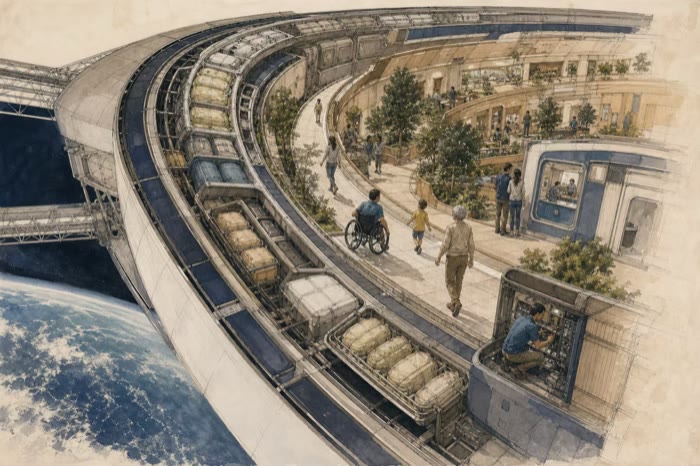
Evidence boundary: Current spacecraft standards and analogs provide evidence for small, selected adult crews over finite missions with Earth support. Terrestrial accessibility, housing, healthcare, and community-design evidence supplies additional starting points. No analog reproduces birth, childhood, aging, civil conflict, irreversible separation, ecological closure, or cultural evolution across generations. Behavioral-health, disability-rights, child-development, medical, and governance conclusions are high consequence and require independent two-person review.
Plain-language summary
A habitat can keep air inside and still be unlivable. People need private places, relationships they choose, quiet and lively areas, controllable light, nature, play, education, care, dissent, and the ability to change their surroundings. Those are not decorative benefits added after engineering. They affect sleep, attention, conflict, learning, recovery, dignity, and whether residents can live lives that are more than servicing a mission.
Spaceflight evidence supports practical principles: long missions need privacy; noise requires system-level control; lighting affects tasks and circadian health; translation and controls should match human capabilities; and emergency routes must be visible and usable. Yet astronaut standards are designed for small groups of screened professionals. A generation ship would be a town with infants, families, older people, different cultures, illness, disability, disagreement, and unequal needs.
The architecture should distribute real control. Residents need to adjust their home, choose social contact, protect confidential care and communication, navigate independently, and participate in changing common space. A sensor-rich habitat must not turn life support into universal surveillance.
From cabin volume to civic space
Net habitable volume is useful but insufficient. Two layouts with the same volume can differ in:
- crowding and unwanted encounters;
- distance between noisy and quiet functions;
- privacy from sight, sound, vibration, odor, and data collection;
- access to daylight-like cycles and planted space;
- number and diversity of routes;
- ability to host family, care, ritual, play, study, or dissent;
- ease of modification as population and culture change.
Minimum volume cannot establish a healthy community. The answer depends on activity, duration, household structure, mobility, storage, acoustic separation, environmental quality, and social choice.
Neighborhoods can distribute daily services, but can also enforce segregation. Boundaries should remain permeable, and services should not depend on status.
Privacy has physical and digital layers
NASA-STD-3001 Volume 2 requires individual privacy facilities for missions longer than 30 days and links privacy to behavioral health, sleep, reduced distraction, private medical or psychological conversations, and emotional restoration. That is meaningful current evidence. It does not tell us how much privacy a family, adolescent, elder, patient, political dissenter, or religious community needs over a lifetime.
Physical privacy includes:
- a door or partition with real acoustic and visual separation;
- space for sleep, dressing, hygiene, care, and intimacy;
- private communication and records;
- control of entry and a way to summon help;
- ventilation and fire safety that do not vanish when a door closes;
- alternatives for people who cannot operate the standard latch or interface.
Digital privacy matters because environmental systems can infer presence, sleep, health, relationships, speech, and behavior. Collect the minimum data necessary for a stated safety purpose. Separate local control from central analytics; retain data briefly; show occupants what is sensed; support consent and challenge; and prohibit covert ranking, coercive monitoring, or automated punishment. Emergency overrides must be narrow, logged, reviewable, and unable to become ordinary governance by convenience.
LLMs can translate controls, summarize maintenance information, and help residents navigate complex services. They can also expose private material, infer sensitive traits, reproduce bias, or manipulate choices. They should not be a landlord, therapist, police authority, eligibility judge, or sole emergency decision-maker.
Sound is an architectural load
Fans, pumps, rotating machinery, transit, workshops, alarms, voices, and impact noise share the structure. NASA-STD-3001 requires an acoustic noise-control plan because small equipment changes can alter integrated noise. A habitat needs both exposure protection and intelligibility: an environment can meet an average sound level yet mask alarms or speech.
Design from source to receiver:
- choose quieter equipment and operating points;
- isolate vibration before it enters structure;
- separate loud uses spatially and temporally;
- add absorption and barriers without creating fire or contamination hazards;
- measure at actual ears and occupied positions;
- provide quiet refuges and sleep protection;
- make alarms multimodal rather than simply louder.
Hearing protection is not a substitute for a livable neighborhood. It can block communication and excludes people differently. Continuous monitoring should publish understandable levels while avoiding conversational surveillance.
Light supports tasks, bodies, and agency
NASA’s active human-system standard distinguishes task lighting, emergency lighting, glare control, color fidelity, circadian effects, and local adjustment. A single brightness and spectrum cannot serve repair, medicine, art, sleep, navigation, plant growth, and visual disabilities.
Residents need stable day-night cues and the ability to darken sleep spaces. Emergency routes need lighting that survives general power failure. Visual information also needs tactile and audible equivalents; color cannot be the only signal. Flicker, glare, contrast, and spectral content affect people differently, including those with migraine, low vision, sensory sensitivity, or aging eyes.
Nature must be more than a wallpaper
Plants can provide food, ecological functions, sensory variety, education, and meaning. They also bring humidity, allergens, microbes, pests, lighting loads, and maintenance.
The evidence for nature in a generation ship is indirect. Terrestrial studies and analog experience can guide testable hypotheses, but no study identifies a sufficient “dose” for a closed multigenerational settlement. Design diverse access: planted commons, small personal growing spaces, views into working ecology, water or material textures where safe, and quiet contact without requiring labor or payment.
Nature should not be a luxury amenity; distribution, accessibility, and maintenance are infrastructure questions.
Accessibility cannot be postponed
Spaceflight programs often select healthy adults. A civil community cannot solve access by selecting out residents. Disability will arise through injury, illness, aging, and ordinary human variation.
The U.S. Access Board’s ADA standards provide terrestrial requirements for routes, doors, clear spaces, reach, controls, visual and audible communication, and sanitation. Their legal scope and Earth-gravity geometry do not transfer automatically to a spacecraft. They remain useful minimum-reference evidence.
Test:
- step-free and low-effort routes coincident with ordinary circulation;
- door and hatch operation under pressure, smoke, power loss, and reduced strength;
- turning, transfer, and assistance space;
- seated and standing reach to controls and storage;
- tactile, visual, and audible wayfinding;
- captions, sign language, plain language, and non-speech communication;
- toilets, bathing, kitchens, work, exercise, and recreation across abilities;
- evacuation with mobility devices, respiratory support, service animals where applicable, or human assistance;
- homes that can change without institutional displacement.
Accessibility means not making every activity depend on vision, fine motor control, connectivity, an implanted device, or one language.
Commons, conflict, and change
Shared meals, recreation, learning, making, assembly, and celebration can build relationships. People also need to avoid gatherings, form new groups, and dissent from an official culture. A central plaza is not civic freedom if cameras classify behavior and all rooms require permission.
Provide doorsteps, small shared rooms, neighborhood commons, ship-wide assembly, workshops, gardens, and private retreat. Duplicate critical functions and keep spaces reconfigurable through accessible fasteners, standard panels, movable furnishings, and published utility interfaces.
Scarcity is real, but allocation rules are choices. Noise budgets, room booking, repair priority, housing changes, and access to planted space need transparent criteria, appeals, and protection against wealth or office. Residents born aboard deserve political agency and meaningful non-mission lives, not permanent status as crew.
Failure recovery includes social continuity
A neighborhood may be lost to fire, decompression, contamination, heat, or maintenance. Refuge is more than survival volume. Displaced residents need accessible housing, medication, privacy, sanitation, communication, schooling, cultural continuity, and a fair path home or to replacement space.
Design should avoid placing all quiet rooms, mobility support, pediatric care, archives, or one community’s sacred space in the same failure domain. Recovery exercises should test weeks and months of displacement, not only a ten-minute evacuation. Mental-health monitoring must remain voluntary and confidential except under narrowly defined, reviewable emergencies.
An Earth-first test program
Build full-scale inhabited mockups and let diverse residents change them. Measure sleep, noise, wayfinding, conflicts, maintenance access, privacy failures, energy, queueing, and accessibility over months—not only first impressions. Inject loss of a lift, corridor, washroom, lighting circuit, data network, and neighborhood. Invite disability-led review and compensate participants. Publish adverse findings and design changes.
Analog facilities such as CHAPEA can test selected routines and layouts. They retain Earth gravity, outside rescue, finite duration, adult selection, and mission framing. Schools, hospitals, cohousing, shelters, ships, and accessible housing offer additional partial evidence. No analog should be described as a miniature generation ship.
Evidence ledger
- L04-04-A — Current crew standards value privacy, controllable lighting, acoustic control, translation, and assisted egress in bounded missions. Basis: observed and standardized. Readiness: operational. Confidence: strong.
- L04-04-B — Current spaceflight and analog evidence concerns small selected adult groups with Earth support. Basis: observed. Readiness: operational evidence with limited transfer. Confidence: strong.
- L04-04-C — No minimum volume or analog establishes healthy civil-community requirements across birth, aging, culture, and generations. Basis: evidence-boundary assessment. Readiness: early research. Confidence: strong that the gap exists.
- L04-04-D — Accessible, reconfigurable, quiet, low-toxicity interiors have nearer value in hospitals, shelters, vessels, and remote workplaces. Basis: observed terrestrial practice and proposed transfer. Readiness: operational to major scale-up. Confidence: supported.
- L04-04-E — Residents require privacy, cultural choice, political agency, and meaningful non-mission lives under scarcity. Basis: normative rights and habitability claim. Readiness: institution not demonstrated. Confidence: supported.
- L04-04-F — Full-scale diverse-body mockups and long-duration social evidence are required before commitment. Basis: normative safety gate. Readiness: implementable now. Confidence: supported. High consequence: behavioral health, disability, childhood, medical privacy, and governance; two-person review required.
Linked corpus claims: claim-04-01, claim-04-04, claim-04-08, claim-04-10, claim-09-01, claim-09-03, claim-09-05, claim-09-07, and claim-09-10. See the claim registry for each record's current evidence grade and independent-review state.
Assumptions and limits
NASA standards apply to defined human spaceflight programs and professional crews. ADA standards apply to covered terrestrial facilities; cited dimensions are not rotating-space certification. Behavioral evidence is population-, culture-, and context-dependent. CHAPEA and other analogs retain intervention and rescue. This lesson does not prescribe mental-health treatment, compulsory monitoring, population selection, or one ideal family or culture.
What would change this conclusion?
Confidence would rise after multi-year, diverse-population habitat trials showed durable privacy, sleep, accessibility, care, cultural choice, conflict resolution, reconfiguration, and recovery from neighborhood loss without coercive surveillance. Evidence must include children, older adults, disabled people, caregivers, and multiple household and cultural forms. Persistent unequal access, inability to opt out of monitoring, rising conflict, or recovery that displaces some groups indefinitely would lower readiness and require architectural or governance change.
Sources and locators
- S01 — NASA-STD-3001 Volume 2, Revision E (opens external site in a new tab). Locator: Sections 6.6 acoustics; 7.9 sleep and privacy; 8.1 volume; 8.3 translation and assisted egress; 8.7 lighting; active 2025 standard; accessed 2026-07-25.
- S02 — NASA, “Habitability Functions — Volume 2” (opens external site in a new tab). Locator: Sections 7.1–7.11, especially sleeping, hygiene, food, exercise, recreation, and 7.9.2 behavioral health and privacy; accessed 2026-07-25.
- S03 — NASA, “Human Integration Design Handbook” (opens external site in a new tab). Locator: Revision 1 and companion processes on anthropometry, architecture, acoustics, lighting, habitability, and human-in-the-loop evaluation; updated 2026-02-18; accessed 2026-07-25.
- S04 — NASA, “Behavioral Health Risk” (opens external site in a new tab). Locator: isolation and confinement risks, bounded ISS countermeasures, and unvalidated exploration-class countermeasure gap; updated 2025-09-17; accessed 2026-07-25.
- S05 — NASA, “About CHAPEA” (opens external site in a new tab). Locator: adult crew, Earth-based habitat, mission duration, simulated stressors, research goals, and analog scope; accessed 2026-07-25.
- S06 — U.S. Access Board, “ADA Accessibility Standards” (opens external site in a new tab). Locator: Chapters 2–7 on accessible routes, doors, clear spaces, controls, communication, sanitation, and dwelling units; terrestrial legal scope noted; accessed 2026-07-25.
- S07 — United Nations, “Convention on the Rights of Persons with Disabilities” (opens external site in a new tab). Locator: certified treaty text, especially Articles 5, 9, 19, 21, 23–25, 29, and 30 on equality, accessibility, independent living, privacy and family, health, participation, and culture; accessed 2026-07-25.
Editorial record
- Prepared by: GShips Project
- Last edited: 2026-07-25
- Status: Substantive editorial draft
- Independent domain review: Pending
- Last independently reviewed: Not yet reviewed; no review date
- High-consequence review: Behavioral-health, disability-rights, childhood, medical-privacy, and governance conclusions require independent two-person review
- Required review: architecture and urban design; environmental psychology; behavioral health; acoustics and lighting; disability access; childhood and aging; civil rights and governance
- Reviewer: No independent reviewer assigned
- Conflicts: Maintainer intends to explore a commercial venture based on some GShips work; no entity, funding, customer, sponsor, or partner relationship currently exists
- Relationship boundary: GShips is independent; citations do not imply affiliation, endorsement, sponsorship, or partnership with any source organization
- Corrections: Suggest a correction