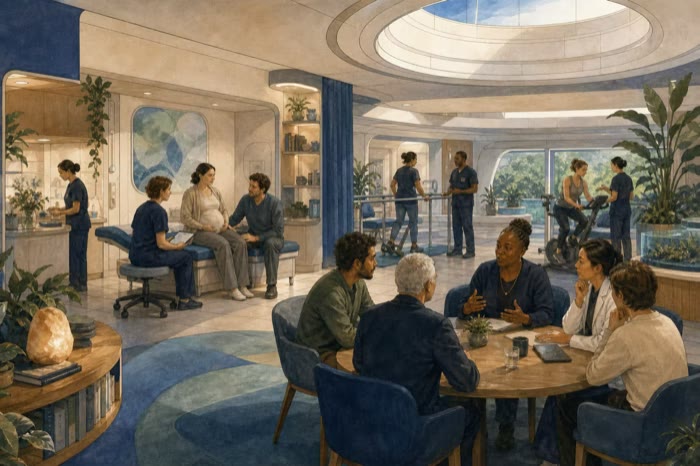
Evidence boundary: Human spaceflight and terrestrial analogs document important changes in selected, highly screened adults exposed to microgravity or simulated unloading for limited periods. They do not establish safe gravity, rotation, or transition schedules for conception, pregnancy, birth, childhood, lifelong disability, or aging. This lesson is not medical advice, a treatment protocol, or a human-research proposal.
Plain-language summary
Gravity is not simply “on” or “off.” People experience magnitude, direction, duration, transitions, rotation, local gradient, motion, exercise, impact, and individual variation.
Current astronauts provide valuable evidence about adult bone, muscle, balance, cardiovascular, vision, immune, sleep, and behavioral changes. Most are healthy selected adults, missions are short compared with a lifetime, and crews receive extensive monitoring, countermeasures, supplies, and Earth expertise.
This bounded review found no published evidence of a human pregnancy carried through birth or of childhood development away from Earth. Mars and lunar gravity have not been tested as lifelong human developmental environments. A rotating habitat adds Coriolis effects and head-to-foot gravity differences that depend on radius and spin rate.
The ethical conclusion is not “choose one-third g” or “spin at two revolutions per minute.” It is: do not make reproduction or lifelong health depend on an environment whose developmental evidence does not exist.
Describe the exposure before the effect
A gravity claim should state:
- Acceleration magnitude at the relevant body location.
- Direction relative to the body and activity.
- Continuous, intermittent, or changing exposure.
- Rotation radius and angular speed.
- Head-to-foot gradient.
- Transitions among environments.
- Vibration and vehicle acceleration.
- Exercise, loading, nutrition, medication, health, age, and prior exposure.
- Outcome, measurement, duration, and follow-up.
An adult exercise session at approximately Earth-normal loading does not reproduce continuous gravity for a developing fetus, a crawling child, sleep, falls, digestion, or decades of tissue loading.
What human evidence establishes
NASA’s Human Research Program identifies altered gravity as a hazard that affects multiple physiological systems. Spaceflight observations and ground analogs support that unloading can contribute to bone loss, muscle loss, sensorimotor change, cardiovascular deconditioning, and other effects in adults. Countermeasures such as exercise reduce some risks but do not erase every effect.
Evidence quality varies by outcome. Cohorts are small, participants are selected, missions and measurements differ, and many changes interact with radiation, confinement, sleep, workload, diet, carbon dioxide, and stress. Terrestrial bed-rest or head-down-tilt studies isolate some mechanisms but preserve Earth gravity on cells and organs in ways orbital flight does not.
This evidence justifies concern and further research. It does not establish a universal safe dose across a civil population.
Development is not a scaled adult
Conception, placentation, organ formation, birth, motor learning, bone growth, vision, vestibular development, immune development, puberty, and fertility involve timed processes. An effect can depend on when exposure occurs, not only its average.
Animal and cell studies can reveal mechanisms, but species, developmental timing, body scale, lifespan, and experiment conditions limit transfer. In one ISS experiment, adult male mice housed in a centrifuge-generated artificial-1g condition were compared with adult male mice in microgravity. That is useful bounded evidence about a particular adult-animal exposure; it is not evidence for a rotating human habitat, pregnancy, childhood, aging, disability, or lifetime safety. No animal result can ethically justify assuming human pregnancy and childhood safety.
Children born aboard would not have chosen the exposure. Their interests require independent representation, conservative gates, long-term follow-up, privacy, disability support, and the possibility that the architecture is rejected before they bear the risk.
The absence of observed harm in adults cannot be converted into evidence for unobserved development.
Partial gravity is a missing dataset
Humans have walked on the Moon for short missions. No person has lived for months or years in lunar gravity, and no one has lived in Mars gravity. It is unknown whether a threshold exists above which particular systems remain healthy, whether the threshold differs across tissues and life stages, and how transitions matter.
“Partial gravity is better than zero” may be mechanically plausible for some functions, but it is not a complete medical conclusion. The relevant question is better enough for which outcome, person, duration, and margin.
Research should avoid one-number thinking. A habitat may need different spaces or regimens, but unequal access to safer gravity could create health and political inequality.
Rotating gravity trades magnitude against motion
For a rotating habitat:
\[ a = \omega^2 r \]
where \(a\) is centripetal acceleration, \(\omega\) is angular speed, and \(r\) is distance from the axis.
A smaller radius requires faster rotation for the same floor acceleration. Faster rotation increases motion-related effects when people turn their heads or move radially. A person’s head is also closer to the axis than their feet, producing a gravity gradient.
This equation calculates acceleration; it does not calculate comfort, development, safe pregnancy, falls, accessibility, or long-term health.
Large-radius demonstrators and human-in-the-loop research can reduce uncertainty. A simulation headset or short centrifuge exposure does not reproduce living, sleeping, working, aging, and raising children for decades.
Disability and variability are design inputs
A civil habitat includes people with mobility, balance, sensory, cognitive, chronic-health, and fatigue differences; injuries and aging will create new disabilities. Gravity affects transfers, wheelchairs, prostheses, lifts, emergency movement, care work, falls, and reach.
Universal design requires:
- Multiple safe movement modes.
- Handholds, seating, rest, contrast, tactile information, and quiet.
- Accessible evacuation and refuge.
- Controls and maintenance access for diverse bodies.
- No assumption that everyone can exercise intensely.
- Independent disability-led testing and authority.
- Equal access to healthier zones, care, work, education, and civic life.
Selecting only people who fit a narrow habitat is not a substitute for a livable society, and descendants cannot be selected in advance.
Countermeasures are a supply chain
Exercise devices, medications, nutrition, monitoring, rehabilitation, and clinical care depend on equipment, spare parts, power, consumables, expertise, and adherence. A treatment that works under Earth resupply may fail when a bearing, drug, sensor, or specialist is unavailable.
Every claimed countermeasure needs:
- Intended outcome and population.
- Evidence quality and duration.
- Adverse effects and contraindications.
- Required hardware, consumables, and training.
- Monitoring and stop criteria.
- Alternatives and what happens if it fails.
This is a reason to design the environment to reduce harm, not place all responsibility on residents to exercise or comply.
AI and clinical authority
An offline AI system might retrieve a controlled protocol, compare a measurement with a resident’s own history, or help summarize evidence. It can also confabulate, extrapolate adult data to a child, hide cohort exclusions, or treat a model output as a diagnosis.
Clinical and habitat decisions need qualified current standards, validated instruments, provenance, privacy, abstention, independent medical authority, and appeal. The AI cannot set reproductive eligibility, ration access to safer gravity, or override a resident’s rights. Care needs an AI-off path.
A responsible research ladder
- Improve longitudinal adult data and disclose cohort limits.
- Compare ground analogs with flight measurements without treating them as identical.
- Conduct nonhuman and tissue work under applicable ethics and welfare review.
- Build large-radius human-in-the-loop demonstrators for adult comfort, work, accessibility, and emergency response.
- Test transitions, variability, assistive technology, and equipment maintenance.
- Operate a reversible Solar System habitat where rescue remains possible.
- Keep reproduction outside the validated boundary until independent evidence and legitimate review support it.
Human research must be voluntary, ethically reviewed, privacy-preserving, and scientifically necessary. Children must never be created as experiments.
Evidence ledger
- L07-02-A — Altered gravity affects multiple systems in current adult spaceflight evidence. Basis: observed. Readiness: operational knowledge within current mission contexts. Confidence: strong about hazard, outcome-specific about magnitude.
- L07-02-B — Partial-gravity lifetime health and development remain unestablished. Basis: unknown with limited short exposure. Readiness: early research. Confidence: strong about the evidence gap.
- L07-02-C — This bounded review found no published evidence of a human pregnancy carried through birth or of childhood development off Earth. Basis: bounded literature-review finding. Readiness: no direct human evidence located. Confidence: strong within the reviewed sources, not a proof of a universal historical negative.
- L07-02-D — Rotating acceleration is calculable, but medical and developmental suitability is not determined by the equation. Basis: demonstrated mechanics plus biological uncertainty. Readiness: major human evidence gap. Confidence: strong.
- L07-02-E — Reproduction must not depend on an unvalidated gravity environment. Basis: normative medical and rights gate. Readiness: operational as GShips policy. Confidence: strong; two-person independent review required.
Linked corpus claims: claim-07-02, claim-07-04, claim-07-05, and claim-07-10. See the claim registry for each record's current evidence grade and independent-review state.
Assumptions and limits
- No safe gravity, radius, rotation rate, exposure schedule, or countermeasure is proposed.
- Adult astronaut evidence is not generalized to every resident.
- Animal, tissue, bed-rest, and centrifuge studies retain species and analog limits.
- The lesson does not interpret individual medical results.
- Reproductive and developmental research raises special ethical constraints beyond engineering.
- The source review is bounded, English-language, and not systematic.
What would change this conclusion?
Readiness would rise through independently replicated evidence connecting declared gravity and rotation exposures to long-term outcomes across diverse adults, aging, disability, and ethically appropriate developmental models, followed by reversible habitat demonstrations with transparent adverse events and follow-up. Human reproduction must remain outside the architecture until qualified independent review supports the environment and rights-respecting care. Evidence of serious developmental harm, unequal access, unmanageable motion effects, or countermeasures that require an unsustainable supply chain should force redesign, a larger radius, Earth-normal gravity where possible, waiting, or do not launch.
Sources and locators
- NASA Human Research Program — Hazard: Gravity Fields (opens external site in a new tab). Locator: multi-system human-performance and health risks, evidence scope, and countermeasure research; accessed 2026-07-25.
- NASA — Human Research Program (opens external site in a new tab). Locator: current human-spaceflight risk research, evidence base, analogs, and exploration-mission context; accessed 2026-07-25.
- NASA Space Flight Human-System Standard, Volume 1: Crew Health (opens external site in a new tab). Locator: current crew-health requirements and applicability; not a multigenerational civil-population standard.
- National Academies — Thriving in Space (opens external site in a new tab). Locator: biological and physical sciences evidence, human-system research, knowledge gaps, and future research priorities; 2023.
- NASA — Artificial Gravity (opens external site in a new tab). Locator: human-body-in-space educational context and current countermeasure boundary; accessed 2026-07-25.
- Matsumura et al. — Male mice, artificial 1g, and microgravity aboard ISS (opens external site in a new tab). Locator: adult male mouse centrifuge and microgravity comparison, exposure configuration, outcomes, and nonhuman/adult scope; *Scientific Reports*, 2019; accessed 2026-07-26.
- United Nations — Convention on the Rights of Persons with Disabilities (opens external site in a new tab). Locator: equality, accessibility, health, family, education, work, privacy, and participation.
- UNICEF — Convention on the Rights of the Child (opens external site in a new tab). Locator: best interests, health, development, disability support, education, expression, and participation.
Editorial record
- Prepared by: GShips Project
- Last edited: 2026-07-26
- Status: Substantive editorial draft; not independently reviewed
- Independent domain review: Pending; two-person high-consequence review required
- Required review: Space medicine, developmental biology, obstetrics, pediatrics, rehabilitation, disability rights, artificial gravity, human factors, bioethics, child rights, and affected communities
- Conflicts: Maintainer intends to explore a commercial venture based on some GShips work; no entity, funding, customer, sponsor, or partner relationship currently exists
- Relationship boundary: Source inclusion does not imply author, institution, NASA, National Academies, UNICEF, or United Nations endorsement or partnership
- Corrections: Suggest a correction