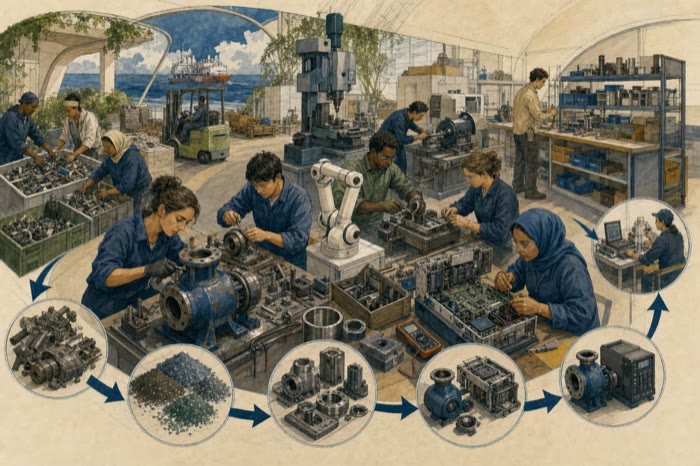
Evidence boundary: Polymer additive manufacturing has operated on the International Space Station, and in-space programs are developing metal manufacturing, joining, recycling, electronics, construction, and robotic servicing. Terrestrial factories routinely combine additive and subtractive processes with heat treatment, metrology, nondestructive evaluation, and quality systems. No demonstration has taken mixed waste or local ore through a self-maintaining autonomous factory to a qualified, installed, life-critical space part while also replacing the tools and standards used to make it.
Plain-language summary
A printer changes the shape of compatible feedstock. A factory changes trustworthy information and controlled material into a qualified function.
That job may require mills, lathes, grinders, presses, furnaces, welders, chemical baths, clean rooms, winding and coating systems, test stands, nondestructive evaluation, calibrated instruments, and skilled people. It also needs power, cooling, gases, filters, software, fixtures, protective equipment, and waste treatment.
A generation ship’s factory faces one further demand: it must help maintain the factory. Machine-tool bearings wear. Cutting tools dull. lasers, power electronics, seals, lubricants, sensors, reference artifacts, and control computers age. “Tools to make tools” is therefore not a slogan. It is a traceable dependency problem.
The responsible design goal is not perfect self-sufficiency by declaration. It is a bounded account of which functions can be reproduced, which inputs remain finite, how quality is verified, and how failure changes the mission decision.
Follow one replacement part
Consider a corroded pump impeller in a water-treatment loop. Printing its geometry does not close the repair. A defensible route includes:
- Requirement recovery. What flow, pressure, speed, temperature, fluid compatibility, lifetime, balance, and failure consequence must the impeller satisfy?
- Configuration identification. Which installed pump version is present, and what modifications have accumulated?
- Material selection. Which alloy, polymer, ceramic, coating, or composite has the required corrosion, fatigue, radiation, and cleaning behavior?
- Feedstock assurance. Is composition known? Are contamination, particle size, moisture, morphology, and reuse history within limits?
- Process planning. Which forming, machining, heat treatment, joining, coating, and cleaning steps create the required properties?
- Tool and fixture preparation. Can the factory hold, reference, and safely process the workpiece?
- Manufacture. Are machine condition, atmosphere, temperature, forces, and process data controlled?
- Post-processing. Does the part need support removal, stress relief, hot isostatic pressing, solution treatment, aging, grinding, polishing, or passivation?
- Inspection and test. Are dimensions, surface finish, balance, chemistry, microstructure, internal defects, and mechanical properties acceptable?
- Installation and acceptance. Does the repaired assembly work across its operating range without contaminating the water system?
- Record and recovery. Are the digital record, consumed material, waste, failed part, and lessons returned to the maintenance system?
Each step can invalidate the next. A dimensionally accurate part can have unacceptable porosity. A sound weld can introduce distortion. A correct alloy can be weakened by the wrong thermal history. A passed sensor reading can be meaningless if its calibration is lost.
The factory stack
Requirements, models, and process knowledge
The stack begins before hardware. Drawings, specifications, tolerances, process limits, hazard controls, software, acceptance criteria, and their rationale must remain interpretable. A three-dimensional model is not a complete product definition; critical characteristics may live in notes, standards, inspection plans, or worker knowledge.
Material preparation
Raw material rarely enters a final process unchanged. Metals may require sorting, assay, refining, alloying, atomization, powder classification, wire production, casting, or billet preparation. Polymers may require monomer production, compounding, drying, filtration, and extrusion. Ceramics require controlled powder, binders, mixing, forming, debinding, and sintering.
Recycled material carries history. Oxidation, absorbed water, mixed alloys, degraded polymer chains, abrasive particles, or trace contaminants may alter processing and lifetime. NIST’s additive-manufacturing measurement programs explicitly treat virgin and recycled feedstock characterization as a qualification problem.
Shaping and property creation
Additive manufacturing is strong when complex geometry, low production volume, and digital reconfiguration matter. Subtractive methods provide surfaces, tolerances, bores, threads, and repair operations that many printed parts still need. Forming, casting, rolling, drawing, and extrusion can offer material efficiency or properties unavailable from a chosen print process.
Geometry and properties are produced together. Grain structure, residual stress, anisotropy, porosity, surface condition, contamination, and heat treatment can control performance more than external shape.
Joining and assembly
Most useful systems contain multiple materials and replaceable elements. Welding, brazing, soldering, adhesive bonding, mechanical fastening, sealing, wiring, fiber termination, and fluid connections have distinct process controls and inspection needs.
Joining is also where maintainability becomes visible. A permanently bonded enclosure may be light but difficult to open. A standardized bolted interface may be heavier but preserve repair options. Factory planning should reward reversible, accessible, nonexclusive interfaces where safety permits.
Metrology and calibration
Metrology connects a measurement to a known reference with stated uncertainty. NASA-STD-8739.12 requires proper selection, calibration, and use of measuring and test equipment when measurements affect safety or mission success.
A ship would need to preserve dimensional, mass, electrical, temperature, pressure, flow, radiation, time, chemical, optical, and material references. Some can be realized from physical constants; others depend on artifacts, reference materials, controlled procedures, and cross-comparison. The metrology system itself needs maintenance, environmental control, redundancy, and a way to detect collective drift.
Qualification and acceptance
NASA-STD-6030 shows why additive flight hardware is not accepted from appearance alone. It addresses part classification, process control, machine qualification, witness specimens, inspection, acceptance, and configuration. NASA-STD-6016 separately controls materials and processes.
Those standards are not generation-ship certification. They establish a present-day evidence discipline. An onboard system would need a justified way to requalify after a machine rebuild, software change, new feedstock route, missing test method, or modified design—without relaxing every threshold merely because resupply is impossible.
Tools to make tools
Factory closure can be represented as a reproduction matrix. Put required capabilities in both rows and columns. A row asks what capability is needed to restore an asset; a column asks what assets that capability can restore.
For example:
- A lathe can make shafts and bushings but depends on bearings, ways, drives, cutters, controls, lubrication, and metrology.
- A furnace can heat-treat tools but depends on insulation, elements or fuel, seals, atmosphere control, thermometry, and power.
- A coordinate-measuring machine can verify geometry but depends on scales, probes, software, environmental stability, and calibration artifacts.
- A semiconductor-controlled drive can run many machines but may depend on electronics the factory cannot fabricate.
The matrix exposes “vitamin inputs”: small items that control large capability. Bearings, seals, lubricants, catalysts, optics, high-purity gases, cutting inserts, power semiconductors, and calibration references may matter more than bulk steel.
Closure should therefore be reported in several ways:
- Fraction of annual material mass recovered.
- Fraction of part families reproducible.
- Fraction of life-critical functions restorable.
- Longest finite-input depletion time.
- Factory downtime after representative failures.
- Number of independent people able to perform and teach each process.
- Qualification yield, scrap rate, and measurement uncertainty.
A “95 percent recycled by mass” claim can conceal the missing five grams that disables a megawatt system.
Cybersecurity and AI are physical factory issues
The authoritative product definition, toolpath, machine parameters, heat-treatment recipe, inspection threshold, and calibration correction are executable controls over matter. A malicious or accidental change can produce a latent defect.
Controls should include:
- Versioned and signed product and process records.
- Reproducible generation of machine instructions where practicable.
- Separation between design exploration and released production.
- Two-person review for critical process or acceptance changes.
- Physical witness specimens and independent measurements.
- An offline known-good toolchain and restoration procedure.
- Traceable material passports without branding them as infallible.
- Detection of rollback, unapproved substitution, and configuration drift.
AI can help schedule work, detect anomalies, estimate tool wear, compare inspection images, or search process history. It cannot turn missing evidence into a qualified part. An AI-generated repair, alloy substitution, or acceptance rationale must remain a proposal until checked against controlled requirements and physical tests. If a model cannot explain which data and requirement support a release decision, it should not release the part.
What current evidence permits
NASA’s 2025 ISAM State of Play documents inspection, servicing, assembly, fabrication, and construction. Its manufacturing plan describes ISS polymer work and development in metals, electronics, welding, recycling, and biomanufacturing. GAO finds robotic servicing is not routine and manufacturing is less mature.
This supports three conclusions:
- Space manufacturing is a real engineering program, not merely fiction.
- Its demonstrated boundary is narrow relative to an industrial ecosystem.
- Qualification, economics, serviceable interfaces, test access, and standards remain central—not secondary to the printer.
Earth-first test ladder
Start with an isolated terrestrial factory cell and a declared product family. Require it to:
- Accept virgin, recycled, and deliberately contaminated feedstock.
- Manufacture parts by more than one process.
- Rebuild a worn fixture, cutter, sensor mount, and machine subassembly.
- Detect a bad material lot and a poisoned toolpath.
- Maintain calibrated measurement through environmental drift.
- Qualify and install a critical replacement under independent review.
- Account for energy, gases, fluids, filters, consumables, scrap, and worker time.
- Continue after loss of a specialist and the primary software environment.
Later tests can move to parabolic flight, orbital platforms, or surface demonstrations. The evidence also serves remote industry, circular manufacturing, and right-to-repair.
Evidence ledger
- L05-03-A — Polymer parts have been additively manufactured in orbit. Basis: demonstrated. Readiness: operational for bounded noncritical applications. Confidence: strong.
- L05-03-B — In-space metal manufacturing, welding, electronics, recycling, and large construction remain development portfolios rather than an integrated factory. Basis: observed. Readiness: early research to major scale-up by process. Confidence: strong for the cited portfolio boundary.
- L05-03-C — Mission-critical additive parts require material, machine, process, inspection, acceptance, and configuration controls. Basis: normative. Readiness: operational in current NASA programs with Earth infrastructure. Confidence: strong.
- L05-03-D — No end-to-end chain was identified in the reviewed public sources that converts mixed waste or ore into an autonomously installed critical part independently accepted against declared requirements. Basis: bounded public-source review, not proof of universal absence. Readiness: breakthrough-dependent for integrated closure. Confidence: supported.
- L05-03-E — Toolchains, metrology, material records, and AI-assisted process decisions are cyber-physical assurance assets. Basis: normative. Readiness: early research for an isolated multigenerational factory. Confidence: supported.
Linked corpus claims: claim-14-01, claim-14-04, claim-14-05, claim-14-06, claim-14-10, and claim-12-07. See the claim registry for each record's current evidence grade and independent-review state.
Assumptions and limits
- No factory throughput, product mix, habitat population, mission duration, or closure percentage is assumed.
- “Qualified” means accepted against declared requirements and evidence, not certified by this lesson.
- Current NASA standards rely on institutions, suppliers, laboratories, and reference chains that would not automatically exist onboard.
- Additive processes are not assumed to replace subtractive work, forming, joining, chemistry, or inspection.
- Material recycling does not guarantee preservation of alloy, polymer, ceramic, or composite properties.
- AI support remains bounded and advisory; no generic chatbot or autonomous certification authority is proposed.
What would change this conclusion?
Readiness would improve through an end-to-end factory demonstration that starts from characterized waste or resource-derived feedstock, survives tool wear and calibration drift, makes replacement tooling, produces and independently qualifies a safety-relevant part, installs it, and repeats the cycle with measured yield and consumables. A persistent inability to reproduce a small set of life-critical “vitamin” inputs should bound mission duration or trigger a wait/do-not-launch decision.
Sources and locators
- S01 — NASA, In-Space Manufacturing Portfolio Plan (opens external site in a new tab). Locator: portfolio architecture and sections on polymer, metal, electronics, welding, recycling, inspection, and cross-cutting maturation; 2025; accessed 2026-07-25.
- S02 — NASA, In-Space Servicing, Assembly, and Manufacturing State of Play, 2025 Edition (opens external site in a new tab). Locator: definitions, capability taxonomy, demonstrated missions, in-situ fabrication and repair, assembly, and construction status; NASA peer committee review, 2025; accessed 2026-07-25.
- S03 — U.S. GAO, In-Space Servicing, Assembly, and Manufacturing (opens external site in a new tab). Locator: maturity comparison, demonstrated servicing boundary, limited test opportunities, emerging standards, and serviceable-interface policy options; GAO-25-107555, July 2025; accessed 2026-07-25.
- S04 — NASA-STD-6030, Additive Manufacturing Requirements for Spaceflight Systems (opens external site in a new tab). Locator: sections 4–7 and appendices on classification, feedstock, machine and process qualification, witness material, inspection, acceptance, and tailoring; active baseline dated 2021-04-21; accessed 2026-07-25.
- S05 — NASA-STD-6016C with Change 1, Standard Materials and Processes Requirements for Spacecraft (opens external site in a new tab). Locator: scope plus materials-and-process selection, control, verification, contamination, and documentation requirements; change dated 2023-11-15; accessed 2026-07-25.
- S06 — NASA-STD-8739.12 Revision A, Metrology and Calibration (opens external site in a new tab). Locator: selection, calibration, control, and use of measuring and test equipment affecting safety and mission success; active revision dated 2024-11-20; accessed 2026-07-25.
- S07 — NIST, Measurement Science for Additive Manufacturing (opens external site in a new tab). Locator: material characterization, process sensing and control, qualification, part inspection, data, and model-validation program; accessed 2026-07-25.
- S08 — Mani et al., Measurement Science Needs for Real-time Control of Additive Manufacturing Powder Bed Fusion (opens external site in a new tab). Locator: process-parameter/signature/quality relationships and gaps in traceable dimensional and thermal metrology; NISTIR 8036, 2015; accessed 2026-07-25.
- S09 — NIST SP 800-82 Revision 3, Guide to Operational Technology Security (opens external site in a new tab). Locator: manufacturing-control architectures, safety/availability constraints, supply-chain and maintenance threats, segmentation, and recovery; September 2023; accessed 2026-07-25.
Editorial record
- Prepared by: GShips Project
- Last edited: 2026-07-25
- Status: Substantive editorial draft
- Independent domain review: Pending
- Required review: manufacturing engineering, materials and processes, metrology, nondestructive evaluation, space manufacturing, quality assurance, and industrial cybersecurity
- Reviewer: No independent reviewer assigned
- Conflicts: Maintainer intends to explore a commercial venture based on some GShips work; no entity, funding, customer, sponsor, or partner relationship currently exists
- Corrections: Suggest a correction