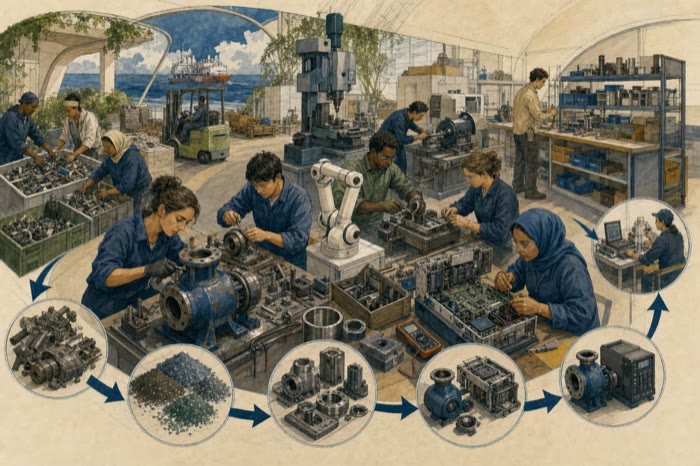
Evidence boundary: MOXIE produced oxygen from the Martian atmosphere sixteen times, totaling 122 grams, and terrestrial test programs have excavated simulants and extracted oxygen or metals through multiple candidate processes. These are real, bounded demonstrations. No off-Earth system has autonomously prospected, mined, beneficiated, refined, stored, certified, and delivered industrial feedstock at settlement scale while maintaining its own equipment. Lunar simulants reproduce selected properties; they are not lunar material or proof of performance at a particular site.
Plain-language summary
“The Moon contains oxygen” is a geological statement. “This factory has qualified oxygen, metal, glass, or ceramic available on schedule” is an industrial statement. Between them is a chain of machines, measurements, energy, people, waste streams, and uncertainty.
In-situ resource utilization—ISRU—uses material found at the place of operation rather than importing every product. It can reduce transported mass; it is not free inventory.
A responsible claim names:
- The body and specific site.
- The measured resource and uncertainty.
- The product and required purity or properties.
- Every transformation and transport step.
- Energy, water, gases, reagents, wear parts, and labor.
- Waste, losses, contamination, and environmental limits.
- Production rate, storage, reserves, and downtime.
- The evidence level achieved at the relevant scale and environment.
For a generation ship, the boundary is sharper. During interstellar cruise there may be no practical external ore body to mine. ISRU could support precursor infrastructure, Solar System construction, or destination operations, but it does not replace a closed onboard material strategy for transit.
Resource, reserve, product, and feedstock are different
A resource is material known or inferred to exist. A reserve is the economically and technically recoverable portion under stated conditions. A product is an output such as oxygen, water, iron, silicon, or aggregate. Feedstock is material characterized and prepared for a specific downstream process.
Those categories must not be collapsed. Regolith rich enough in oxygen-bearing minerals may still be:
- Buried or geographically dispersed.
- Mechanically difficult to excavate.
- Abrasive, electrostatic, or thermally extreme.
- Variable in mineralogy and grain size.
- Mixed with contaminants that poison a process.
- Expensive to heat, reduce, transport, or purify.
- Unsuitable for the properties required by the next machine.
Feedstock is relational. Powder acceptable for a construction binder may be unacceptable for laser powder-bed fusion. Oxygen suitable for an industrial furnace may not meet breathing, medical, or propellant specifications. A bulk metal may still need alloying, removal of sulfur or other impurities, casting, heat treatment, and certification.
The resource-to-feedstock chain
1. Prospect and characterize
Remote sensing narrows possibilities; representative local sampling establishes what is present. The model needs composition, mineral phases, volatiles, particle distribution, depth, mechanical properties, spatial variation, and uncertainty. A rich point measurement cannot be multiplied by an area without a justified geological model.
2. Excavate and transport
Excavation transfers reaction forces, generates dust, consumes power, and wears tools. Low gravity changes traction and material behavior; vacuum and temperature alter lubrication, heat flow, and volatile loss. Haulers, hoppers, seals, bearings, cables, and dust barriers become part of the production system.
A tonne delivered to a processor is not equivalent to a tonne disturbed at the face. Report availability, distance, grade, dilution, spillage, and downtime.
3. Beneficiate
Beneficiation separates or concentrates useful fractions before chemical extraction. It may screen by size, remove magnetic material, sort optically, separate electrostatically, crush, mill, dry, or heat.
This stage can lower downstream energy and reactor mass, but it creates its own wear, dust, rejected material, and quality-control burden. A process demonstrated with carefully prepared simulant may fail when site material is broader, more cohesive, or chemically different.
4. Extract
Extraction changes chemical form. Candidate lunar processes include reduction, electrolysis, and thermal routes to oxygen, metals, or construction material. Mars atmospheric ISRU can compress and electrolyze carbon dioxide.
The useful metric is net product after startup, purification, maintenance, and off-spec batches, divided by total energy and consumed inputs over a declared interval.
5. Purify and condition
The next process defines acceptable composition, particle size, moisture, phase, morphology, temperature, and packaging. Purification may demand multiple separation stages, high-purity reagents, filters, crucibles, electrodes, membranes, or catalysts.
Some of those inputs are small in mass and difficult to make. They are “vitamins” in the industrial metabolism. An ISRU proposal that imports all electrodes, catalysts, filters, and electronics may still be valuable, but it should report the dependency.
6. Store, distribute, and verify
Production and demand rarely align continuously. Gases may need compression, liquefaction, containment, and purity monitoring. Powders may oxidize, absorb moisture, segregate, or become hazardous. Metals require lot identity and protection from cross-contamination.
The feedstock passport should record source location, sampling, transformations, equipment state, batch genealogy, measurements, uncertainty, deviations, and authorized use. It is evidence, not magic: records can be wrong or altered and should be checked against physical assays.
7. Manage waste and disturbed sites
Tailings, rejected regolith, gases, heat, chemical residues, dust, and depleted sites are part of the mass balance. “Using local resources” does not erase environmental stewardship, planetary protection, worker exposure, cultural and scientific value, or political questions about who may appropriate a resource.
At a destination with possible life or irreplaceable scientific evidence, extraction may be prohibited or delayed. A capable system must preserve the option not to mine.
Make the mass balance visible
For a declared boundary and interval:
``text opening inventory + inputs = closing inventory + products + recoverable by-products + stored waste + releases + measurement discrepancy ``
Each term needs units and uncertainty. Flowmeters, scales, assays, tank models, and stockpile surveys disagree. The discrepancy should not be silently assigned to “recycling.”
Useful performance measures include:
- Kilograms excavated, delivered, and processed.
- Grade and spatial uncertainty.
- Product mass, purity, and qualified yield.
- Energy and peak power per unit qualified product.
- Imported consumables and replacement mass.
- Water, gas, reagent, and coolant inventories.
- Waste composition and containment.
- Availability, maintenance hours, and mean recovery time.
- Measurement uncertainty and unexplained loss.
Closure should be bounded by element and function. Recovering 99 percent of bulk oxygen does not solve a missing catalyst. Producing aluminum does not establish semiconductor-grade silicon or bearing steel.
What MOXIE demonstrated
MOXIE is the clearest off-Earth chemical ISRU demonstration to date. Aboard Perseverance, it drew in the Martian atmosphere and used solid-oxide electrolysis to produce oxygen. The peer-reviewed mission paper documents operation across different atmospheric conditions. NASA’s final record reports sixteen runs, 122 grams total production, and up to 12 grams per hour at 98 percent purity or better.
That evidence supports a specific statement: oxygen production from Martian atmospheric carbon dioxide was demonstrated on Mars at instrument scale.
It does not demonstrate:
- Continuous industrial operation.
- Liquefaction, long-term storage, or delivery.
- Breathing- or propulsion-system integration.
- Production and replacement of cells, compressors, seals, filters, electronics, or power.
- Lunar regolith processing.
- A self-maintaining settlement supply chain.
MOXIE’s value increases when the boundary is kept intact.
Simulants are test materials, not destinations
Actual lunar samples are scarce, so most engineering tests use terrestrial simulants. NASA guidance emphasizes application-specific properties, characterization, and traceability.
There is no single “lunar dirt.” Highland and mare materials differ; local impact history, grain shapes, agglutinates, glass, nanophase iron, electrostatic charging, vacuum exposure, and volatile content matter. A simulant chosen for excavation may not be appropriate for oxygen extraction or human-health testing.
Every test should state which properties the simulant represents, which it does not, its lot, preparation, and environmental conditions. Passing a bucket-wheel test in Earth gravity with one simulant is not lunar production readiness.
Autonomy, cybersecurity, and AI
Delayed communication makes autonomous planning, equipment coordination, fault detection, and resource-model updates attractive. NASA’s ISRU autonomy work explicitly maps robotic functions across prospecting, excavation, beneficiation, extraction, product storage, and delivery.
Automation does not remove assurance:
- Resource estimates must retain uncertainty and raw observations.
- Machine-learning classifications need physical samples and out-of-distribution checks.
- Production commands require bounded authority and collision/exclusion controls.
- Material passports, assay data, recipes, and calibration are cyber-physical assets.
- Safety-critical process changes require accountable review.
- Manual and degraded modes must exist when positioning, models, or networks fail.
An LLM can help retrieve procedures or compare production histories. It cannot declare an unknown deposit a reserve, invent an assay, or waive a purity limit. Generated recommendations must cite current evidence and remain subordinate to physical measurement.
Earth-first and Solar System test ladder
- Publish a reference process with a complete mass, energy, consumables, and waste boundary.
- Run variable, blinded simulant lots rather than a single prepared batch.
- Integrate excavation, transport, beneficiation, extraction, purification, storage, and product verification.
- Inject dust, abrasive wear, sensor drift, contamination, power interruption, and missing consumables.
- Demonstrate repair and return to qualified output.
- Operate in thermal-vacuum, reduced-gravity analogs, and finally an off-Earth pilot.
- Require independent resource and environmental review before scale-up.
The same discipline improves terrestrial mining, recycling, critical-material recovery, and circular-economy claims.
Evidence ledger
- L05-04-A — MOXIE produced oxygen from Martian atmospheric carbon dioxide on Mars. Basis: demonstrated. Readiness: operational as a completed instrument experiment; major scale-up for continuous production. Confidence: strong.
- L05-04-B — Lunar excavation and extraction concepts have substantial terrestrial test activity but no integrated off-Earth production chain. Basis: demonstrated. Readiness: early research. Confidence: supported across the cited NASA program sources.
- L05-04-C — Lunar simulants represent selected properties and require application-specific characterization. Basis: normative. Readiness: operational test practice. Confidence: strong.
- L05-04-D — No cited system closes prospecting through qualified feedstock while maintaining its production equipment. Basis: observed. Readiness: no known path for integrated closure. Confidence: strong for the bounded source set.
- L05-04-E — ISRU claims require declared mass balance, uncertainty, imported consumables, waste, storage, and environmental boundaries. Basis: normative. Readiness: operational as an accounting practice; early research as an integrated off-Earth assurance system. Confidence: strong.
Linked corpus claims: claim-14-03, claim-14-04, claim-14-05, claim-14-06, claim-14-10, and claim-05-10. See the claim registry for each record's current evidence grade and independent-review state.
Assumptions and limits
- No target body, site, ore grade, production rate, process, population, or product specification is selected.
- ISRU during interstellar cruise is not assumed; external material access would require a separately defined architecture.
- MOXIE results apply to its Mars instrument, operating conditions, and oxygen product.
- Simulant tests do not validate local geology or reproduce every environmental property simultaneously.
- Resource use remains subject to environmental, scientific, legal, labor, safety, and governance review.
- AI is advisory and evidence-linked; no generic chatbot or autonomous resource-appropriation authority is proposed.
What would change this conclusion?
An off-Earth pilot that prospectively predicts a deposit, excavates variable native material, produces and stores a specified product, reports complete mass and energy balance, survives faults, and restores qualified output after maintenance would advance readiness. Long-duration evidence must also show that catalysts, electronics, filters, wear parts, and calibration can be replenished. Discovery of harmful contamination, unacceptable environmental impact, poor grade, or unstable supply must be allowed to move the gate to wait, import material, choose another site, or do not extract.
Sources and locators
- S01 — Hoffman et al., Mars Oxygen ISRU Experiment—Preparing for Human Mars Exploration (opens external site in a new tab). Locator: instrument architecture, solid-oxide electrolysis, operating conditions, initial Mars results, and scale-up boundary; *Science Advances* 8(35), 2022; accessed 2026-07-25.
- S02 — NASA/JPL, MOXIE Completes Mars Mission (opens external site in a new tab). Locator: sixteen runs, 122 grams total oxygen, peak 12 grams per hour, purity, and missing liquefaction/storage system; September 6, 2023, updated June 22, 2026; accessed 2026-07-25.
- S03 — Sanders and Kleinhenz, Overview of NASA ISRU Plans, Priorities, and Activities (opens external site in a new tab). Locator: water and oxygen mining, metal/feedstock development, resource assessment, system integration, and end-to-end pilot priorities; NASA technical-management-reviewed presentation, 2022; accessed 2026-07-25.
- S04 — Sanders, Autonomy and Robotics Needed for Integrated ISRU Operations (opens external site in a new tab). Locator: functions across prospecting, excavation, transport, beneficiation, extraction, product handling, coordination, and maintenance; NASA technical presentation, 2024; accessed 2026-07-25.
- S05 — Slabic et al., Lunar Regolith Simulant User’s Guide, Revision A (opens external site in a new tab). Locator: simulant selection, lunar-material variability, properties, applications, limitations, and periodic revision; NASA/TM-20240011783, October 2024; accessed 2026-07-25.
- S06 — Sibille et al., Lunar Regolith Simulant Materials (opens external site in a new tab). Locator: need for common, traceable, repeatable simulant characterization, production, and distribution; NASA/TP-2006-214605, September 2006; accessed 2026-07-25.
- S07 — NASA-STD-1008, Classifications and Requirements for Testing Systems and Hardware to be Exposed to Dust in Planetary Environments (opens external site in a new tab). Locator: dust classes, simulant selection, facility conditions, documentation, and test requirements; active baseline dated 2021-08-21; accessed 2026-07-25.
- S08 — NASA-STD-6030, Additive Manufacturing Requirements for Spaceflight Systems (opens external site in a new tab). Locator: feedstock control, reuse, contamination, machine/process qualification, witness material, inspection, and acceptance; active baseline dated 2021-04-21; accessed 2026-07-25.
Editorial record
- Prepared by: GShips Project
- Last edited: 2026-07-25
- Status: Substantive editorial draft
- Independent domain review: Pending
- Required review: ISRU, extractive metallurgy, planetary geology, materials characterization, mining systems, environmental governance, and mass-balance assurance
- Reviewer: No independent reviewer assigned
- Conflicts: Maintainer intends to explore a commercial venture based on some GShips work; no entity, funding, customer, sponsor, or partner relationship currently exists
- Corrections: Suggest a correction