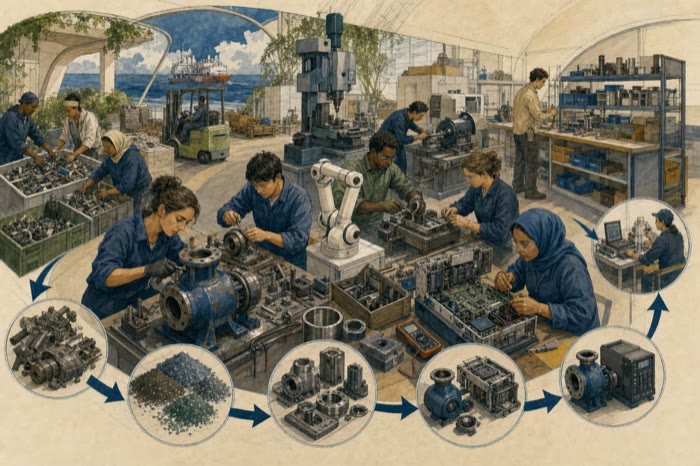
Evidence boundary: Astronauts have assembled and repaired the International Space Station and serviced the Hubble Space Telescope; robotic missions have demonstrated narrower inspection, docking, life-extension, and manipulation functions. NASA has formal reliability and maintainability practices, and terrestrial industry uses condition monitoring and reliability-centered maintenance. These are relevant demonstrations, not evidence that a habitat can renew all life-critical machinery, materials, software, calibration, and skill for centuries without Earth.
Plain-language summary
A machine can be reliable for a mission and still be unsuitable for a society.
Conventional spacecraft are usually designed for a defined service life. Some components are redundant; others are replaced from stock or supported by specialists and suppliers on Earth. A generation ship would eventually lose that supplier base. Its central maintenance question is not “How long does this pump last?” but “Can this society repeatedly recognize degradation, restore the pump’s function, verify the repair, replenish what the repair consumed, and preserve the ability to do it again?”
That recurring cycle resembles metabolism. A living body detects damage, moves resources, removes waste, and renews tissue. An industrial habitat needs an engineered version:
observe → diagnose → decide → isolate → restore → verify → return → recover material → learn
If any link depends permanently on a sealed box, a forgotten craft, an Earth server, or a consumable that cannot be replaced, the loop is open.
Reliability is not immortality
Reliability asks whether a system performs as required for a stated time and environment. Maintainability asks how safely and effectively it can be restored. Availability depends on both, plus logistics and operations.
A high-reliability component can still be a poor choice when:
- Its failure is rare but impossible to diagnose locally.
- Opening it destroys calibration or containment.
- Its replacement needs a proprietary tool or expired chemical.
- The repair requires a skill held by one person.
- The spare silently ages in storage.
- Its firmware, test fixture, or interface can no longer run.
- It shares a hidden failure mode with every redundant copy.
NASA-STD-8729.1 requires reliability and maintainability planning across a program lifecycle. NASA guidance treats access, fault isolation, testability, training, and restoration as design concerns. A generation-scale case must extend the time horizon, close the supply loop, and include people born after the original design.
The maintenance metabolism
1. Observe condition
Scheduled inspection remains useful, but calendar replacement alone wastes scarce parts and can introduce maintenance errors. Reliability-centered maintenance asks what functions matter, how they fail, what consequences follow, and which inspection or intervention is effective.
Useful signals include vibration, current, temperature, pressure, leakage, chemical composition, acoustic emission, dimensional change, lubricant debris, radiation dose, software errors, and operator observation. No sensor is neutral: it drifts, needs power, has a sampling limit, and can fail in the same environment as the equipment it watches.
The design therefore needs independent observations and test points. “The digital twin says healthy” is not evidence if the twin receives one biased sensor and has never been updated after modification.
2. Diagnose the function, not only the part
A failed air-circulation function might involve a motor, bearing, impeller, duct obstruction, inverter, breaker, controller, power-quality problem, sensor, or malicious command. Replacing the motor because an error code names it can consume the wrong spare while leaving the cause.
Diagnosis should preserve hypotheses, uncertainty, evidence, and counterevidence. Procedures need branches for unknown configurations and novel faults. Maintainers should be able to reproduce tests and compare physical measurements with the current requirements baseline.
3. Decide and isolate
Maintenance changes risk. Taking a machine offline can endanger life support; keeping it online can worsen damage. An architecture should identify the authority to isolate equipment, the people affected, compensating functions, maximum safe outage, and stop-work rights.
Physical and digital lockout must be possible. A controller should not unexpectedly restart a machine while someone is inside it. Equally, an attacker or governance faction should not be able to misuse maintenance authority to deny air, water, medical service, or mobility.
4. Restore capability
Restoration may mean adjustment, cleaning, lubrication, software rollback, component replacement, machining, joining, rewinding, remanufacture, or controlled cannibalization. Additive manufacturing is one method among many. Bearings need surfaces and heat treatment; seals need controlled polymers; electronics need components and workmanship; pressure hardware needs joining, inspection, and proof.
The replacement part is only one output. The loop also consumes staff time, energy, inert gas, solvents, abrasives, cutting tools, filters, shielding, fixtures, and calibration capacity. Those inputs belong in the material and power budgets.
5. Verify before return
A part that fits is not necessarily trustworthy. Verification may include dimensional inspection, electrical test, leak test, balancing, nondestructive evaluation, pressure proof, software checks, cleanliness, material identification, or a controlled load run.
NASA’s additive-manufacturing standard illustrates the depth of qualification expected for flight hardware: feedstock control, process definition, machine qualification, witness material, inspection, acceptance, and configuration control. Tailoring is anticipated for in-space work; the standard does not certify a future onboard factory. It demonstrates why “print the spare” is not a complete safety case.
6. Recover and learn
The removed component is evidence and inventory. It should be examined for root cause, preserved when needed, and otherwise separated into recoverable material streams. The repair record must update remaining-life estimates, spares forecasts, procedures, training scenarios, and design changes.
Learning also needs a social path. Apprentices should perform real work under supervision before an expert generation retires. Documentation must stay legible across language and interface changes. People with diverse bodies and abilities need access to workstations, lifting aids, protective equipment, and technical careers.
What has actually been demonstrated?
The 2025 NASA ISAM State of Play distinguishes servicing, assembly, and manufacturing capabilities. Crewed Hubble servicing and ISS assembly and maintenance show that people can inspect, replace, upgrade, and reconfigure complex space hardware with extensive Earth support. Robotic servicing is less mature and has been demonstrated on only a small number of missions.
NASA’s 2025 In-Space Manufacturing Portfolio Plan documents polymer printing and recycling, metal and electronic manufacturing research, welding, biomanufacturing, and supporting inspection. It also records negative evidence: the ISS Refabricator did not complete its planned recycling demonstration and was returned to Earth; post-flight inspection implicated filament breakage and foreign-object debris. That result is valuable. A serious program learns more from the broken loop than from a promotional claim that recycling “will” close it.
GAO’s 2025 technology assessment similarly concludes that robotic ISAM is mostly unproven in space, with few test opportunities and emerging standards. These sources justify a test program. They do not justify assuming autonomous repair is solved.
Spares are a portfolio
No single inventory strategy is sufficient:
- Direct spares restore known high-risk units quickly but age and consume mass.
- Common modules simplify training and stock but can create common-cause failure.
- Piece parts support board- and mechanism-level repair but require diagnostic and workmanship skill.
- Feedstock is flexible only when appropriate processes, tooling, recipes, and qualification exist.
- Cannibalization recovers scarce parts but can destroy future options and should be governed transparently.
- Design modification may remove an unavailable part, but creates a new verification burden.
Spares planning should track consequence, replacement time, shelf life, storage, repair yield, and replenishment. A century stockpile of identical electronics may be less resilient than repairable controllers with open interfaces and migration paths.
AI can assist the loop but cannot close it
Condition-monitoring models can find anomalies, compare spectra, forecast demand, and search a large maintenance record. An offline language model can retrieve controlled procedures, translate legacy explanations, or help a maintainer enumerate hypotheses.
The boundaries must be strict:
- Generated instructions cite the current approved procedure and configuration.
- Measurements remain distinguishable from inference.
- Model suggestions never erase dissenting observations.
- Safety-critical isolation and return-to-service require accountable human and deterministic checks.
- Training data, model weights, retrieval indexes, and maintenance files are treated as supply-chain artifacts.
- Teams repeatedly practice with the model absent, corrupted, or confidently wrong.
Onboard manufacturing turns cybersecurity into physical assurance. A changed toolpath, calibration file, material passport, or inspection threshold can create a part that appears correct and fails later. Secure update, access control, provenance, two-person review for critical changes, and independent measurement are maintenance controls, not optional IT features.
A representative test
A serious maintenance test should run long enough for deterioration and organizational turnover to matter. Give a mixed crew a bounded habitat and factory with declared inventories. Inject tool wear, a drifting sensor, contaminated feedstock, an obsolete controller, loss of an expert, a compromised work instruction, and an unexpected cross-system dependency.
Success is not “the broken part was printed.” It is:
- The functional loss was detected before unacceptable harm.
- Diagnosis separated observation from assumption.
- Isolation preserved safety and rights.
- Restoration used declared tools and consumables.
- The repaired system passed an independent acceptance test.
- Waste and removed material were accounted for.
- The record changed future maintenance and training.
- A later crew could repeat the work without the original experts.
Remote communities, hospitals, research stations, utilities, and disaster-response systems could use the same evidence.
Evidence ledger
- L05-02-A — Reliability and maintainability are lifecycle disciplines rather than end-of-design repair instructions. Basis: normative. Readiness: operational in NASA and terrestrial programs. Confidence: strong within those program boundaries.
- L05-02-B — Crewed servicing and maintenance have restored and upgraded complex assets in orbit. Basis: demonstrated. Readiness: operational for selected missions with Earth support. Confidence: strong.
- L05-02-C — Robotic ISAM and in-space recycling remain limited and uneven; the Refabricator did not complete its planned closed-loop demonstration. Basis: observed. Readiness: early research. Confidence: strong for the cited program record.
- L05-02-D — A generation ship requires an end-to-end renewal loop including diagnosis, fabrication, verification, material recovery, and skill continuity. Basis: normative. Readiness: breakthrough-dependent. Confidence: supported as a whole-system requirement.
- L05-02-E — AI-supported maintenance requires provenance, bounded authority, independent measurements, and an AI-off recovery path. Basis: normative. Readiness: early research for life-critical autonomous use. Confidence: strong about the boundary; tentative about future implementations.
Linked corpus claims: claim-14-01, claim-14-04, claim-14-07, claim-14-08, claim-14-10, and claim-12-07. See the claim registry for each record's current evidence grade and independent-review state.
Assumptions and limits
- No failure-rate model, crew size, mission duration, inventory, or repair yield is selected.
- ISS and Hubble results include extensive Earthside engineering, logistics, communications, and replacement hardware.
- Reliability-centered maintenance does not eliminate scheduled maintenance or justify operating damaged equipment.
- Additive manufacturing is treated as one process in a larger factory and qualification chain.
- Cannibalization and maintenance prioritization have rights and governance consequences not resolved here.
- AI tools remain advisory; no generic chatbot or autonomous return-to-service authority is proposed.
What would change this conclusion?
A multi-year closed test would improve readiness if it preserved critical functions through real degradation, consumed only declared stocks and feedstock, rebuilt its own maintenance tools, qualified safety-critical repairs, survived expert turnover and cyber fault injection, and published failures as well as successes. Evidence that essential catalysts, electronics, calibration, or skills cannot be regenerated should narrow the mission duration or force a wait/do-not-launch decision rather than be hidden inside “future maintenance.”
Sources and locators
- S01 — NASA-STD-8729.1A, Reliability and Maintainability Standard (opens external site in a new tab). Locator: reliability and maintainability objectives, planning, analyses, verification, and lifecycle evaluation; active standard dated 2017-06-13; accessed 2026-07-25.
- S02 — NASA TM-4628, Recommended Techniques for Effective Maintainability (opens external site in a new tab). Locator: design access, testability, fault isolation, handling, standardization, maintenance analysis, demonstration, training, and operations; December 1994; accessed 2026-07-25.
- S03 — NASA, In-Space Servicing, Assembly, and Manufacturing State of Play, 2025 Edition (opens external site in a new tab). Locator: definitions and eleven capability areas; ISS, Hubble, Mission Extension Vehicle, robotic servicing, inspection, repair, and manufacturing status; NASA peer committee review, 2025; accessed 2026-07-25.
- S04 — NASA, In-Space Manufacturing Portfolio Plan (opens external site in a new tab). Locator: manufacturing portfolio and maturation paths; Refabricator outcome, filament breakage, foreign-object debris, and return to Earth; 2025; accessed 2026-07-25.
- S05 — U.S. GAO, In-Space Servicing, Assembly, and Manufacturing (opens external site in a new tab). Locator: demonstrated crewed servicing, limited robotic demonstrations, test-access and standards gaps; GAO-25-107555, July 10, 2025; accessed 2026-07-25.
- S06 — NASA-STD-6030, Additive Manufacturing Requirements for Spaceflight Systems (opens external site in a new tab). Locator: sections 4–7 on part classification, process control, feedstock, qualification, witness material, inspection, acceptance, and configuration; active baseline dated 2021-04-21; accessed 2026-07-25.
- S07 — NIST SP 800-82 Revision 3, Guide to Operational Technology Security (opens external site in a new tab). Locator: OT architectures, safety and availability constraints, threats, segmentation, maintenance access, and countermeasures; September 2023; accessed 2026-07-25.
- S08 — NIST AI 600-1, Generative AI Profile (opens external site in a new tab). Locator: confabulation, information-integrity, human-AI configuration, evaluation, and incident-disclosure risks; July 2024; accessed 2026-07-25.
Editorial record
- Prepared by: GShips Project
- Last edited: 2026-07-25
- Status: Substantive editorial draft
- Independent domain review: Pending
- Required review: reliability and maintainability, space servicing, industrial maintenance, human factors, manufacturing, safety assurance, and operational-technology cybersecurity
- Reviewer: No independent reviewer assigned
- Conflicts: Maintainer intends to explore a commercial venture based on some GShips work; no entity, funding, customer, sponsor, or partner relationship currently exists
- Corrections: Suggest a correction