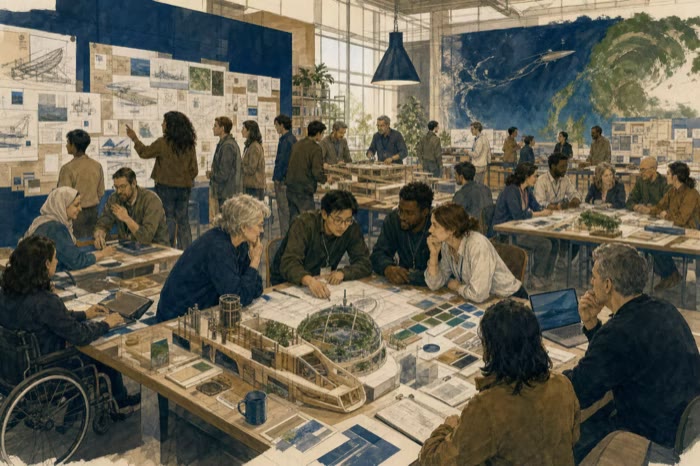
Evidence boundary: This is a cited substantive editorial draft, not an independently reviewed analog program or a human-subjects protocol. The facilities below test different slices under Earth conditions. Their inclusion does not imply partnership, endorsement, access, or that any result transfers unchanged to space.
Plain-language summary
An analog is useful when it makes one important part of the real problem observable at lower cost and risk. It becomes misleading when surface resemblance—an isolated crew, a sealed building, a harsh landscape—is treated as proof that a much larger system will work.
NASA’s first CHAPEA crew completed 378 days in a 1,700-square-foot Mars-simulation habitat. The exercise included resource limits, isolation, delayed communications, maintenance, crop work, and simulated surface operations. ESA uses the remote Concordia station to study isolation, darkness, disrupted sleep, hypoxia, and small multicultural teams. Biosphere 2 exposes researchers to large controlled ecosystems and unusually visible energy and water infrastructure. HERA runs shorter controlled isolation campaigns. The International Space Station supplies real microgravity, radiation, spacecraft operations, life support, resupply, and emergency experience.
None combines centuries of duration, children and aging, no rescue, no resupply, industrial renewal, interstellar hazards, institutional succession, and an unknown destination. The right question is not “Which analog is most like a generation ship?” It is “Which claim does this analog test, under what boundary, and what harder test follows?”
An analog is a model with people and hardware
Every analog has at least six boundaries:
- Environment: gravity, radiation, pressure, atmosphere, temperature, lighting, microbial exposure, and surrounding infrastructure.
- Duration: hours, months, a year, or repeated campaigns—not merely the date range, but the number of maintenance and social cycles exercised.
- Scale: people, floor area, mass flows, equipment count, ecological diversity, and organizational complexity.
- Intervention: rescue, resupply, remote advice, spare parts, medical evacuation, and researchers changing the protocol.
- Fidelity: what is physical, what is simulated, what is scripted, and what is absent.
- Measurement: preregistered outcomes, sensor coverage, participant reports, failure logging, missing data, and publication access.
An analog result should be written as a bounded conditional:
Under these stated conditions, for this duration and group, the observed system produced these outcomes while receiving these interventions.
It should not be written as “Mars living works” or “closed ecosystems are feasible.” Those conclusions are larger than the test.
What the major analog families can teach
CHAPEA and HERA: controlled human-performance campaigns
NASA describes CHAPEA as a series of year-long Mars-surface simulations with four-person crews. Mission 1 ran from June 25, 2023 through July 6, 2024. Mission 2 began October 19, 2025. The program can impose workloads, equipment faults, restricted resources, communication delay, exercise, hygiene, maintenance, crop growth, and private-quarters conditions while collecting structured health and performance data.
That makes CHAPEA valuable for questions about schedule design, food acceptability, task conflicts, resource decisions, communication latency, team process, and maintenance workload. It is weak evidence for gravity effects, radiation, spacecraft atmosphere, ecological closure, manufacturing, pregnancy, childhood, lifetime medicine, or a society containing thousands of people. Participants know they are on Earth; safety staff and external infrastructure exist even when operational communication is deliberately delayed.
HERA offers shorter, repeatable controlled campaigns. Shorter runs can be a strength when the research needs replication, controlled protocol changes, or rapid iteration. They are not long-duration evidence simply because the habitat looks spacecraft-like.
Concordia: real isolation, logistics, darkness, and maintenance
Concordia is a French–Italian Antarctic research station used by ESA for human research. Winter conditions can isolate a crew for months, with extreme cold, darkness, altitude-related hypoxia, small-team interdependence, and real responsibility for maintaining an inhabited station. Unlike a scripted habitat fault, Antarctic weather and logistics have consequences that participants cannot switch off.
Concordia can inform sleep, mood, cognition, group dynamics, remote medicine, winter-over selection, supplies, maintenance, and handover. It also confounds variables: hypoxia, cold, darkness, volunteer selection, national programs, and Earth-normal gravity occur together. A result from a small adult crew cannot establish outcomes for children, disabled residents, pregnancy, old age, or a culturally diverse city.
Biosphere 2 and MELiSSA: coupled ecological and process evidence
Biosphere 2 is now a research user facility with systems including the Landscape Evolution Observatory, rainforest, ocean, agrivoltaics, and the Space Analog for the Moon and Mars. Its published facility information also makes a crucial boundary visible: the enclosed research complex depends on substantial external energy and thermal infrastructure. “Airtight” is not synonymous with energetically closed, materially self-sufficient, or autonomous.
ESA’s MELiSSA program decomposes regenerative life support into compartments for organic-waste processing, carbon removal, nitrification, photosynthetic food and oxygen production, higher plants, and crew demand. This process-oriented approach is useful because it exposes streams and unit operations instead of treating “nature” as a black box. Its pilot plants and organisms are evidence about particular loops, not a demonstrated permanent human ecosystem.
Both point toward a better metric than a single recycling percentage: a time series of every imported, exported, stored, accumulated, vented, discarded, and biologically transformed material, plus energy, labor, sensors, replacement parts, and external expertise.
The International Space Station: flight evidence with a supply chain
The ISS provides operational evidence in microgravity. NASA reported a system-level water-recovery milestone near 98 percent after adding a brine processor, while its broader ECLSS description emphasizes filters, catalytic processing, sensors, electrolysis, carbon-dioxide removal, and continuing hardware support.
The milestone is important and bounded. Water recovery is not food closure, nutrient closure, industrial closure, or zero maintenance. A percentage also hides inventory, contaminant buildup, consumables, off-nominal events, reject streams, crew labor, spares, and resupply. The ISS is a continuously supported orbital laboratory, not a detached civilization.
Build an analog portfolio, not a champion
No single facility should carry the validation burden. A useful portfolio assigns different claims to different test environments:
- Component rigs characterize membranes, catalysts, bearings, crops, sensors, and fault behavior.
- Human-in-the-loop habitats test workload, interfaces, privacy, handover, maintenance, and emergency procedures.
- Ecological facilities test coupled material cycles, community dynamics, contamination, and recovery.
- Remote stations test real logistics, isolation, local authority, medical escalation, and winter-over maintenance.
- Orbital platforms test microgravity, radiation, vacuum interfaces, spacecraft operations, and limited resupply.
- Industrial plants test throughput, quality control, tooling, contamination, operator training, and economic maintenance.
- Communities and critical infrastructure test whether resilience work produces present public value.
An evidence graph should show exactly which requirement each experiment touches. If an experiment is described only as “generation-ship research,” it is probably too vague to evaluate.
A transfer ledger
For every result, record:
- claim tested and requirement identifier;
- analog environment and omitted hazards;
- participant or system population and selection;
- duration, duty cycles, and interruptions;
- external power, water, data, personnel, spares, and rescue;
- planned versus unplanned interventions;
- failure chronology and recovery;
- measurement uncertainty and missing data;
- adverse events and participant protections;
- whether the result replicated;
- what cannot be inferred;
- the next harder, still-reversible test.
The transfer factor is not a single number. It is a structured argument. A maintenance procedure may transfer well from a submarine or chemical plant even when the social environment does not. A crew-cohesion observation may transfer poorly from four carefully selected adults to a multigenerational population. A closed-loop mass balance may transfer only after gravity, organism, temperature, and scale effects are retested.
Failure is an output
Analog programs are vulnerable to branding pressure. A dramatic habitat, crew patch, countdown, and “mission” narrative can make the experiment feel more successful than its measurements justify. Sponsors and facilities may fear that publishing faults will hurt future funding.
A responsible program reverses that incentive:
- preregister important measures and stopping rules;
- publish protocol deviations and rescue interventions;
- separate participant safety decisions from performance scoring;
- preserve raw-enough data for lawful reanalysis;
- reward fault discovery and negative results;
- disclose conflicts and facility relationships;
- allow independent reviewers to challenge transfer claims;
- avoid ranking crews as morally fit or unfit for future settlement.
Human-subjects research requires ethics review, consent, privacy, withdrawal protections, and careful handling of identifiable health and behavior data. “The mission needs it” does not waive those duties.
Evidence ledger
- L12-01-A — Present analogs cover different slices. Basis: observed institutional programs. Readiness: operational at their stated scales. Confidence: strong that the programs exist; transfer remains claim-specific. Support: NASA CHAPEA and ECLSS, ESA Concordia and MELiSSA, Biosphere 2.
- L12-01-B — No single analog validates a generation ship. Basis: modeled systems comparison. Readiness: operational as an evidence-policy rule. Confidence: strong because every reviewed analog omits multiple defining conditions.
- L12-01-C — External interventions must be counted. Basis: observed operations and normative verification practice. Readiness: operational. Confidence: strong.
- L12-01-D — Negative results improve the proof ladder. Basis: normative research policy supported by verification practice. Readiness: operational when governance and publication terms permit. Confidence: supported; incentive effects require continued study.
- L12-01-E — Human analogs do not authorize coercive selection. Basis: normative rights boundary. Readiness: operational as project policy. Confidence: strong as a GShips red line; independent ethics review remains required.
Linked corpus claims: claim-18-01, claim-18-02, claim-18-05, and claim-18-10. See the claim registry for each record's current evidence grade and independent-review state.
Assumptions and limits
- Official program descriptions are used to establish scope, not to independently validate unpublished outcomes.
- Facility pages can emphasize intended value; peer-reviewed results and protocols should be checked claim by claim.
- The lesson does not evaluate participant medical risk or recommend enrollment.
- Analog populations are generally small and selected, limiting generalization.
- Earth gravity, rescue, law, supply chains, and outside expertise remain available in ways a stellar vehicle may not share.
- No analogy substitutes for flight evidence, and no flight evidence substitutes for multigenerational evidence.
What would change this conclusion?
A replicated analog program combining long duration, materially accountable ecology, autonomous industry, mixed-age residents, genuine communication delay, constrained rescue, transparent fault injection, independent ethics, and open failure reporting would strengthen transfer across several domains. A sustained Solar System habitat could add flight evidence. Neither would make one facility sufficient. Evidence that a cheaper test answers a claim better should redirect work away from a more theatrical analog.
Sources and locators
- NASA — About CHAPEA (opens external site in a new tab). Locator: goals, habitat, mission schedule, stressors, and research scope; accessed 2026-07-25.
- NASA — First Mars Crew Completes Yearlong Simulated Red Planet Mission (opens external site in a new tab). Locator: 378-day Mission 1, four-person crew, operations, resource limits, and communication delay; accessed 2026-07-25.
- ESA — Isolation studies in Antarctica (opens external site in a new tab). Locator: isolation, sleep, hypoxia, small-team, and countermeasure research at Concordia; accessed 2026-07-25.
- Biosphere 2 — User Facility Information (opens external site in a new tab). Locator: research systems, access model, durations, and user-program boundary; accessed 2026-07-25.
- Biosphere 2 — Energy and Water (opens external site in a new tab). Locator: external power, cooling, heating, and water-system figures; accessed 2026-07-25.
- ESA — MELiSSA Closed Loop Compartments (opens external site in a new tab). Locator: five compartments, unit functions, and incomplete waste conversion; accessed 2026-07-25.
- NASA — ISS Water Recovery Milestone (opens external site in a new tab). Locator: 98-percent system goal, brine processor, treatment chain, and prior recovery range; accessed 2026-07-25.
- NASA Systems Engineering Handbook (opens external site in a new tab). Locator: product verification, product validation, intended environment, stakeholder expectations, and captured evidence; NASA/SP-2016-6105 Rev 2.
Editorial record
- Prepared by: GShips Project
- Last edited: 2026-07-25
- Status: Substantive editorial draft
- Independent domain review: Pending
- Required review: analog research, human factors, closed ecology, reliability, systems verification, and research ethics
- Reviewer: No independent reviewer assigned
- Conflicts: Maintainer intends to explore a commercial venture based on some GShips work; no entity, funding, customer, sponsor, partner, or analog-facility relationship currently exists
- Corrections: Suggest a correction