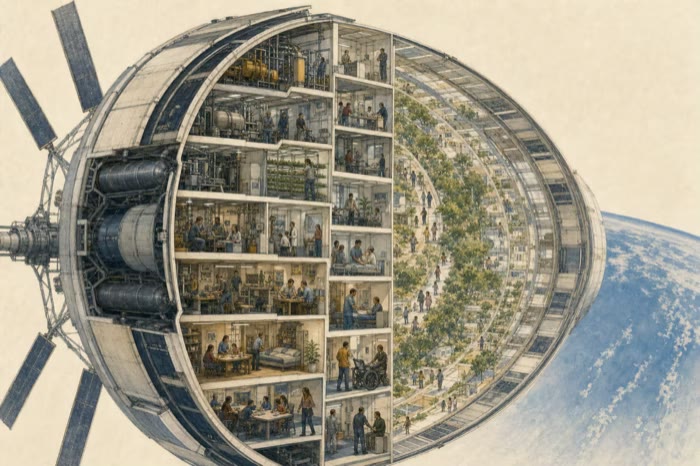
Evidence boundary: No model can forecast centuries of propulsion, politics, ecology, or human choice with decision-grade confidence. The overtaking calculations discussed here are conditional mathematical models, not instructions to wait forever or permission to send a slow population into an irreversible voyage. Torpor, embryo missions, uploading, and faster-than-light travel are not demonstrated alternatives.
Plain-language summary
A later, faster spacecraft could leave after a slow one and arrive first. That is the overtaking problem.
It matters because a centuries-long mission can expose generations to risk while future technology makes the original journey unnecessary. But “wait for something better” can also become an excuse for never testing anything. The answer is not one prediction. It is a recurring comparison of alternatives using current evidence and explicit values.
The choice set must remain larger than “launch now” or “launch later.” It includes robotic probes, Solar System habitats, faster propulsion research, torpor, Earth resilience, staying in mobile habitats, and deliberate non-expansion. Every alternative has different benefits, burdens, and uncertainties.
The overtaking arithmetic
Suppose a target is distance D away. A mission launched now at speed v0 has an ideal cruise time D / v0. A later mission waits w years, then travels at improved speed v(w). It arrives after w + D / v(w).
The later mission arrives first when:
w + D / v(w) < D / v0
That equation is simple. Predicting v(w) is not.
Kennedy’s “wait calculation” and Heller’s relativistic extension model speed growth and seek a minimum of waiting time plus travel time. Heller used historical transport-speed data and exponential growth assumptions, then showed that results depend on target distance and growth model; in the analyzed relativistic treatment, the minimum can disappear for nearby targets.
The important lesson is conditionality:
- Past vehicle speed growth is not guaranteed to continue.
- Propulsion speed, payload mass, braking, safety, energy, and readiness do not improve at one common rate.
- A gram-scale flyby and a settlement-scale habitat are different curves.
- Political delay, construction time, and infrastructure readiness may dominate propulsion.
- Later arrivals do not undo the lives and constraints experienced aboard the earlier ship.
The overtaking model is a useful question generator, not a launch rule.
Overtaking is more than arriving first
Imagine a slow habitat is passed by a later probe. That may improve reconnaissance without making the inhabited mission obsolete. Imagine it is passed by a faster settlement mission. The first population still exists and retains rights; it cannot be treated as a failed prototype.
An architecture must ask:
- Can information, supplies, or braking infrastructure catch the first vehicle?
- Can the slow vehicle safely change target or remain mobile?
- What happens if the later mission reaches the target and discovers indigenous life?
- Does the later society claim priority or authority?
- Can either population decline settlement?
- Who bears the risk created by duplicated or incompatible infrastructure?
“Obsolescence” is a property of equipment and plans, not a status that cancels people.
Alternative 1: robotic probes
Robotic probes avoid the reproductive, childhood, confinement, civil-governance, and multigenerational life-support burdens of crewed transport. They can characterize stars, planets, dust, radiation, communications, and arrival environments. They can fail without trapping a society.
Probes are not harmless by definition. They still raise contamination, dual-use, debris, target-interference, and governance risks. The Outer Space Treaty’s Article IX establishes present duties concerning harmful contamination, due regard, and consultation, while COSPAR provides current planetary-protection policy.
The evidence advantage is substantial: a sequence of probes can reduce uncertainty before human commitment. A probe-first presumption should therefore be the default for a poorly known destination. That is a normative priority informed by lower rights burden, not a physical law.
Alternative 2: Solar System habitats
Habitats around Earth, the Moon, asteroids, or other Solar System locations could test many enabling systems with shorter communication delay and some possibility of resupply, rescue, return, or independent inspection.
They can generate evidence about:
- Regenerative air and water systems.
- Food production and ecological fault recovery.
- Artificial gravity and habitat form.
- Maintenance, manufacturing, metrology, and spares.
- Long-delay operations and offline knowledge.
- Privacy, accessibility, work, law, and resource governance.
They do not directly validate centuries of operation, interstellar dust at high relative speed, irreversible separation, or governance through birth and death over multiple generations. A Solar System habitat is a testbed and possible desirable destination in its own right—not merely a stepping stone.
Alternative 3: wait while learning
Waiting can preserve the chance to use improved propulsion, better destination observations, stronger institutions, or safer alternatives. It can also reveal that no crewed mission is warranted.
Productive waiting has a program:
- Observe nearby systems and biosignatures.
- Send increasingly capable probes.
- Test braking before scaling acceleration.
- Demonstrate habitat functions where help remains possible.
- Build rights, environmental, security, and review institutions.
- Set expiration dates on assumptions and decisions.
Passive waiting assumes progress will arrive on its own. Productive waiting buys evidence and keeps choices open.
Alternative 4: faster propulsion
Faster travel can reduce exposure duration and the number of generations in transit, but it raises or relocates energy, momentum, heat, shielding, braking, infrastructure, and dual-use burdens.
NASA’s assessment of propulsion breakthroughs reported that no breakthrough appeared imminent and described the difficulty of choosing research when goals extend beyond known capability. NASA’s 2020 interstellar-technology assessment similarly treats high-fraction-of-light-speed propulsion as a severe large-mass constraint and identifies breakthrough work as a remote possibility suitable for feasibility study.
Research is justified when its evidence level is honest. A paper model, laboratory effect, component test, robotic demonstration, and crew-rated system must never share the same readiness label.
Waiting for faster propulsion is not automatically better if the enabling infrastructure causes unacceptable harm, the destination remains unknown, or speed eliminates useful reconnaissance and braking margins.
Alternative 5: torpor or radical longevity
Torpor could reduce living volume, consumables, or awake-time burden for a Mars-scale transit if safe cycling were demonstrated. NASA TechPort records a completed NIAC concept study at TRL 3 based on non-cryonic torpor. It does not establish years or centuries of stasis, autonomous intensive care, reliable awakening across varied bodies, reproduction after stasis, or informed consent for people who cannot revoke it while unconscious.
Radical life extension would change who experiences a long voyage, not automatically solve ecology, maintenance, radiation, governance, or the right to exit. Both belong in medical and ethical research with ordinary near-term health benefit, not in a mission baseline before evidence exists.
Alternative 6: embryo, artificial-gestation, and digital missions
An embryo mission proposes stored reproductive material, artificial gestation, and machine-led childhood at the destination. Each link is unvalidated as a complete system. The architecture concentrates power over identity, guardianship, genetic selection, disability, culture, and consent.
A digital-person or upload concept depends on unresolved scientific and philosophical questions about consciousness, identity, copying, embodiment, and rights. Moving data is demonstrated. Moving a person by copying data is not.
These are distinct speculative proposals. Their small launch mass cannot be counted as feasibility while their human and institutional assumptions are omitted.
Alternative 7: Earth resilience
The same attention and capital can be applied directly to clean water, food security, health systems, energy resilience, climate adaptation, disability access, education, peace, and accountable institutions.
Earth investment is not a consolation prize. It may be the highest-value response to the risks used to justify space settlement. A generation-ship research project must compare its claimed terrestrial benefit with direct alternatives and publish opportunity cost.
The burden of proof rises when a proposal invokes catastrophe. Preventing or reducing the catastrophe may help more people, sooner, without imposing a permanent voyage on descendants.
Alternative 8: deliberate non-expansion
A society may decide not to send people to another star. Reasons can include:
- Lack of legitimate authority.
- Unresolved rights or coercion.
- Credible indigenous life.
- Planetary-protection duties.
- Environmental or dual-use risk.
- Unacceptable opportunity cost.
- A preference for robotic science.
- Satisfaction with life on Earth or in the Solar System.
Non-expansion is not technical failure. It is a possible ethical and political choice. The ability to choose it must remain real, not ceremonial.
Compare alternatives on common dimensions
A decision dossier should compare each option using the same questions:
- What goal does the option serve?
- Who benefits and who bears risk?
- Which capabilities are observed, demonstrated, modeled, proposed, or unknown?
- What rights burden does it create?
- What environmental and contamination pathways exist?
- What dual-use capabilities are developed?
- How reversible is the next step?
- What rescue, return, and refusal options remain?
- What is the full lifecycle cost and opportunity cost?
- What new evidence would cause launch, wait, redirect, stop, or abandonment?
Mandatory rights, safety, and planetary-protection criteria should not be traded against speed or prestige through a weighted average.
A recurring decision, not a final ladder
Alternatives must be rerun at every major stage. The preferred option can change when:
- A target atmosphere or biosignature is measured.
- A propulsion or braking test fails.
- A habitat shows a correlated ecological failure.
- A rights-preserving governance model cannot be demonstrated.
- A better probe becomes possible.
- Direct Earth interventions show greater benefit.
- A later technology changes transit time.
Previous spending cannot authorize the next irreversible act. Research approval is not vehicle approval. Vehicle construction is not launch approval. Departure is not settlement permission.
Evidence ledger
- L01-03-A — Later, faster missions can overtake earlier missions under some speed-growth assumptions. Basis: modeled. Readiness: operational mathematics, not a forecast. Confidence: strong for the inequality and tentative for long-run inputs. Support: Heller 2017, equations and discussion.
- L01-03-B — Robotic probes have a lower human-rights and life-support burden than crewed multigenerational transport. Basis: observed technical distinction plus normative comparison. Readiness: operational for current robotic missions. Confidence: strong about omitted human burdens; mission-specific environmental risks remain.
- L01-03-C — Solar System habitats can test many enabling capabilities without directly validating interstellar duration. Basis: demonstrated components and proposed integration. Readiness: operational to early research by subsystem. Confidence: supported within stated transfer limits.
- L01-03-D — Torpor, embryo architectures, mind uploading, self-replication, radical longevity, and breakthrough propulsion have different evidence and ethical boundaries and must be assessed separately; none currently closes a generation-ship mission. Basis: proposed concepts and bounded early research. Readiness: early research to breakthrough-dependent by concept. Confidence: supported for present non-closure; future feasibility remains unknown.
- L01-03-E — Non-expansion and waiting are valid decision outcomes. Basis: normative. Readiness: operational as governance choices. Confidence: supported by option preservation; no technical result can compel expansion.
Linked corpus claims: claim-19-02, claim-19-03, claim-19-04, and claim-19-10. See the claim registry for each record's current evidence grade and independent-review state.
Assumptions and limits
- The cruise equations omit acceleration, braking, target motion, construction, and reliability.
- Historical speed growth is not a probability distribution for future settlement vehicles.
- “Faster” does not mean safer, more legitimate, or lower impact.
- Current planetary-protection policy covers present mission categories, not a complete interstellar regime.
- The alternatives are not mutually exclusive; a program can pursue probes, Earth work, and bounded habitat research while refusing launch.
- Biological and digital alternatives require separate rights analyses and must not be ranked only by mass.
What would change this conclusion?
Demonstration of safe long-duration human torpor, artificial gestation with legitimate guardianship, identity-preserving digital transfer, or a scalable propulsion-and-braking system would change the readiness of a specific alternative, but not eliminate comparison with rights, contamination, and non-expansion. Longitudinal evidence that transport performance has stabilized could weaken an overtaking forecast; a validated rapid improvement trajectory for settlement-scale vehicles could strengthen the case for waiting. High-confidence discovery of a lifeless, safe target would reduce some destination uncertainty, while credible indigenous life would strengthen the case against settlement. The central conclusion would change only if an alternative-comparison process itself were shown to produce worse, less legitimate decisions than irreversible commitment without comparison.
Sources and locators
Accessed 2026-07-25.
- Heller, “Relativistic Generalization of the Incentive Trap of Interstellar Travel” (opens external site in a new tab) — abstract; sections 2–4 for wait-time models, assumptions, and nearby-target result.
- Hein et al., “World Ships: Feasibility and Rationale” (opens external site in a new tab) — sections 2–4 for worldship definitions, roadblocks, and alternative transport modes.
- NASA, Assessing Potential Propulsion Breakthroughs (opens external site in a new tab) — abstract and assessment framework; historical program conclusion that no breakthrough appeared imminent.
- NASA, Technology Strategy for Exploring the Interstellar Medium (opens external site in a new tab) — propulsion-roadmap and additional-knowledge-gap sections.
- NASA TechPort, Advancing Torpor Inducing Transfer Habitats for Human Stasis to Mars (opens external site in a new tab) — project description and TRL record.
- NASA, What Is the Habitable Zone? (opens external site in a new tab) — limits of habitable-zone location as a habitability indicator.
- United Nations Office for Outer Space Affairs, Outer Space Treaty (opens external site in a new tab) — Articles I, VI, and IX.
- COSPAR Policy on Planetary Protection (opens external site in a new tab) — 2026 policy landing page and linked policy text.
- NASA Systems Engineering Handbook (opens external site in a new tab) — section 6.8 on alternatives, criteria, uncertainty, and decision analysis.
Editorial record
- Prepared by: GShips Project
- Last edited: 2026-07-25
- Status: Substantive editorial draft; not independently reviewed
- Independent domain review: Pending
- Required review: Mission architecture, propulsion forecasting, medicine, reproductive justice, philosophy of mind, economics, planetary protection, and affected-public governance
- Conflicts: Maintainer intends to explore a commercial venture based on some GShips work; no entity, funding, customer, sponsor, or partner relationship currently exists
- Relationship boundary: Source inclusion does not imply author, publisher, NASA, UN, COSPAR, or indexed-organization endorsement or partnership
- Corrections: Suggest a correction