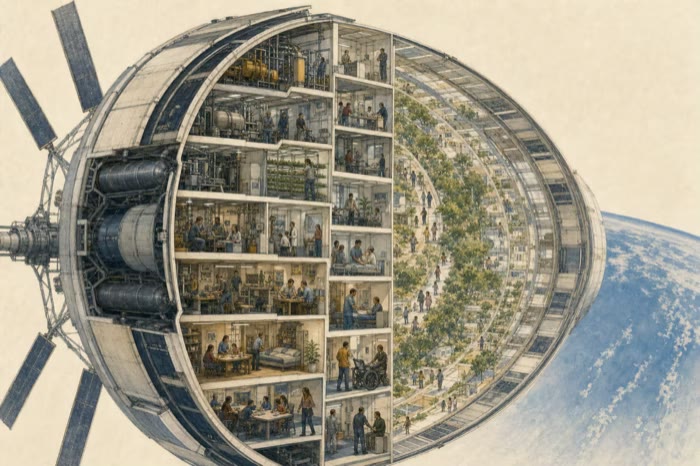
Evidence boundary: No isolation analog, spacecraft, settlement, constitution, or demographic model validates a society across generations in irreversible transit. Human-rights instruments and participation guidance provide reference constraints, not a complete ship jurisdiction. Independent review by legal, cultural, child-rights, disability-led, ecological, technical, and affected-public experts is pending.
Plain-language summary
A generation ship would be one life-critical technical system inhabited by people who may form many communities over time.
The air processor, electrical grid, clinic, food system, factory, software, and civic institutions cannot be designed independently. A rule about water allocation changes health, work, privacy, religion, family life, and political power. A software permission can become a constitutional decision. A medical constraint can become reproductive coercion.
Integration does not require cultural uniformity. Architecture must support dissent, disability, beliefs, evolving families, cultural creation, and peaceful changes of government. Founders cannot specify one permanent society for descendants.
The machinery allocates power
In an ordinary city, people can sometimes change utilities, move, organize alternatives, appeal to outside courts, or obtain supplies through other networks. A closed habitat can collapse those choices.
Control of any of these systems can become political control:
- Atmosphere pressure and oxygen.
- Water production and sanitation.
- Food, seeds, and agricultural space.
- Energy, heat rejection, and communications.
- Medical care, reproduction, and health records.
- Identity, access, and surveillance systems.
- Maintenance tools, manufacturing, and spare materials.
- Education, archives, models, and AI advice.
- Airlocks, mobility routes, shelters, and private space.
That does not mean every valve setting requires a referendum. It means the authority to set, inspect, override, and appeal life-critical rules belongs in the system requirements.
Engineering interfaces should record the civic consequence of failure. Governance rules should record the material systems they assume.
Governance is part of life support
The phrase “governance is life support” is literal in a closed system. Institutions must allocate scarce resources, authorize maintenance, manage emergencies, resolve conflict, preserve records, and correct error.
But necessity does not authorize permanent command. A rights-preserving design needs separation among:
- Technical operators who manage bounded real-time hazards.
- Civic authorities who make public policy.
- Independent safety, medical, cyber, and ecological reviewers.
- Courts, ombuds, or other appeal bodies.
- Audit and investigative functions.
- Residents and affected groups who can organize and replace leaders.
The vehicle owner or operating company should not automatically be sovereign. Employment, housing, medicine, political status, and access to life support must not collapse into one revocable contract.
Emergency authority needs a defined trigger, limited scope, recorded action, independent review, expiration, and remedy. If every shortage becomes an emergency, constitutional limits disappear.
A rights floor before a social blueprint
Founders cannot predict what languages, relationships, religions, arts, economies, or political institutions will make sense centuries later. They can identify a minimum rights floor that no culture or mission objective may erase.
Reference rights include:
- Life, bodily integrity, and nondiscrimination.
- Privacy, expression, conscience, belief, association, and peaceful dissent.
- Due process, remedy, and protection from arbitrary punishment.
- Accessible information, infrastructure, education, health care, and civic participation.
- Reproductive autonomy and freedom from genetic or demographic coercion.
- Children’s care, development, identity, education, and voice.
- Cultural participation and the ability to create new traditions.
- Amendment, leadership succession, and peaceful institutional change.
UNESCO’s Universal Declaration on Cultural Diversity states that cultural diversity cannot be invoked to limit human rights. That is a crucial constraint: pluralism protects different ways of living, not abuse.
The ICCPR, Convention on the Rights of the Child, and Convention on the Rights of Persons with Disabilities are treaties with specific state-party scopes and implementation systems. Their direct application aboard a future interstellar vehicle requires legal analysis. Their provisions still reveal design questions that should not be postponed.
Children are residents and future citizens
People born aboard did not volunteer for departure. Treating them as replacement crew turns childhood into conscription.
The Convention on the Rights of the Child provides useful anchors: nondiscrimination, best interests, development, identity, expression, privacy, education, culture, protection from exploitation, and the right of children capable of forming views to be heard in matters affecting them.
Practical implications include:
- Education must prepare children to question the mission, not only maintain it.
- Civic processes need age-appropriate information and youth participation.
- Family support cannot be reduced to demographic targets.
- Children need private life, play, relationships, and cultural choice.
- Work pathways must avoid hereditary occupation.
- Guardians, clinicians, schools, and government require independent accountability.
A society cannot claim intergenerational legitimacy while giving the first generation born aboard no path to change inherited decisions.
Disability is normal, not a disqualifier
Across a population and centuries, disability is expected through birth, aging, illness, injury, and environmental exposure. An architecture that assumes a permanently selected able-bodied crew is not a civil habitat.
The Convention on the Rights of Persons with Disabilities emphasizes accessibility, equal recognition, independent living and inclusion, health without discrimination, and participation in political and public life. Its universal-design principle supports designing environments usable by varied people without requiring exceptional adaptation.
Ship requirements should therefore include:
- Redundant sensory and communication modes.
- Accessible evacuation, shelter, work, education, and civic systems.
- Supported decision-making without automatic loss of legal agency.
- Maintenance and care roles that do not trap families or a stigmatized class.
- Disability-led testing and authority to block inaccessible safety-critical workflows.
- Privacy and consent in health monitoring.
Efficiency claims must not hide exclusion. If a mission only works by denying support to people expected to exist, the mission does not work.
Culture cannot be frozen
An archive can preserve languages, art, science, law, and memory. It cannot prescribe which parts remain alive or what new culture people will create.
UNESCO’s cultural-diversity declaration links pluralism to participation and treats cultural rights as part of human rights. For a closed society, this implies:
- Space and time for art, ritual, quiet, recreation, and assembly.
- Access to archives without a single authorized interpretation.
- Freedom to create and transmit new works.
- Translation and preservation across language change.
- Protection for minorities and dissenting communities.
- Limits on cultural claims that violate individual rights.
Culture shapes trust, grief, work, care, identity, conflict, and the meaning of the voyage.
One infrastructure can support plural communities
Pluralism does not require every group to maintain a separate atmosphere plant. It requires common infrastructure to support different lives without letting the operator impose one total culture.
Possible design patterns include:
- Neighborhood-scale spaces with shared civil utilities.
- Transparent resource accounting and appeal.
- Multiple schools, associations, cooperatives, and cultural institutions within a rights floor.
- Personal and communal spaces that residents can reconfigure.
- Civic data separated from commercial, medical, and security records.
- Federated decision-making where local variation does not endanger shared systems.
- Constitutional allocation of emergency and maintenance authority.
These are proposals, not validated designs. They must be tested against correlated failure, unequal access, segregation, capture, and the risk that physical compartmentalization hardens into caste.
Technical and civic redundancy differ
Engineers use redundancy to preserve function after failure. Societies also need ways to detect and recover from institutional failure:
- Multiple channels for reporting hazards.
- Independent medical confidentiality.
- Competing explanations and protected research.
- Appeal outside the original decision chain.
- Leadership succession and recall.
- Distributed archives and transparent change history.
- Whistleblower protection and anti-retaliation.
- Periodic constitutional review.
Duplicating one authority under different names is not independent redundancy. Neither is asking an AI system owned by the operator to review the operator.
What analogs can teach—and cannot
NASA’s HERA facility supports studies of isolation, communication delay, autonomy, human factors, and medical capability in a small habitat. CHAPEA simulates a yearlong Mars surface mission with four selected adult volunteers. The ISS provides decades of international operational experience and maintained life-support systems.
These programs can study workload, privacy, team processes, maintenance, human-system interfaces, communication, and failure response. They do not reproduce:
- Birth, childhood, aging, and death over generations.
- A population that cannot leave.
- Constitutional replacement of founding authority.
- A complete independent economy and ecology.
- Centuries of cultural and language change.
- The moral status of people who never consented to the mission.
Analogs should be designed to test bounded questions, publish transfer limits, and avoid turning selected crews into evidence for permanent social arrangements.
Participation must have consequence
OECD guidance says a participation process should have a clear purpose, link to decision-making, inclusive and accessible recruitment, adequate information, feedback about how input was used, and evaluation.
For generation-ship research today, participation should include people affected by testbeds, funding choices, environmental risk, disability barriers, biological research, and proposed governance. Public consultation after architecture and contracts are fixed is not shared authority.
For a future onboard society, participation mechanisms must function during scarcity and disagreement, not only during calm simulations. Residents need agenda-setting, accessible evidence, minority findings, and enforceable remedy.
Integration without totalization
Whole-system design can itself become dangerous if “integration” is used to justify collecting every datum or controlling every behavior. The goal is coordinated safety with bounded authority.
Design principles include:
- Minimize personal data and separate purposes.
- Prefer local control where shared safety permits.
- Make overrides visible, limited, and appealable.
- Preserve offline and non-digital participation.
- Treat privacy and dissent as resilience, not inefficiency.
- Use hard rights constraints before optimization.
- Require proof when someone claims that scarcity makes coercion necessary.
A society is not a machine to optimize. It is a changing public whose members retain moral status.
Evidence ledger
- L01-04-A — Technical and social systems are coupled in a closed habitat. Basis: demonstrated dependence of crews on engineered life support plus systems reasoning. Readiness: operational for bounded habitats; early research for civil integration. Confidence: strong about coupling, unverified about a complete solution.
- L01-04-B — Current space analogs do not validate a multigenerational society. Basis: observed program scope. Readiness: operational as limited-duration research. Confidence: strong. Support: NASA HERA and CHAPEA descriptions.
- L01-04-C — Children and disabled residents require agency, access, and participation rather than treatment as mission resources. Basis: normative human-rights instruments. Readiness: operational as a present design constraint; legal application depends on jurisdiction. Confidence: strong as a rights floor, pending specialist review.
- L01-04-D — Cultural pluralism must operate within universal rights. Basis: UNESCO normative instrument. Readiness: operational as a governance principle. Confidence: supported; implementation is unresolved.
- L01-04-E — Founders cannot legitimately bind every descendant to one permanent social system. Basis: normative reasoning grounded in future freedom of choice. Readiness: early research for institutional implementation. Confidence: supported; no validated intergenerational constitution exists.
Linked corpus claims: claim-01-06, claim-09-01, claim-10-07, and claim-10-10. See the claim registry for each record's current evidence grade and independent-review state.
Assumptions and limits
- Cited human-rights instruments differ in legal status, parties, enforcement, and jurisdiction.
- The rights floor here is incomplete and requires plural legal and affected-community review.
- HERA, CHAPEA, and ISS evidence transfers only to specified operational questions.
- Cultural diversity is dynamic and cannot be represented by a founder-selected demographic checklist.
- Scarcity can create real emergency constraints without automatically justifying permanent exceptional power.
- A single vehicle may be unable to provide enough spatial, institutional, or economic diversity; that can be a mission-stopping result.
What would change this conclusion?
The proposed institutional patterns should change if long-duration, diverse, independently evaluated communities demonstrate better ways to separate technical authority from civic power, preserve rights under scarcity, and recover from institutional failure. Legal conclusions should change with new treaties, jurisdictional practice, or authoritative interpretations. Evidence that a particular architecture cannot support privacy, disability access, cultural plurality, child development, or peaceful constitutional change should disqualify or radically redesign that architecture. Evidence of safe civic diversity would strengthen the design case, but no successful analog of selected consenting adults would authorize rule over people born aboard.
Sources and locators
Accessed 2026-07-25.
- NASA, About HERA (opens external site in a new tab) — habitat description and research scope for isolation, communication, autonomy, human factors, and medicine.
- NASA, Crew Health and Performance Exploration Analog (opens external site in a new tab) — program scope, four-person habitat, and yearlong Mission 1 boundary.
- NASA Human Integration Design Handbook (opens external site in a new tab) — sections 3–4 and habitability/human-interface guidance; companion role to NASA-STD-3001.
- NASA, Environmental Control and Life Support Systems (opens external site in a new tab) — current life-support functions that illustrate material dependence and maintenance boundaries.
- International Covenant on Civil and Political Rights (opens external site in a new tab) — Articles 2, 17–19, 21–22, 25–27.
- UNICEF, Convention on the Rights of the Child (opens external site in a new tab) — Articles 2, 3, 6, 12–17, 23–24, 28–31, and 32.
- United Nations, Convention on the Rights of Persons with Disabilities (opens external site in a new tab) — Articles 3–5, 9, 12, 19, 21, 24–25, and 29–30.
- UNESCO Universal Declaration on Cultural Diversity (opens external site in a new tab) — Articles 1–5.
- UNESCO Declaration on the Responsibilities of the Present Generations Towards Future Generations (opens external site in a new tab) — Articles 1, 2, 7, 10, and 11.
- OECD Guidelines for Citizen Participation Processes (opens external site in a new tab) — executive summary, ten-step process, and quality principles.
Editorial record
- Prepared by: GShips Project
- Last edited: 2026-07-25
- Status: Substantive editorial draft; not independently reviewed
- Independent domain review: Pending
- Required review: Constitutional and international law, child rights, disability-led design, reproductive justice, cultural anthropology, human factors, ecology, labor, and affected-public governance
- Conflicts: Maintainer intends to explore a commercial venture based on some GShips work; no entity, funding, customer, sponsor, or partner relationship currently exists
- Relationship boundary: Source inclusion does not imply author, institution, NASA, UN, UNICEF, UNESCO, or OECD endorsement or partnership
- Corrections: Suggest a correction