Evidence boundary: No generation ship has been built, validated, authorized, or launched. This lesson supplies a working definition for comparing proposals; it does not establish feasibility, legal authority, or a duty to attempt one. Independent engineering, law, human-rights, disability, ecological, and affected-public review is pending.
Plain-language summary
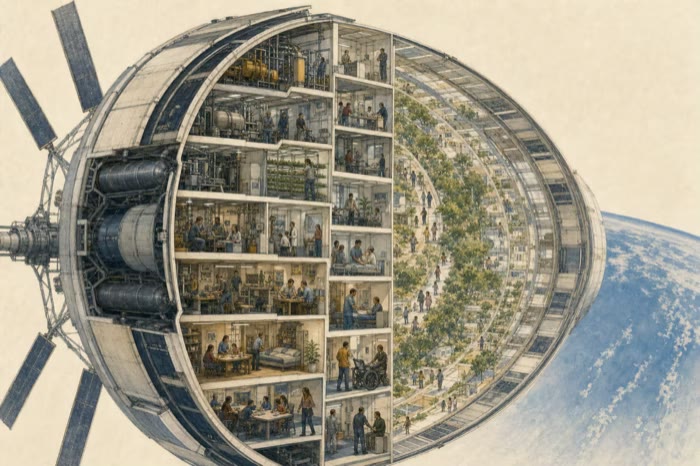
A generation ship is not simply a large spacecraft. It is an interstellar vehicle and inhabited society whose voyage would continue through multiple human generations before arrival.
That definition changes the design problem. The vehicle must support more than a selected crew completing a bounded expedition. People born aboard did not choose departure. They need health care, education, privacy, culture, political agency, family life, disability access, due process, and meaningful lives that are not merely instruments of an ancestor’s mission.
“Generation ship,” “worldship,” “ark,” “habitat,” “sleeper ship,” and “probe” are often used as if they were interchangeable. They are not.
A working definition
For GShips, a proposal belongs in the generation-ship class when all of these conditions are intended:
- It transports a resident human population between stellar systems.
- The planned transit exceeds at least one human reproductive generation.
- Birth, childhood, adulthood, aging, disability, and death occur during the voyage.
- The population depends on the traveling system for the material basis of life.
- The society must maintain or renew critical technical, ecological, medical, cultural, and civic functions without timely rescue or resupply from Earth.
- Arrival requires a separate, ethically and technically credible plan rather than treating the destination as automatically habitable or unoccupied.
This is an analytic definition, not an international legal category. A future regulator or treaty body could use different terms. The purpose here is to reveal obligations that disappear when a proposal is described only as a vehicle.
The definition also does not prescribe one size or form. A single habitat, a convoy, a succession of mobile habitats, or a vehicle that creates an orbital settlement at arrival could all raise multigenerational obligations. Architecture remains open; the rights and lifecycle questions do not.
Generation ship and worldship
Hein, Smith, Marin, and Staats review definitions in the interstellar literature and describe world ships as hypothetical, very large, self-contained spacecraft for crewed interstellar travel over centuries. Their paper distinguishes and overlaps terms rather than announcing an accepted standard. It also identifies maintenance, resources, sociotechnical feasibility, population, and possible technological obsolescence as central roadblocks.
GShips uses worldship for a stronger architectural claim: a traveling environment intended to function as a comparatively complete world, potentially with a very large population and extensive industry. A generation ship is defined by multigenerational transit. A worldship would normally be a generation ship, but a generation-ship proposal might claim a smaller population, multiple linked habitats, or more dependence on stored inventories.
The distinction matters because “self-contained” is not binary. A vehicle can recycle much of its water and still depend on replacement catalysts, electronics, seed stock, medicines, knowledge, or external navigation data. Every claim of closure needs a boundary, duration, loss budget, maintenance model, and recovery path.
A habitat is necessary but not sufficient
An orbital or planetary habitat can test air revitalization, water recovery, agriculture, human factors, governance, maintenance, and emergency response while remaining close enough for communication, resupply, evacuation, or return. NASA’s International Space Station life-support record is valuable because it demonstrates real regenerative processes and real maintenance. It also shows the boundary: station systems rely on ground expertise, logistics, replacement hardware, and disposal.
A Solar System habitat can be a responsible precursor without being a miniature generation ship. It does not reproduce centuries of duration, interstellar dust at cruise speed, multigenerational legitimacy, or a destination with no established infrastructure.
This difference protects good precursor work from hype. A closed-loop experiment may materially improve terrestrial water treatment or remote operations even if it never becomes part of a stellar vehicle.
A probe is a different moral and technical class
A robotic probe does not need a civil constitution, reproductive health system, school, or lifetime of meaningful choice. It can be smaller, accept higher acceleration, tolerate narrower redundancy, and fail without trapping a population.
Probes still create duties: contamination control, dual-use review, public accountability, responsible target selection, and honest risk. The Outer Space Treaty requires state responsibility for national space activities, including authorization and continuing supervision of nongovernmental activity, and its Article IX addresses harmful contamination, due regard, and consultation. COSPAR’s planetary-protection policy operationalizes contamination categories for present Solar System missions.
Those instruments were not written for a crewed interstellar polity, and their application over centuries is unsettled. They nevertheless refute the idea that reaching another world is solely a private engineering decision.
Sleeper, torpor, embryo, and digital-person proposals are not synonyms
A sleeper mission proposes that the departing people remain inactive for much of the trip. NASA funded early-stage NIAC studies of non-cryonic torpor for Mars transfer habitats; NASA TechPort records the later project at technology readiness level 3. That is evidence of concept study and limited experimental framing, not validated decades-long human stasis, reliable awakening, pregnancy after stasis, or a substitute for a civil society.
If adults remain awake in rotating shifts, governance and maintenance still continue. If everyone is inactive, autonomous care becomes a single point of ethical and technical failure. If a voyage lasts longer than the sleepers can remain in stasis, it returns to a multigenerational problem.
An embryo mission replaces traveling adults with stored embryos, artificial gestation, and robotic upbringing. No demonstrated system can perform that chain, and the concept intensifies consent, guardianship, kinship, disability, developmental, and coercion problems. It should not be presented as a smaller generation ship.
An upload or digital-person mission depends on unresolved claims about mind, identity, embodiment, rights, computation, and continuity. Moving information or a model is not evidence that a person has traveled. These proposals deserve their own evidence and moral analysis.
“Ark” is a story, not a requirements class
Ark language suggests rescue from catastrophe and can smuggle urgency, scarcity, selection, and moral exceptionalism into a proposal. It invites questions that an engineering diagram cannot answer:
- Who declares that Earth is lost?
- Who is excluded, and by what authority?
- Does the project divert resources from preventing the catastrophe?
- Are selected people passengers, workers, research subjects, citizens, or property?
- Can their descendants revise or abandon the founding mission?
- What duties remain to people on Earth?
A generation ship may be studied as a contingency without being framed as an escape. The Earth-first position is stronger: work is justified only when it has nearer benefits, preserves alternatives, and does not depend on abandoning people or the planet.
The ship is a society and a system of systems
NASA defines systems engineering as a multidisciplinary approach spanning design, realization, technical management, operations, and retirement. Its handbook emphasizes interfaces, lifecycle tradeoffs, verification, validation, and stakeholder expectations.
For a generation ship, the system boundary includes institutions and rights because technical control allocates life-critical resources. Air rules affect labor and freedom of movement. Medical capacity affects reproductive autonomy. Software authority affects due process. Maintenance policy affects education and occupational choice. Agricultural decisions affect culture as well as nutrition.
The system therefore cannot be decomposed into “hardware now, society later.” At minimum, a reference architecture must connect:
- Mission, destination, acceleration, braking, and arrival.
- Power, thermal rejection, shielding, structure, and artificial gravity.
- Air, water, food, waste, microbiomes, and ecological recovery.
- Medicine, reproduction, childhood, aging, and disability support.
- Industry, spares, metrology, software, cybersecurity, and knowledge.
- Rights, law, work, culture, education, dissent, and constitutional change.
An elegant propulsion concept with no legitimate society is not a generation-ship architecture. A humane constitution with no material survival path is not one either.
People born aboard are not mission equipment
Current generations can choose research priorities and define conditions under which they would refuse to launch. They cannot consent on behalf of all future residents.
The UNESCO Declaration on the Responsibilities of the Present Generations Towards Future Generations is not a generation-ship constitution, but it provides useful normative anchors. It calls for safeguarding future needs and interests, freedom of choice in political, economic, and social systems, cultural and religious diversity, and assessment of consequences for future generations before major projects.
These principles support design constraints:
- No inherited duty to settle a target.
- No forced reproduction or hereditary occupation.
- Real amendment, appeal, dissent, and peaceful transfer of authority.
- Education that enables critique of the mission, not only its continuation.
- Preservation of safe alternatives where physics permits, including loitering, changing target, remaining in habitat, or declining surface settlement.
The inability to provide meaningful choice can make an architecture unacceptable even if its machinery appears feasible.
What the definition does and does not prove
Calling something a generation ship exposes the scope of its burden. It does not prove:
- That a viable population size is known.
- That ecological or industrial closure is achievable.
- That a nearby destination is habitable, lifeless, or open to settlement.
- That propulsion and braking can move the required mass.
- That current law supplies legitimate authority.
- That any founder can represent humanity.
- That the project is a better use of resources than Earth resilience, probes, Solar System habitats, waiting, or non-expansion.
The correct first output is therefore a comparison framework and a set of reversible test programs—not a launch date.
Evidence ledger
- L01-01-A — “Generation ship” denotes a multigenerational interstellar mission class in the research literature. Basis: proposed taxonomy and scholarly synthesis. Readiness: early research. Confidence: supported for analytical use; no binding standard exists. Support: Hein et al., sections 2–3.
- L01-01-B — Current regenerative life support provides bounded precursor evidence, not civilization-scale closure. Basis: demonstrated aboard the ISS. Readiness: operational for specified station functions; major scale-up for autonomous multigenerational closure. Confidence: strong within the ISS boundary and unverified beyond it. Support: NASA ECLSS overview.
- L01-01-C — Human torpor is not an operational alternative to multigenerational travel. Basis: proposed and early experimental work. Readiness: early research; NASA TechPort records TRL 3 for the cited Mars study. Confidence: strong that the cited project does not validate long-duration stasis; tentative on future feasibility.
- L01-01-D — Present space law creates state-responsibility and contamination duties but does not settle interstellar constitutional authority. Basis: observed treaty text and normative interpretation. Readiness: operational for states party within current practice; unknown for a multigenerational interstellar polity. Confidence: strong about treaty text, tentative about future application.
- L01-01-E — Preserving the option to study a generation ship does not create a duty to build or launch one. Basis: normative GShips principle. Readiness: operational as a research-governance rule. Confidence: supported by reversibility and future-choice considerations; not an empirical law.
Linked corpus claims: claim-01-01, claim-01-04, and claim-19-01. See the claim registry for each record's current evidence grade and independent-review state.
Assumptions and limits
- “Human generation” is used socially and biologically, not as one fixed number of years.
- The lesson assumes no validated human stasis, artificial gestation, mind uploading, or faster-than-light transport.
- Rights instruments cited here are reference constraints, not a complete jurisdictional opinion.
- Present Solar System law may evolve long before any interstellar decision.
- A convoy or distributed architecture may change failure modes without removing multigenerational obligations.
- Definitions should be revised when they hide rather than expose affected people, dependencies, or alternatives.
What would change this conclusion?
The working definition should be revised if an internationally legitimate standards process adopts a clearer category; if demonstrated stasis makes birth during transit unnecessary; or if an architecture avoids continuous human residence while preserving identity and rights under evidence not presently available. A claim that habitats or probes are equivalent would require showing that their duration, rescue, resupply, destination, human-development, and governance boundaries match. Evidence that current legal instruments clearly govern centuries-long interstellar societies would narrow the stated legal uncertainty. None of those changes would by itself create a moral duty to launch.
Sources and locators
Accessed 2026-07-25.
- Hein, Smith, Marin, and Staats, “World Ships: Feasibility and Rationale” (opens external site in a new tab) — abstract; sections 2–4 for definitions, feasibility, and alternatives. Peer-reviewed article manuscript.
- NASA Systems Engineering Handbook, NASA/SP-2016-6105 Rev 2 (opens external site in a new tab) — sections 2.0–2.2 on multidisciplinary lifecycle systems engineering.
- NASA, Environmental Control and Life Support Systems (opens external site in a new tab) — overview and Water Recovery, Air Revitalization, and Oxygen Generation sections.
- NASA TechPort, Advancing Torpor Inducing Transfer Habitats for Human Stasis to Mars (opens external site in a new tab) — project description, duration, and technology-maturity record.
- United Nations Office for Outer Space Affairs, Outer Space Treaty (opens external site in a new tab) — Articles I, VI, VIII, IX, and XI.
- COSPAR Policy on Planetary Protection (opens external site in a new tab) — 2026 policy landing page and linked policy text.
- UNESCO Declaration on the Responsibilities of the Present Generations Towards Future Generations (opens external site in a new tab) — Articles 1, 2, 4, 5, 7, and 11.
Editorial record
- Prepared by: GShips Project
- Last edited: 2026-07-25
- Status: Substantive editorial draft; not independently reviewed
- Independent domain review: Pending
- Required review: Mission architecture, habitat engineering, international space law, human rights, disability-led design, bioethics, and affected-public governance
- Conflicts: Maintainer intends to explore a commercial venture based on some GShips work; no entity, funding, customer, sponsor, or partner relationship currently exists
- Relationship boundary: Source inclusion does not imply author, institution, NASA, UN, UNESCO, or COSPAR endorsement or partnership
- Corrections: Suggest a correction