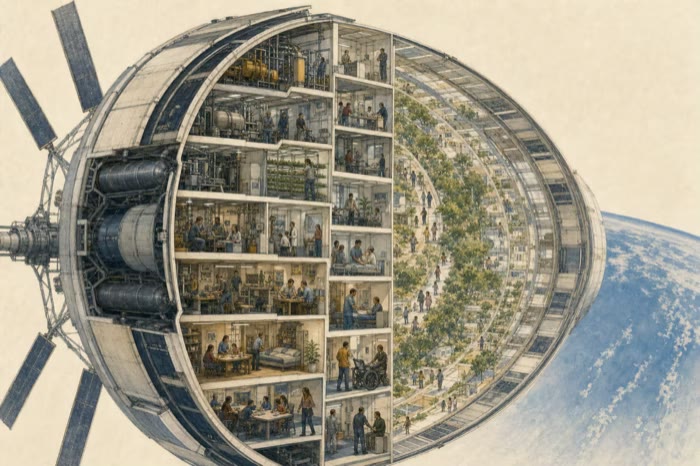
Evidence boundary: This lesson argues for a conditional research program, not for building or launching a generation ship. Claims about Earthside benefit must be demonstrated project by project. “Preserving an option” cannot excuse opportunity cost, dual-use harm, weak evidence, environmental damage, or rule by a self-appointed founder.
Plain-language summary
Humanity may never need—or choose—to launch a generation ship. It can still be useful to ask what one would require.
The question forces air, water, food, health, energy, maintenance, cybersecurity, education, governance, and rights into one long-horizon system. Work on those capabilities can help remote communities, research stations, hospitals, disaster response, resilient infrastructure, and responsible Solar System habitats.
That benefit is not automatic. A project earns support only when it has a real nearer user, a measurable problem, a reversible test, transparent risks, and a stopping rule. “For the stars” is not a substitute for evidence.
Preserving the option means keeping knowledge and humane choices open. It does not mean preserving one vehicle design, one organization, one ideology, or one timetable.
Option value is not mission commitment
An option is valuable because it allows a later decision after more has been learned. It is destroyed when a program treats continued spending, incorporation, infrastructure, or public enthusiasm as proof that launch must eventually occur.
For GShips, preserving the option means:
- Maintaining open, inspectable knowledge about capability gaps and alternatives.
- Funding experiments that remain useful if no stellar mission follows.
- Avoiding irreversible commitments before evidence and legitimacy exist.
- Keeping robotic probes, Solar System habitats, waiting, Earth investment, and non-expansion in every major trade.
- Protecting future people’s ability to revise or refuse inherited plans.
This framing rejects two extremes. One is that a generation ship is inevitable and only the date is uncertain. The other is that a distant goal has no present value because a complete vehicle is impossible today. A disciplined research portfolio can produce present value without pretending that its ultimate scenario is ready.
The forcing-function benefit
Ordinary engineering programs can optimize one mission and import services from a large surrounding economy. A generation-ship thought experiment removes many of those conveniences. It asks:
- What happens when resupply stops?
- Who repairs the repair tools?
- How are measurements kept traceable after institutions and languages change?
- Can a food system recover after interacting failures rather than one planned outage?
- Who controls oxygen, health data, source code, and emergency authority?
- How can knowledge remain challengeable instead of becoming sacred instructions?
- What rights remain nonnegotiable when resources are scarce?
These questions expose interfaces that narrower programs can miss. NASA’s systems-engineering handbook describes a broad, multidisciplinary lifecycle view and emphasizes defining alternatives, stakeholder expectations, interfaces, verification, validation, risk, and retirement. Applying that discipline to an extreme horizon can generate useful testable requirements now.
The thought experiment is only a forcing function. It does not validate the answers it provokes.
Nearer value must be explicit
Several capability areas already have bounded demonstrations:
- The International Space Station recovers water and regenerates oxygen through maintained, ground-supported equipment.
- NASA’s HERA analog studies isolation, communication delay, autonomy, human factors, and medical capability in missions lasting up to weeks.
- CHAPEA places four volunteers in a yearlong Mars-surface simulation with resource limits, equipment failures, delayed communication, maintenance, exercise, and crop work.
- Voyager demonstrates long-lived robotic operations, delayed command, declining power management, recovery using aging hardware, and institutional handoff.
None demonstrates a generation ship. Each produces evidence relevant to narrower Earth or Solar System problems.
A credible proposal should name its first beneficiary in operational terms. Examples include:
- A water-recovery assurance method for remote clinics.
- A maintenance-and-spares model for isolated infrastructure.
- Offline technical knowledge for disaster response.
- Accessible controls for safety-critical facilities.
- Cyber recovery for disconnected industrial systems.
- Food-system fault experiments useful to controlled agriculture.
- Participatory resource governance for cooperatives or remote settlements.
If the beneficiary exists only after interstellar settlement, the project has not met the Earth-first test.
A project-level public-benefit test
Before funding a workstream, ask:
- Who can use the result within a credible near-term period?
- What measurable capability gap does it close?
- What evidence would show that it failed?
- Can the experiment stop without trapping people, institutions, or ecosystems?
- What opportunity cost does it create?
- Could the capability enable coercion, surveillance, weapons, environmental harm, or unsafe biological work?
- Who has independent authority to pause it?
- Will negative results and limitations be published?
- Does the work remain valuable if a generation ship is never launched?
A proposal that cannot answer these questions should not be rescued by grandeur.
Portfolios should preserve alternatives
The NASA Systems Engineering Handbook’s decision-analysis process calls for defining the decision, alternatives, criteria, decision body, evidence, uncertainty, and consequences. It allows mandatory criteria that disqualify an option rather than merely lowering its weighted score.
For GShips, a portfolio should contain:
- Observation: exoplanet characterization, astrobiology, the interstellar medium, human health, ecology, and failure data.
- Reversible demonstrations: remote habitats, closed-loop components, repair, long-delay operations, and accessible civic processes.
- Enabling infrastructure: standards, testbeds, shared data, verification methods, and open evidence graphs.
- Alternative missions: robotic probes and Solar System science that do not carry multigenerational human burdens.
- Independent challenge: red teams, affected-public review, disability-led testing, ethics, security, law, and environmental assessment.
- Stopping capacity: decommissioning, archive, transfer, and termination plans.
The portfolio should not be arranged as a technology staircase whose only acceptable top step is launch. Evidence can redirect it sideways or end a branch.
Earth first is a constraint, not a slogan
The UNESCO Declaration on the Responsibilities of the Present Generations Towards Future Generations says present generations should safeguard future needs and interests, protect freedom of choice, avoid irreversible environmental damage, and consider consequences for future generations before major projects.
Those principles challenge escape narratives. A distant contingency cannot justify neglecting climate stability, peace, public health, biodiversity, poverty, or democratic institutions. A project that weakens Earth to prepare an exit contradicts the stated purpose.
Earth-first evaluation includes distribution:
- Who pays, works, takes risk, and receives benefit?
- Are benefits public or captured by a narrow owner?
- Does a test consume scarce land, water, energy, materials, or attention?
- Are affected communities involved before decisions are fixed?
- Can people decline participation without losing essential services?
- Are accessibility and reproductive autonomy built into the requirements?
OECD’s citizen-participation guidance is not a starship governance standard, but its principles—clarity, accountability, transparency, inclusion, accessibility, integrity, privacy, information, resources, and evaluation—are useful for current public-interest programs.
Knowledge is part of the option
Preserving an option is as much about retaining the ability to reason as retaining hardware.
Useful knowledge infrastructure includes:
- Stable claim identifiers linked to sources and exact locators.
- Models whose assumptions, units, software, and limits can be reproduced offline.
- Negative results and abandoned concepts.
- Versioned standards and interface records.
- Training that preserves embodied skills through practice.
- Translation, plain language, and accessible formats.
- Conflict and funding disclosures.
- Records of minority findings and unresolved disagreement.
An archive without an institution that can question it becomes dogma. An institution without durable evidence becomes rumor. Both are failure modes.
Dual-use risk travels with capability
Long-duration autonomy, powerful energy systems, synthetic biology, asteroid operations, resilient communications, surveillance, and self-repair can support civil safety or serious harm. Calling work “defensive” or “for survival” is not sufficient.
Option-preserving research needs explicit exclusions, end-use screening, information-hazard review, independent stop-work authority, export-control and sanctions advice when applicable, and a way to terminate relationships. If those controls do not exist, relevant operational engagement should not proceed.
Some knowledge may be inappropriate for open release. The burden is to explain the boundary and submit it to independent review—not to hide inconvenient evidence or use security language to avoid accountability.
Why waiting can be productive
Waiting does not have to mean inactivity. It can mean:
- Sending probes before people.
- Testing habitat systems where rescue remains possible.
- Improving propulsion while refusing to lock a slow crewed mission into centuries of exposure.
- Learning whether a target contains indigenous life.
- Building legitimate international institutions.
- Investing directly in Earth resilience.
- Letting better alternatives make a ship unnecessary.
A program can set “knowledge gates” rather than dates: no crew mission until target characterization, braking, lifecycle maintenance, rights, and ecological closure meet independent thresholds. If those thresholds never pass, preserving the option has still produced honest knowledge and nearer benefits.
Prevent the option from becoming an obligation
Large programs accumulate identities, careers, sunk costs, contracts, and public stories. That creates pressure to redefine setbacks as reasons to continue. Countermeasures must be designed early:
- Separate research success from launch authorization.
- Give independent bodies real pause and termination power.
- Publish criteria before results are known.
- Expire approvals and require renewed evidence.
- Protect dissent and negative findings.
- Fund alternatives from the same decision process.
- Avoid a company charter that treats launch as the only mission success.
- Never use children or future generations as rhetorical consent.
The program succeeds when it improves knowledge and capability while preserving choice. It can succeed by proving that a crewed stellar mission should not happen.
Evidence ledger
- L01-02-A — Whole-system framing can reveal interfaces missed by subsystem-only work. Basis: demonstrated systems-engineering practice and proposed application. Readiness: operational as a method; early research for generation-ship integration. Confidence: supported. Support: NASA Systems Engineering Handbook, sections 2 and 6.8.
- L01-02-B — Current space and analog programs provide bounded precursor evidence. Basis: observed and demonstrated. Readiness: operational within the ISS, HERA, CHAPEA, and Voyager scopes; major scale-up to autonomous multigenerational operation. Confidence: strong about the bounded programs and unverified for transfer to a generation ship.
- L01-02-C — Near-term benefit is not automatic. Basis: normative public-benefit rule. Readiness: operational as a funding criterion. Confidence: supported as accountable program design, but each claimed benefit requires outcome evidence.
- L01-02-D — Reversible research preserves more choices than an early irreversible mission commitment. Basis: systems reasoning and normative judgment. Readiness: operational as research governance. Confidence: supported, subject to the costs and risks of maintaining the option.
- L01-02-E — Preserving the option does not create a duty to launch. Basis: normative. Readiness: operational as the project’s decision boundary. Confidence: strong within GShips policy; societies may legitimately choose not to expand.
Linked corpus claims: claim-01-09, claim-19-01, claim-19-08, and claim-20-10. See the claim registry for each record's current evidence grade and independent-review state.
Assumptions and limits
- This lesson assumes public-benefit claims can be measured rather than inferred from intention.
- NASA examples are analogs and bounded demonstrations, not endorsements of GShips.
- Citizen-participation guidance must be adapted for affected communities and jurisdiction; a checklist cannot manufacture legitimacy.
- Some enabling work may have no immediate commercial customer but still have a credible public or scientific beneficiary.
- Reversibility is a spectrum. Even small research programs consume time, material, and attention.
- The option to act later must be compared with the option to invest elsewhere now.
What would change this conclusion?
The case for an option-preserving program would weaken if its work repeatedly failed to deliver named nearer benefits, crowded out more effective Earth interventions, created unmanageable dual-use or environmental risks, or became institutionally incapable of stopping. It would strengthen if independent evaluations showed measurable improvements in remote-system resilience, water or food security, safety, accessibility, public governance, or scientific knowledge at reasonable opportunity cost. A demonstrated urgent threat might change the timing of particular research, but would not erase rights, evidence, alternatives, or the need for legitimate authority. A safe superior alternative could make generation-ship work unnecessary; that would count as success, not failure.
Sources and locators
Accessed 2026-07-25.
- NASA Systems Engineering Handbook, NASA/SP-2016-6105 Rev 2 (opens external site in a new tab) — sections 2.0–2.2 on the systems view; sections 6.4–6.8 on risk, assessment, and decision analysis; Appendix B on decommissioning review.
- NASA, Environmental Control and Life Support Systems (opens external site in a new tab) — current ISS water, air, and oxygen subsystem overview.
- NASA, About HERA (opens external site in a new tab) — facility description and research scope for isolation, communication, autonomy, human factors, and medical capability.
- NASA, Crew Health and Performance Exploration Analog (opens external site in a new tab) — program and mission scope; Mission 1 dates and current program status.
- NASA, Voyager 1 Revives Backup Thrusters (opens external site in a new tab) — bounded example of long-lived hardware recovery and delayed operation.
- UNESCO Declaration on the Responsibilities of the Present Generations Towards Future Generations (opens external site in a new tab) — Articles 1, 2, 4, 5, 10, and 11.
- OECD Guidelines for Citizen Participation Processes (opens external site in a new tab) — executive summary, ten-step process, and guiding principles.
Editorial record
- Prepared by: GShips Project
- Last edited: 2026-07-25
- Status: Substantive editorial draft; not independently reviewed
- Independent domain review: Pending
- Required review: Systems engineering, public-interest technology, environmental justice, disability-led design, dual-use governance, economics, and affected-public participation
- Conflicts: Maintainer intends to explore a commercial venture based on some GShips work; no entity, funding, customer, sponsor, or partner relationship currently exists
- Relationship boundary: Source inclusion does not imply author, institution, NASA, UN, UNESCO, or OECD endorsement or partnership
- Corrections: Suggest a correction