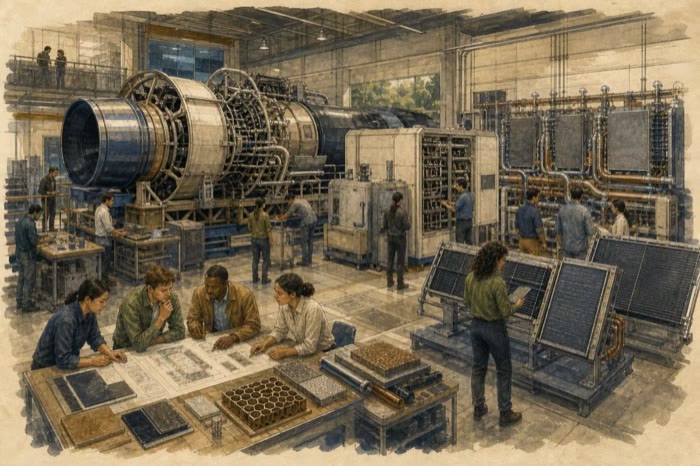
Evidence boundary: Solar-sail deployment and photon-pressure trajectory control have flown on small spacecraft. Ground- or space-based directed-energy propulsion at interstellar scale has not. Breakthrough Starshot is a research program for gram-scale flyby probes, not a demonstrated system and not a crewed-habitat architecture. Numbers below are idealized scaling exercises; they omit many losses and are not construction guidance for a high-power laser facility.
Plain-language summary
Light carries momentum. A reflective sail can gain speed without carrying conventional propellant, either from sunlight or from a deliberately aimed beam. Removing onboard propellant is powerful—but the momentum source, optics, pointing, power, sail, thermal control, and safety do not disappear. Much of the propulsion system moves off the vehicle and becomes infrastructure.
Mass changes the problem dramatically. A few grams can be accelerated hard by a short, intense beam if an ultralight sail survives. A million-tonne habitat cannot be inferred by multiplying that design. Sail strength and area, payload attachment, beam size, array phase control, atmospheric distortion, heat absorption, collision damage, communication, and destination braking all scale differently.
The responsible sequence is robotic: solar-sail missions, materials testing, coherent-beam and metrology demonstrations, then increasingly capable precursor probes. Such work can improve astronomy, sensing, manufacturing, communications, and Solar System logistics even if no interstellar crew launches.
What has actually flown?
Solar sailing uses the Sun as the source. JAXA’s IKAROS mission deployed a roughly square sail about 14 m on a side, made from 7.5 μm polyimide, and demonstrated solar-photon acceleration and navigation during an interplanetary mission. NASA’s Advanced Composite Solar Sail System has demonstrated a different deployable-boom technology in Earth orbit. These missions establish that thin sails can deploy, photon pressure can alter a trajectory, and membranes must coexist with structure, electronics, and attitude control.
They do not establish an interstellar laser array, relativistic velocity, interstellar-dust survival, a multi-light-year downlink, destination braking, or habitat-scale membranes. “Solar sailing has flown” is a bounded claim.
Beamed sailing substitutes a controlled source for sunlight. That can deliver higher intensity, but creates an infrastructure problem: power, aperture, phase control, location, adaptive optics, tracking, target acquisition, exclusion zones, cyber protection, and end-of-life governance.
Momentum and mass
For an ideal beam fully reflected normal to a perfect sail,
F = 2P / c
where F is force, P is beam power intercepted by the sail, and c is the speed of light. A perfectly absorbed beam would provide half that force. An illustrative 100 GW fully intercepted, perfectly reflected beam produces about 667 N.
Acceleration is:
a = F / m = 2P / (mc)
Ignoring the sail, structure, and all losses, 667 N would accelerate:
- a
1 gpayload at about667,000 m/s²; - a
1 kgpayload at about667 m/s²; - a
1,000,000 kgpayload at about0.000667 m/s².
These are not proposed operating points. They show why payload mass, structural limits, acceleration time, and beam-coupling distance cannot be treated as minor parameters.
For a uniform sail, areal density σ = m/A links mass and illuminated area. With beam intensity I, an ideal reflective sail has:
a = 2I / (cσ)
Low areal density raises acceleration, but very thin sails face conflicting requirements: low absorption, high reflectivity at the beam wavelength, mechanical strength, dimensional stability, controlled shape, manufacturability, payload attachment, and resistance to dust and radiation.
The beam does not stay narrow
Diffraction sets a lower bound on the angular spread of a coherent beam. For a circular aperture,
θ ≈ 1.22λ / D
where λ is wavelength and D aperture diameter. An ideal 1 μm beam from a 1 km aperture has θ ≈ 1.22 × 10⁻⁹ radians. At one astronomical unit, its characteristic diffraction radius is about 183 m. At 4.25 light-years, it is roughly 49,000 km.
That comparison assumes a perfect aperture in vacuum. A real system also faces phase errors, atmospheric turbulence if ground-based, thermal distortion, sidelobes, jitter, imperfect knowledge of the sail state, Earth’s rotation, and target motion. The beam need not remain on the sail all the way to the destination for a rapid-acceleration concept, but the useful acceleration distance and duration must be calculated with the actual aperture and sail size.
Array elements must act as one optical instrument, requiring precise metrology, continuous calibration, fault containment, and command security. A high-power beam also needs transparent civil governance: permitted pointing, authorization, independent monitoring, and fail-safe shutdown. GShips excludes offensive weapon integration.
Sail heating and structural survival
Even a tiny absorbed fraction of a large beam becomes heat. If a sail intercepts 100 GW, absorption of one part in 100,000 is still 1 MW. The sail must radiate absorbed heat while optical properties and mechanical shape remain within bounds. Temperature changes can wrinkle or curve the membrane, shifting the force vector and beam coupling.
The acceleration load must travel from film through structure to payload. Stress, vibration, deployment, defects, and control authority matter; a material coupon is not a sail-system demonstration.
Interstellar cruise introduces dust and gas impacts at high relative speed. Small probes may accept gradual degradation or losses across a fleet; a crewed habitat cannot simply accept a low individual survival probability. Shielding a large sail or retracting it after acceleration changes mass, deployment, and braking assumptions.
Probe claims must remain probe claims
Breakthrough Starshot publicly frames a concept for ultralight “nanocrafts” driven by a ground-based light beamer toward Alpha Centauri, with a goal of a flyby and returned imagery. Its own challenge list identifies major open areas including the photon engine, sail, spacecraft, interstellar medium, target environment, and communications.
That is a coherent research framing for tiny robotic probes. It does not supply:
- life support, shielding, artificial gravity, or maintainable habitation;
- acceleration acceptable to people and large structures;
- a sail-payload connection for habitat mass;
- a braking system capable of entering the target system;
- multi-generational governance or consent;
- a demonstrated data link from the tiny transmitter;
- a closed energy, cost, maintenance, and safety account for the array.
A swarm can tolerate some losses, use flyby science, and return a narrow data product. A settlement vehicle must protect every inhabited volume, carry decades or centuries of systems, and reach a controllable arrival state. The valid inference is that gram-scale beamed probes may mature before crewed interstellar transport—not that they are a small version of the same vehicle.
Communications and the return path
Acceleration is only the outbound half of a probe architecture. A useful mission must determine attitude after cruise, acquire the target, collect data at extreme encounter speed, point a transmitter, and deliver bits across light-years. Transmitter power and aperture are tightly mass-limited, while the receiver must separate a faint signal from background light and pointing uncertainty.
The propulsion beam cannot automatically serve as the return link: direction, aperture roles, timing, and spacecraft hardware differ. Solar System optical-communications demonstrations are useful precursors, but distance adds enormous loss. Every probe claim needs propulsion and return-data budgets.
Arrival and braking
The baseline Starshot-style mission is a fast flyby. That is scientifically legitimate, but categorically different from arrival. A sail accelerated by a beam near Earth cannot assume an equivalent beam at the destination. Proposed photon braking using target starlight, magnetic or electric sails, staged sails, or pre-positioned infrastructure each introduce new environmental, material, trajectory, or precursor requirements.
For a crewed mission, “slow down somehow” is a failure of architecture. Braking must be demonstrated under representative deployment, pointing, dust, and material-aging conditions before irreversible departure.
An Earth-first test ladder
A disciplined program would:
- repeat solar-sail deployment and precision-navigation missions with open telemetry;
- characterize reflectivity, absorptivity, emissivity, fatigue, radiation, and defect growth in representative membranes;
- demonstrate low-power beam acquisition and safe closed-loop tracking of instrumented targets;
- scale coherent arrays while independently verifying sidelobes, pointing limits, cyber controls, and fail-safe shutdown;
- fly subrelativistic Solar System probes that return data and expose dust and communications limits;
- require arrival and braking demonstrations for any claim beyond a flyby;
- publish full lifecycle energy, land or orbital footprint, environmental effects, and governance.
The next milestone should be chosen for learning value, not visual resemblance to a starship.
Evidence ledger
- L03-03-A — Solar sails have demonstrated deployment and photon-pressure trajectory control on small spacecraft. Basis: observed. Readiness: operational in bounded small-spacecraft missions. Confidence: strong.
- L03-03-B — Radiation pressure and diffraction support beamed-sail acceleration in physical models, while material, array, pointing, thermal, and control performance set mission-specific bounds. Basis: demonstrated physics and modeled system. Readiness: early research for high-power beamed flight. Confidence: strong for physics; supported for system projections.
- L03-03-C — Breakthrough Starshot is a proposed gram-scale flyby architecture with major unresolved subsystems, not a demonstrated probe or habitat. Basis: proposed. Readiness: early research to breakthrough-dependent. Confidence: strong.
- L03-03-D — Probe-scale sail evidence cannot be scaled directly to a crewed habitat because mass, acceleration tolerance, structure, reliability, communications, and braking requirements differ. Basis: systems assessment. Readiness: no known integrated path. Confidence: supported.
- L03-03-E — Beam control, metrology, materials, and safe power-beaming research could provide Earth and Solar System value independently of an interstellar launch. Basis: demonstrated adjacent applications and proposed extensions. Readiness: operational to major scale-up, depending on application. Confidence: supported.
Linked corpus claims: claim-02-03, claim-02-04, claim-02-09, and claim-02-10. See the claim registry for each record's current evidence grade and independent-review state.
Assumptions and limits
The force examples assume full interception, normal incidence, perfect reflection, constant mass, and no relativistic correction. The diffraction example assumes an ideal circular aperture in vacuum and uses spot radius only as a teaching scale. Real beam profiles, phased arrays, atmosphere, sail shape, pointing, and acceleration distance require detailed simulation. Mission programs and records are time-sensitive. This lesson does not assess facility siting, cost, airspace or orbital regulation, environmental permitting, or public consent in enough depth to authorize deployment.
What would change this conclusion?
Confidence in beamed probes would rise after integrated flight demonstrations measured beam coupling, sail temperature and shape, pointing, control, cruise survival, target acquisition, and returned data at progressively larger distance and speed. Readiness for larger payloads would require representative areal density, structural load transfer, sustained power, aperture, and safety systems—not a mass-only extrapolation. A crewed conclusion would change only after separate demonstrations closed human-compatible acceleration, habitat attachment, debris survival, fault recovery, and destination braking. Unexpected absorption, array instability, atmospheric impact, or weak downlink performance would lower readiness.
Sources and locators
- S01 — JAXA, “IKAROS Overview” (opens external site in a new tab). Locator: mission objectives, sail dimensions, membrane thickness, and solar-sail navigation demonstration; accessed 2026-07-25.
- S02 — JAXA, “IKAROS Press Kit” (opens external site in a new tab). Locator: spacecraft and sail specifications, deployment sequence, and technology-demonstration objectives; May 2010; accessed 2026-07-25.
- S03 — NASA Science, “Sail Along with NASA’s Solar Sail Tech Demo” (opens external site in a new tab). Locator: ACS3 launch, deployment, orbit, composite-boom test, and technology-demonstration status; 2024; accessed 2026-07-25.
- S04 — Breakthrough Initiatives, “Breakthrough Starshot: Challenges” (opens external site in a new tab). Locator: public concept scope and photon engine, sail, spacecraft, interstellar medium, target, and communications challenge areas; accessed 2026-07-25.
- S05 — Kevin L. G. Parkin, “The Breakthrough Starshot System Model” (opens external site in a new tab). Locator: Acta Astronautica 152, system model, assumptions, and parameter trades; 2018.
- S06 — Harry A. Atwater et al., “Materials challenges for the Starshot lightsail” (opens external site in a new tab). Locator: Nature Materials 17, optical, thermal, mechanical, and manufacturing constraints; 2018.
- S07 — Thiem Hoang et al., “The interaction of relativistic spacecrafts with the interstellar medium” (opens external site in a new tab). Locator: Astrophysical Journal 837, gas and dust interaction models for relativistic small spacecraft; 2017.
- S08 — NASA NTRS, “Prospects for Interstellar Propulsion” (opens external site in a new tab). Locator: report record and linked workshop survey of propulsion concept families and gaps; accessed 2026-07-25.
Editorial record
- Prepared by: GShips Project
- Last edited: 2026-07-25
- Status: Substantive editorial draft
- Independent domain review: Pending
- Last independently reviewed: Not yet reviewed; no review date
- Required review: photonics and laser systems; sail materials; propulsion and trajectory design; atmospheric optics; communications; power and thermal engineering; civil safety governance
- Reviewer: No independent reviewer assigned
- Conflicts: Maintainer intends to explore a commercial venture based on some GShips work; no entity, funding, customer, sponsor, or partner relationship currently exists
- Corrections: Suggest a correction