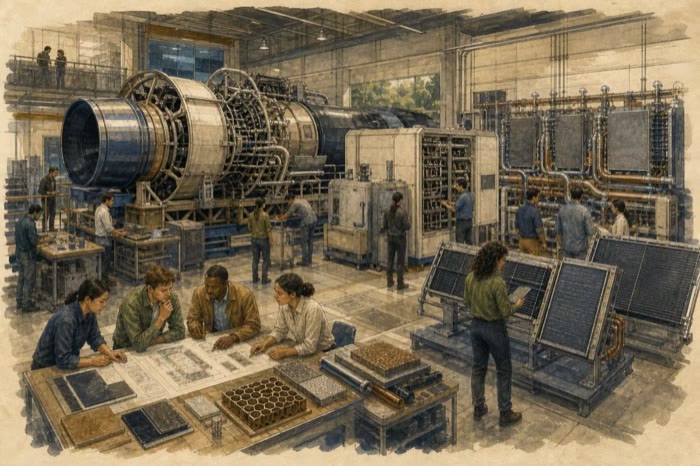
Evidence boundary: Chemical propulsion and several forms of electric propulsion are operational spacecraft technologies. Nuclear thermal and nuclear electric propulsion remain development programs, not operational transport services. None of these facts demonstrates a closed propulsion architecture for a crewed, multigeneration interstellar ship. The numerical examples below teach scaling; they are not vehicle designs or launch recommendations.
Plain-language summary
A propulsion system trades thrust, exhaust speed, propellant, electrical or thermal power, operating life, and mission time. Chemical rockets deliver large thrust for minutes, making them indispensable for launch and rapid maneuvers, but their exhaust speed makes very large velocity changes propellant-intensive. Electric thrusters use propellant far more efficiently and can operate for months or years, but their low thrust demands patience and sustained power. Solar sails exchange onboard propellant for large, delicate structures and a decreasing solar flux. Nuclear heat or electricity could extend operations far from the Sun, but a reactor is a power or heat source—not a complete engine, radiator, shield, maintenance system, or safety case.
That landscape already supports ambitious Solar System work: cargo tugs, robotic exploration, long-duration component tests, and potentially sustained habitats. It does not close the interstellar problem. A worldship must accelerate a massive habitat, protect it during cruise, reject waste heat, retain reserves, brake at the destination, and remain repairable through generations. “High specific impulse” answers only one part of that ledger.
Start with mission function, not engine names
Propulsion should be selected after defining payload, origin, destination, allowed trip time, required velocity change, acceleration limits, power source, heat-rejection conditions, and arrival state. The same thruster can be excellent for one leg and unusable for another.
An integrated architecture may use multiple modes:
- high thrust to leave a gravity well or perform a time-critical maneuver;
- efficient low thrust for cargo spirals or long transfers;
- gravity assists or aerobraking where celestial geometry and atmosphere permit;
- propellantless sailing where photon pressure is sufficient;
- separate propulsion for attitude control, collision avoidance, and emergencies;
- a braking method sized as seriously as departure acceleration.
The governing distinction is not “old” versus “advanced.” It is demonstrated performance inside a bounded mission versus performance assumed for a much larger, longer, or less repairable system.
The rocket equation and its warning
For an ideal rocket that carries its reaction mass,
Δv = vₑ ln(m₀ / m_f)
where Δv is total ideal velocity change, vₑ is effective exhaust velocity, m₀ is initial mass, and m_f is final mass after propellant is expended. Specific impulse is another expression of exhaust velocity:
vₑ = Isp g₀
with standard gravity g₀ = 9.80665 m/s².
Consider an illustrative chemical stage with Isp = 450 s, so vₑ ≈ 4.41 km/s. Ignoring tanks, engine mass, reserves, staging, and gravity losses, a 10 km/s maneuver requires:
m₀ / m_f = exp(10 / 4.41) ≈ 9.65
For 100 km/s, the same idealized mass ratio is about 6.9 billion. That number is not a mission estimate; it exposes exponential scaling. Staging helps a real launch vehicle, but it does not repeal the equation.
An illustrative electric thruster at Isp = 3,000 s has vₑ ≈ 29.4 km/s, reducing the ideal 10 km/s mass ratio to about 1.41. The missing information is thrust, power, lifetime, and heat. A favorable propellant fraction can coexist with an unacceptable acceleration time.
Operational chemical propulsion
Chemical systems turn stored chemical energy into hot exhaust. Their comparatively high thrust makes them suitable for launch, capture, landing, and rapid impulsive maneuvers. Mature does not mean simple: cryogenic storage, ignition cycles, turbomachinery, corrosion, propellant transfer, and long dormancy remain mission-specific engineering problems.
For generation-ship work, chemical propulsion is most credible as supporting infrastructure—lifting hardware, assembling test habitats, repositioning assets, or handling localized maneuvers. Treating a chemical stage as a direct interstellar cruise system runs immediately into mass-ratio and staging limits. A claim that “chemical rockets work” does not establish that they work for every mass and Δv.
Operational electric propulsion
Electric propulsion uses external electrical power to accelerate ions or plasma. NASA’s Dawn spacecraft accumulated more than 2,000 days of thrusting and became the first spacecraft to orbit two extraterrestrial destinations, Vesta and Ceres. Its ion engines produced at most about 91 mN each and carried 425 kg of xenon. That is strong evidence for long-lived, efficient robotic propulsion in a specific power and mass class—not for propelling a habitat.
For an ideal power-limited thruster,
F = 2ηP / vₑ
where F is thrust, η is overall conversion efficiency, P is input power, and vₑ is exhaust velocity. If P = 100 kW, η = 0.70, and vₑ = 30 km/s, then F ≈ 4.67 N. Applied to a constant 100,000 kg mass, that is roughly 4.7 × 10⁻⁵ m/s²; accumulating 10 km/s would take about 6.8 years, before accounting for changing mass, outages, trajectory geometry, or losses.
The equation reveals a real design tension: at fixed power, higher exhaust velocity reduces thrust. Scaling electric propulsion therefore requires not just more thrusters, but power generation, switching, cabling, electromagnetic compatibility, propellant storage and feed, radiators, erosion control, and replacement strategy.
Solar sailing and other propellantless roles
Solar sails use photon pressure rather than onboard reaction mass. Flight demonstrations establish that small spacecraft can deploy sails and measurably alter their trajectories. Solar flux, however, falls with the square of distance from the Sun. Sail area, areal density, deployment reliability, attitude control, micrometeoroid tolerance, and thermal limits determine the mission.
Solar sailing is useful evidence for propellantless navigation and long-lived robotic precursor missions. It does not demonstrate the beamed-power infrastructure or ultralow areal density proposed for relativistic probes, much less a sail attached to a crewed habitat. Those distinctions are developed in the beamed-sails lesson.
Nuclear thermal and nuclear electric are architectures in development
In nuclear thermal propulsion, a reactor heats propellant that expands through a nozzle. The attraction is high thrust with higher exhaust velocity than conventional chemical systems. In nuclear electric propulsion, a reactor supplies electricity to electric thrusters; this separates the reactor from the exhaust process and can support efficient, long-duration thrust.
NASA describes both as technologies under development for future exploration. Neither label supplies the rest of the system. A credible proposal must specify reactor fuel and lifetime, start-up and shutdown, control, shielding, crew separation, decay heat, radiator size, propellant, engine erosion, maintenance access, launch and end-of-life safety, and behavior after partial failure. Nuclear electric systems also inherit the power-limited thrust relationship.
Representative high-power nuclear-electric vehicle studies model improvements to deep-space science and Solar System logistics. Those benefits remain conditional on closing integrated reactor, power conversion and distribution, thruster, shielding, heat-rejection, lifetime, maintenance, and mission requirements; they cannot be transferred to an interstellar worldship by label alone.
Arrival, braking, and reserves
Cruise speed is not a mission if the vehicle cannot arrive in a useful state. A propulsion ledger must account for:
- departure and assembly maneuvers;
- primary acceleration;
- trajectory corrections and collision avoidance;
- attitude control across the cruise;
- redundancy and unusable residual propellant;
- deceleration or another validated arrival method;
- post-arrival power, reconnaissance, and maneuvering.
The destination may have no pre-positioned infrastructure, compatible propellant supply, or forgiving atmosphere. Reversing the vehicle and reproducing the outbound burn can roughly double the mission Δv in simple models, with corresponding mass or energy consequences. Magnetic sails, beamed braking, and destination-assisted methods remain proposals with different environmental assumptions. Braking cannot be left as a future optimization.
An Earth-first test program
The responsible near-term program is a ladder, not a worldship mock-up:
- build inspectable cargo and servicing vehicles with years-long propulsion duty cycles;
- operate high-power electric systems with replaceable thruster, power, and radiator modules;
- demonstrate cryogenic or other propellant storage and transfer over realistic durations;
- test autonomous fault isolation when communications are delayed;
- measure contamination, plume interaction, vibration, radiation, and thermal coupling to habitats;
- publish full mass, energy, thermal, reliability, and end-of-life ledgers;
- use lunar, cislunar, asteroid, and Mars missions to discover integration failures.
These capabilities can support bounded science and Solar System missions when their integrated requirements close. Any claim of resilient-infrastructure or habitat benefit requires its own mission-level evidence. Progress should be measured by closed, reviewable missions—not by the novelty of an engine label.
Evidence ledger
- L03-01-A — Chemical and electric propulsion are operational in bounded spacecraft missions. Basis: observed. Readiness: operational. Confidence: strong.
- L03-01-B — The ideal rocket equation makes large velocity changes exponentially propellant-intensive when exhaust velocity is fixed. Basis: demonstrated physical model. Readiness: operational. Confidence: strong.
- L03-01-C — At fixed input power and efficiency, raising electric-thruster exhaust velocity lowers thrust. Basis: modeled from conservation of energy and momentum; observed within real thruster bounds. Readiness: operational in bounded systems. Confidence: strong.
- L03-01-D — Nuclear thermal and nuclear electric propulsion could expand Solar System transport capability, but remain developmental architectures with unresolved vehicle-level safety and integration work. Basis: proposed and partially demonstrated at subsystem level. Readiness: early research to major scale-up, depending on subsystem. Confidence: supported.
- L03-01-D2 — Representative high-power nuclear-electric vehicles are modeled as potential deep-space science and logistics enablers only if reactor, conversion, distribution, thruster, shielding, heat-rejection, and lifetime requirements close together. Basis: modeled. Readiness: early research. Confidence: supported.
- L03-01-E — No demonstrated chemical, electric, solar-sail, nuclear-thermal, or nuclear-electric system closes acceleration, cruise support, and destination braking for a crewed multigeneration interstellar habitat. Basis: assessment of demonstrated system boundaries. Readiness: breakthrough-dependent at integrated mission scale. Confidence: supported.
Linked corpus claims: claim-01-01, claim-02-01, claim-02-02, claim-02-08, and claim-02-10. See the claim registry for each record's current evidence grade and independent-review state.
Assumptions and limits
The worked examples use ideal equations and rounded inputs. They omit dry mass, tanks, engines, reserves, staging, structural margins, gravity and steering losses, variable power, trajectory geometry, radiation shielding, and reliability. “Operational” refers to a demonstrated technology in a stated mission class, not arbitrary scale. Nuclear programs, mission schedules, and performance records can change; the cited official pages require freshness review. No cost, regulatory, environmental, or launch-safety case is offered here.
What would change this conclusion?
This assessment would become more favorable if a propulsion architecture demonstrated representative thrust, exhaust velocity, duty cycle, maintainability, power conversion, heat rejection, shielding, and propellant operations at habitat-relevant scale; survived long autonomous missions; and closed an independently reviewed mass-energy-thermal budget including braking and reserves. It would become less favorable if lifetime, erosion, radiation, radiator mass, fuel availability, or failure-recovery tests missed their requirements. A probe-scale success would change the probe evidence class, not automatically the crewed-habitat conclusion.
Sources and locators
- S01 — NASA Small Spacecraft Systems Virtual Institute, “In-Space Propulsion” (opens external site in a new tab). Locator: chemical, electric, and propellantless taxonomy; chemical maturity and thrust/specific-impulse trade; accessed 2026-07-25.
- S02 — NASA Glenn Research Center, “Ideal Rocket Equation” (opens external site in a new tab). Locator: derivation and
Δu = V_eq ln(MR)relation; accessed 2026-07-25. - S03 — NASA Science, “Dawn: Technology” (opens external site in a new tab). Locator: ion-engine thrust, xenon load, and accumulated thrusting time; accessed 2026-07-25.
- S04 — NASA Science, “Deep Space 1” (opens external site in a new tab). Locator: mission overview and ion-propulsion and autonomous-navigation technology validation; accessed 2026-07-25.
- S05 — NASA, “Space Nuclear Propulsion” (opens external site in a new tab). Locator: nuclear thermal and nuclear electric development descriptions; page updated 2026-07-21; accessed 2026-07-25.
- S06 — National Academies, “Space Nuclear Propulsion for Human Mars Exploration” (opens external site in a new tab). Locator: Summary and Chapters 2–4 on NTP/NEP technology, mission, and development considerations; 2021; accessed 2026-07-25.
- S07 — NASA NTRS, “Prospects for Interstellar Propulsion” (opens external site in a new tab). Locator: report record and linked 2019 workshop report surveying propulsion concepts and technology gaps; accessed 2026-07-25.
- S08 — NASA Small Spacecraft Systems Virtual Institute, “Thermal Control” (opens external site in a new tab). Locator: spacecraft thermal-control functions and passive/active subsystem survey; accessed 2026-07-25.
- S09 — NASA/TP-20260001499, “Nuclear Electric Propulsion Vehicle Concept Study for Deep Space Science and Logistics” (opens external site in a new tab). Locator: representative vehicle-level modeling, integration assumptions, and bounded mission cases; 2026; accessed 2026-07-26.
Editorial record
- Prepared by: GShips Project
- Last edited: 2026-07-25
- Status: Substantive editorial draft
- Independent domain review: Pending
- Last independently reviewed: Not yet reviewed; no review date
- Required review: chemical and electric propulsion; nuclear systems and safety; trajectory design; power and thermal engineering
- Reviewer: No independent reviewer assigned
- Conflicts: Maintainer intends to explore a commercial venture based on some GShips work; no entity, funding, customer, sponsor, or partner relationship currently exists
- Corrections: Suggest a correction