Editorial boundary: This public alpha is generated from version-controlled source without third-party application or build packages. It is not the reviewed 1.0 corpus: 60 Academy lessons are substantive editorial drafts, 0 remain foundation outlines, and independent domain review remains open.
Current state
- Outer Space Treaty Article VI assigns states international responsibility for national activities, including nongovernmental activities requiring authorization and continuing supervision; Article VII addresses launching-state liability, and Article VIII concerns registry-state jurisdiction and control. Applicability to a multigenerational interstellar polity remains unsettled.
- Human-rights, constitutional, commons, cooperative, and emergency-power traditions provide design material, not a validated ship constitution.
- Short analogs can test procedures but cannot legitimate rule over future generations.
Major unknowns
- Citizenship, statelessness, family law, inheritance, criminal jurisdiction, destination autonomy, and relationship with Earth are unsettled.
- Scarcity and emergency command can harden into permanent caste or authoritarian rule.
- Founders cannot consent on behalf of children or permanently bind descendants to the mission.
Failure modes
- Emergency powers, technical gatekeeping, or resource control hardens into unaccountable rule.
- A legitimacy crisis cannot be repaired because rights, appeal, succession, and constitutional change are underspecified.
Useful precursors
- Rights-bearing cooperative, municipal, Indigenous, and commons institutions studied without treating any as a drop-in template.
- Constitutional simulations, citizen assemblies, ombuds systems, and independently reviewed emergency exercises.
Decision gate
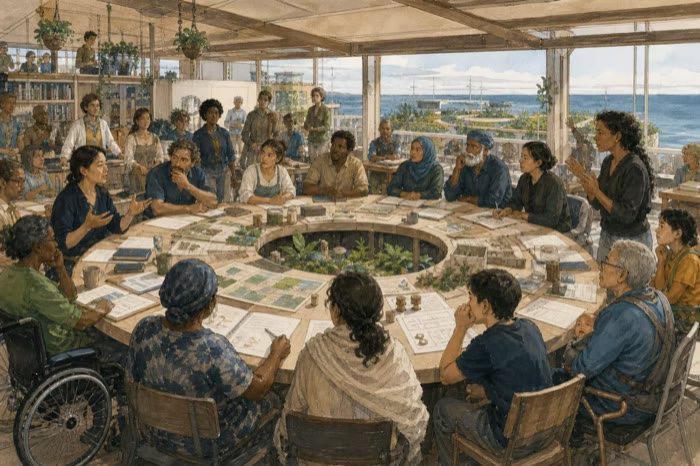
Require an independently reviewed rights floor, civic constitution separate from corporate control, due process, amendment, youth voice, and limits on emergency authority.
Claim records
- Governance is life support: technical control of air and water cannot become unreviewable corporate sovereignty over people born aboard. (normative · early-research · supported; two independent reviewers required for essential-services, governance, human-rights; current review: pending-two-person-required)
- Outer Space Treaty Article VI assigns states international responsibility for national activities, including nongovernmental activities requiring authorization and continuing supervision; Article VII addresses launching-state liability, and Article VIII concerns registry-state jurisdiction and control. Applicability to a multigenerational interstellar polity remains unsettled. (observed · operational · supported; two independent reviewers required for governance, space-law; current review: pending-two-person-required)
- Human-rights, constitutional, commons, cooperative, and emergency-power traditions provide design material, not a validated ship constitution. (observed · early-research · supported; two independent reviewers required for governance, crime-justice, human-rights; current review: pending-two-person-required)
- Short analogs can test procedures but cannot legitimate rule over future generations. (normative · no-known-path · supported; two independent reviewers required for governance, child-rights, privacy, intergenerational-rights, human-rights; current review: pending-two-person-required)
- Citizenship, statelessness, family law, inheritance, criminal jurisdiction, destination autonomy, and relationship with Earth are unsettled. (unknown · no-known-path · tentative; two independent reviewers required for governance, space-law, intergenerational-rights, crime-justice; current review: pending-two-person-required)
- Scarcity and emergency command can harden into permanent caste or authoritarian rule. (proposed · early-research · supported; two independent reviewers required for governance, emergency, essential-services, human-rights; current review: pending-two-person-required)
- Founders cannot consent on behalf of children or permanently bind descendants to the mission. (normative · no-known-path · supported; two independent reviewers required for governance, intergenerational-rights; current review: pending-two-person-required)
- Transparent commons governance, emergency sunset clauses, ombuds institutions, and future-generations review strengthen Earth institutions. (proposed · early-research · tentative; two independent reviewers required for governance, emergency, human-rights, privacy, child-rights, intergenerational-rights; current review: pending-two-person-required)
- Participatory resource allocation can improve remote communities and infrastructure cooperatives. (proposed · early-research · tentative; two independent reviewers required for essential-services, governance, labor; current review: pending-two-person-required)
- Require an independently reviewed rights floor, civic constitution separate from corporate control, due process, amendment, youth voice, and limits on emergency authority. (normative · early-research · supported; two independent reviewers required for governance, intergenerational-rights; current review: pending-two-person-required)
Context sources—not claim citations
Foundation system synthesis · Linked claims editorially assessed · Independent system review pending · Suggest a correction