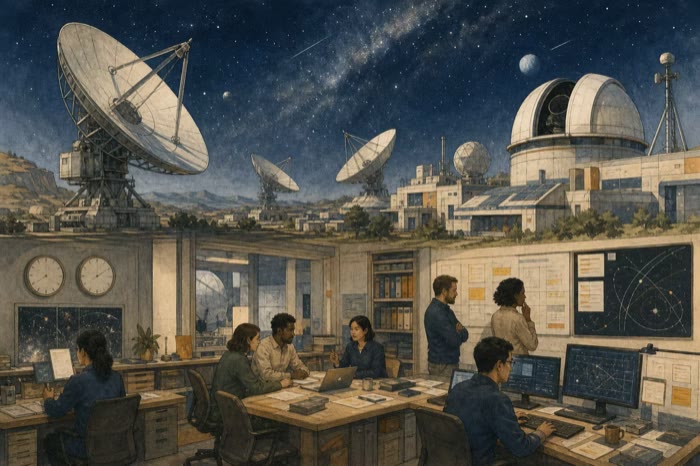
Editorial boundary: This public alpha is generated from version-controlled source without third-party application or build packages. It is not the reviewed 1.0 corpus: 60 Academy lessons are substantive editorial drafts, 0 remain foundation outlines, and independent domain review remains open.
Current state
- Deep Space Network service and star tracking are operational in defined mission contexts; optical communication and pulsar-navigation capabilities have separate demonstrations and limitations; delay-tolerant networking has standards and bounded deployments.
- Voyager provides evidence of multi-decade spacecraft operation supported by Earth institutions. Treating it as a lesson in institutional continuity, power triage, remote diagnosis, and archive dependence is an inference—not evidence of autonomous continuity.
- Open formats, checksums, fixity audits, multiple media, emulation, build recovery, authority metadata, and repeated teach-back are distinct Earth preservation practices. Checksums and CRCs do not establish authenticity.
Major unknowns
- Usable data rates across light-years require enormous apertures, power, pointing accuracy, and patience.
- Media, codecs, compilers, models, and cultural interpretation can fail even when bits survive.
- Target state may change during centuries of travel, making ongoing observation and course governance essential.
Failure modes
- Clock, reference-frame, ephemeris, antenna, pointing, or optical-terminal loss compounds over long autonomous intervals.
- Communications power and aperture are budgeted for cruise but not safe-mode recovery or weak arrival signals.
Useful precursors
- Deep Space Network delay-tolerant operations, optical communications, pulsar navigation, and autonomous rendezvous.
- Long-duration navigation exercises that deliberately remove Earth updates and degrade sensors and clocks.
Decision gate
Demonstrate navigation and archive recovery without current experts, cloud services, vendor activation, or a single surviving medium.
Claim records
- A stellar mission must navigate, preserve truth, and communicate through growing delay and eventual practical independence from Earth. (modeled · breakthrough-dependent · supported; two independent reviewers required for governance, privacy, cybersecurity, spacecraft-safety, dual-use, intergenerational-rights; current review: pending-two-person-required)
- Deep Space Network service and star tracking are operational in defined mission contexts; optical communication and pulsar-navigation capabilities have separate demonstrations and limitations; delay-tolerant networking has standards and bounded deployments. (demonstrated · major-scale-up · strong; 1 independent reviewer required; current review: pending)
- Voyager provides evidence of multi-decade spacecraft operation supported by Earth institutions. Treating it as a lesson in institutional continuity, power triage, remote diagnosis, and archive dependence is an inference—not evidence of autonomous continuity. (observed · operational · strong; two independent reviewers required for education, labor, governance, intergenerational-rights; current review: pending-two-person-required)
- Open formats, checksums, fixity audits, multiple media, emulation, build recovery, authority metadata, and repeated teach-back are distinct Earth preservation practices. Checksums and CRCs do not establish authenticity. (demonstrated · operational · strong; two independent reviewers required for education, culture, governance, cybersecurity, intergenerational-rights; current review: pending-two-person-required)
- Usable data rates across light-years require enormous apertures, power, pointing accuracy, and patience. (modeled · breakthrough-dependent · strong; two independent reviewers required for cybersecurity, spacecraft-safety, dual-use; current review: pending-two-person-required)
- Media, codecs, compilers, models, and cultural interpretation can fail even when bits survive. (observed · major-scale-up · supported; two independent reviewers required for culture, education, intergenerational-rights, governance, privacy; current review: pending-two-person-required)
- Target state may change during centuries of travel, making ongoing observation and course governance essential. (modeled · early-research · supported; two independent reviewers required for governance, spacecraft-safety, dual-use, intergenerational-rights; current review: pending-two-person-required)
- Delay-tolerant networking is operational in bounded space deployments, including ISS payload services and PACE; that evidence does not establish outcomes in terrestrial challenged-network settings. (observed · operational · strong; 1 independent reviewer required; current review: pending)
- Durable archives and teach-back programs improve public records, science, and organizational succession. (demonstrated · operational · supported; two independent reviewers required for privacy, governance, cybersecurity, education, labor, intergenerational-rights; current review: pending-two-person-required)
- Demonstrate navigation and archive recovery without current experts, cloud services, vendor activation, or a single surviving medium. (normative · operational · supported; two independent reviewers required for cybersecurity, spacecraft-safety; current review: pending-two-person-required)
Context sources—not claim citations
Foundation system synthesis · Linked claims editorially assessed · Independent system review pending · Suggest a correction