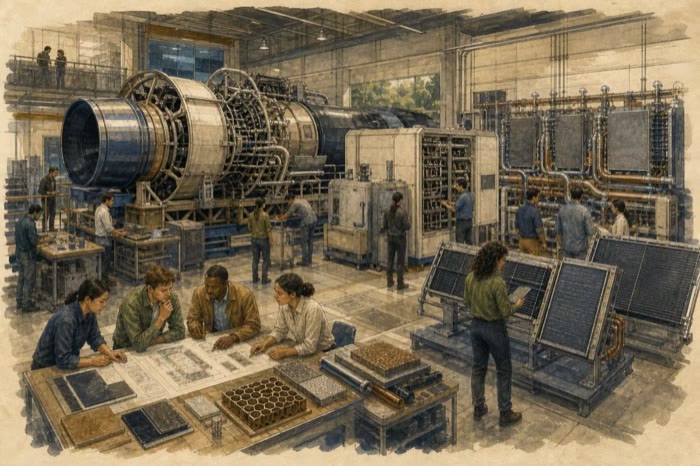
Editorial boundary: This public alpha is generated from version-controlled source without third-party application or build packages. It is not the reviewed 1.0 corpus: 60 Academy lessons are substantive editorial drafts, 0 remain foundation outlines, and independent domain review remains open.
Current state
- Solar arrays, radioisotope systems, batteries, and conventional thermal hardware are flight-proven at present spacecraft scales.
- Kilopower demonstrated a small fission system on the ground, while higher-power space reactors remain development programs.
- Heat pipes, pumped loops, radiators, segmented buses, and load shedding are mature concepts but not at worldship scale.
Major unknowns
- No crewed space system has demonstrated an integrated megawatt-class electrical source and matching heat-rejection system.
- Century-scale conversion machinery, insulation, power electronics, working fluids, and black-start systems require replacement ecosystems.
- Fusion heat exhaust, radiation damage that varies by fuel cycle and design, fuel cycles, and radiator mass remain unresolved as a complete space system.
Failure modes
- A common electrical bus fault or control error cascades across life support, food, computing, and manufacturing.
- Radiator damage, fouling, or loss of coolant prevents black start and turns recoverable power into uninhabitable heat.
Useful precursors
- Islandable terrestrial microgrids and remote critical-infrastructure black-start exercises.
- Long-life space power, heat-pipe, radiator, and waste-heat recovery demonstrations with injected failures.
Decision gate
Demonstrate isolated power trains, black start, representative heat rejection, local repair, and stable operation through injected failures.
Claim records
- The ship needs a maintainable energy ecosystem, not one miracle reactor. Nearly all electrical energy consumed inside a steady-state habitat ultimately appears as heat; energy exported in exhaust, directed radiation, discarded mass, or stored products must be accounted separately, and remaining waste heat must be transported and radiated to space. (demonstrated · major-scale-up · strong; two independent reviewers required for nuclear, dual-use; current review: pending-two-person-required)
- Solar arrays, radioisotope systems, batteries, and conventional thermal hardware are flight-proven at present spacecraft scales. (demonstrated · operational · strong; two independent reviewers required for spacecraft-safety, power, thermal, materials, nuclear; current review: pending-two-person-required)
- Kilopower demonstrated a small fission system on the ground, while higher-power space reactors remain development programs. (demonstrated · early-research · strong; two independent reviewers required for nuclear, spacecraft-safety, power, thermal, dual-use; current review: pending-two-person-required)
- Heat pipes, pumped loops, radiators, segmented buses, and load shedding are mature concepts but not at worldship scale. (demonstrated · major-scale-up · strong; 1 independent reviewer required; current review: pending)
- No crewed space system has demonstrated an integrated megawatt-class electrical source and matching heat-rejection system. (observed · breakthrough-dependent · strong; two independent reviewers required for nuclear, spacecraft-safety, power, thermal, materials; current review: pending-two-person-required)
- Century-scale conversion machinery, insulation, power electronics, working fluids, and black-start systems require replacement ecosystems. (normative · breakthrough-dependent · supported; two independent reviewers required for spacecraft-safety, life-support-continuity; current review: pending-two-person-required)
- Fusion heat exhaust, radiation damage that varies by fuel cycle and design, fuel cycles, and radiator mass remain unresolved as a complete space system. (modeled · breakthrough-dependent · supported; two independent reviewers required for nuclear, radiation, dual-use; current review: pending-two-person-required)
- Resilient power islands, microgrid recovery, and condition monitoring benefit hospitals, remote communities, and critical infrastructure. (demonstrated · operational · supported; two independent reviewers required for critical-infrastructure, power, cyber, medical; current review: pending-two-person-required)
- High-temperature lightweight radiators and thermal-storage systems serve data centers, aircraft, and industrial energy systems. (proposed · early-research · tentative; two independent reviewers required for materials, thermal, power, spacecraft-safety; current review: pending-two-person-required)
- Demonstrate isolated power trains, black start, representative heat rejection, local repair, and stable operation through injected failures. (normative · early-research · supported; two independent reviewers required for nuclear, cybersecurity, spacecraft-safety, life-support-continuity; current review: pending-two-person-required)
Context sources—not claim citations
Foundation system synthesis · Linked claims editorially assessed · Independent system review pending · Suggest a correction