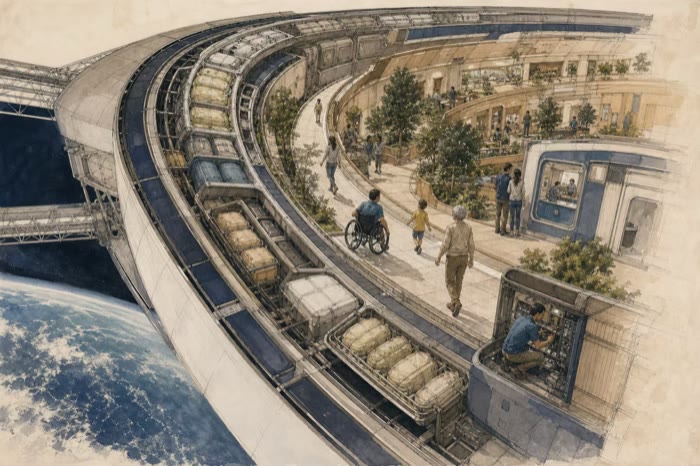
Editorial boundary: This public alpha is generated from version-controlled source without third-party application or build packages. It is not the reviewed 1.0 corpus: 60 Academy lessons are substantive editorial drafts, 0 remain foundation outlines, and independent domain review remains open.
Current state
- Crewed pressure modules, expandable structures, MMOD shields, and human-factors standards are operational in Earth orbit.
- Rotating-habitat gravity follows well-understood physics, but lifetime comfort and developmental biology have not been validated.
- Spaceflight standards focus on small groups of healthy professional adults rather than a diverse civil population.
Major unknowns
- Safe gravity level, rotation rate, gradient, and exposure for pregnancy, childhood, aging, and disability are unknown.
- Large crew-bearing rotating pressure interfaces integrated with habitation utilities, changing mass distributions, civil evacuation, and locally sustained century-scale maintenance remain unvalidated.
- Passive GCR shielding is mass-intensive; active shielding is experimental and adds new failure hazards.
Failure modes
- Fatigue, creep, seal aging, debris impact, or undetected corrosion propagates through a pressure boundary.
- Rotation hardware or mass imbalance creates vibration, bearing, control, and evacuation hazards.
Useful precursors
- Long-duration pressure-vessel and material-exposure programs on stations, the Moon, and uncrewed orbital platforms.
- Human-rated rotating-habitat demonstrations that validate balance, access, repair, and safe spin transitions.
Decision gate
Require full-scale human-in-the-loop mockups, diverse-body accessibility review, fire/refuge tests, and long-duration rotating-environment evidence.
Claim records
- A worldship would combine a pressure vessel, rotating machine, city, hospital, school, farm, factory, and refuge; this bounded standards survey did not identify one standard covering that combination. (observed · major-scale-up · supported; two independent reviewers required for structural-safety, fire, medical, spacecraft-safety; current review: pending-two-person-required)
- Crewed pressure modules, expandable structures, MMOD shields, and human-factors standards are operational in Earth orbit. (demonstrated · operational · strong; two independent reviewers required for structural-safety, spacecraft-safety; current review: pending-two-person-required)
- Rotating-habitat gravity follows well-understood physics, but lifetime comfort and developmental biology have not been validated. (demonstrated · early-research · strong; two independent reviewers required for medical, spacecraft-safety; current review: pending-two-person-required)
- Spaceflight standards focus on small groups of healthy professional adults rather than a diverse civil population. (observed · operational · strong; two independent reviewers required for medical, disability, spacecraft-safety; current review: pending-two-person-required)
- No reviewed evidence establishes a safe gravity level, rotation rate, gradient, and exposure regime spanning pregnancy, childhood, aging, and disability. (unknown · breakthrough-dependent · supported; two independent reviewers required for medical, disability, spacecraft-safety; current review: pending-two-person-required)
- Large crew-bearing rotating pressure interfaces integrated with habitation utilities, changing mass distributions, civil evacuation, and locally sustained century-scale maintenance remain unvalidated. (unknown · early-research · strong; two independent reviewers required for structural-safety, fire, spacecraft-safety, dual-use; current review: pending-two-person-required)
- Passive GCR shielding is mass-intensive; active shielding is experimental and adds new failure hazards. (modeled · early-research · supported; two independent reviewers required for medical, radiation, nuclear, spacecraft-safety, dual-use; current review: pending-two-person-required)
- Accessible, reconfigurable, quiet, low-toxicity interiors improve hospitals, shelters, submarines, and polar stations. (proposed · major-scale-up · tentative; two independent reviewers required for medical, disability; current review: pending-two-person-required)
- Multifunctional panels can combine structure, thermal transport, sensing, radiation moderation, and repairability. (proposed · early-research · supported; two independent reviewers required for structural-safety, radiation, spacecraft-safety, nuclear, dual-use; current review: pending-two-person-required)
- Require full-scale human-in-the-loop mockups, diverse-body accessibility review, fire/refuge tests, and long-duration rotating-environment evidence. (normative · early-research · supported; two independent reviewers required for spacecraft-safety, medical, disability, fire, radiation, life-support; current review: pending-two-person-required)
Context sources—not claim citations
Foundation system synthesis · Linked claims editorially assessed · Independent system review pending · Suggest a correction