Editorial boundary: This public alpha is generated from version-controlled source without third-party application or build packages. It is not the reviewed 1.0 corpus: 60 Academy lessons are substantive editorial drafts, 0 remain foundation outlines, and independent domain review remains open.
Current state
- Evidence from small, highly selected adult occupational cohorts—mostly in low Earth orbit—identifies risks involving radiation, bone, muscle, vision, sleep, behavior, and immune function but does not establish lifetime outcomes for a diverse civil population.
- Remote clinical decision support, tissue models, omics, analogs, and commercial-astronaut repositories are active research areas.
- No documented human has completed gestation, birth, or childhood development in an off-Earth environment.
Major unknowns
- Pregnancy, placental function, birth, pediatric development, lifetime fertility, and transgenerational effects in altered gravity remain unknown.
- Pharmaceutical manufacture, shelf life, surgery, dentistry, intensive care, and rare-disease management lack independent support chains.
- Clinical privacy and authority may conflict with mission command, population planning, and public-health surveillance.
Failure modes
- A diagnosis, surgery, drug, implant, or specialist skill is unavailable when evacuation and resupply are impossible.
- Chronic radiation, low gravity, isolation, or constrained diet creates multi-system illness outside current evidence.
Useful precursors
- Remote and austere medicine, autonomous diagnostics, shelf-life extension, and distributed medical manufacturing.
- Longitudinal health studies in stations, submarines, polar bases, and carefully governed habitat analogs.
Decision gate
Do not rely on reproduction until independent evidence supports the intended environment and the architecture remains viable under voluntary reproductive choices, accessible clinical care, privacy, appeal, disability support, and no coercive quotas.
Claim records
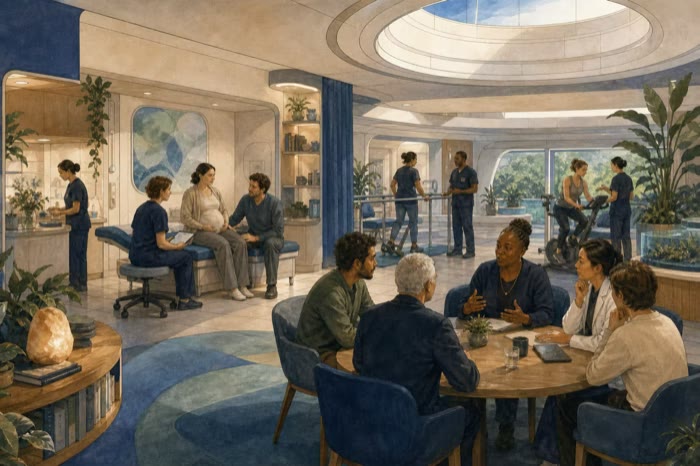
- Medicine aboard a generation ship is a complete public-health system across conception, childhood, adulthood, aging, disability, emergency care, and death. (normative · breakthrough-dependent · supported; two independent reviewers required for medical, life-support-continuity; current review: pending-two-person-required)
- Evidence from small, highly selected adult occupational cohorts—mostly in low Earth orbit—identifies risks involving radiation, bone, muscle, vision, sleep, behavior, and immune function but does not establish lifetime outcomes for a diverse civil population. (observed · major-scale-up · strong; two independent reviewers required for medical; current review: pending-two-person-required)
- Remote clinical decision support, tissue models, omics, analogs, and commercial-astronaut repositories are active research areas. (observed · early-research · strong; two independent reviewers required for medical; current review: pending-two-person-required)
- This bounded review found no published evidence of a human pregnancy carried through birth, or of childhood development, in an off-Earth environment. (observed · no-known-path · strong; two independent reviewers required for medical, intergenerational-rights; current review: pending-two-person-required)
- Animal, cellular, and adult-flight studies provide bounded precursor evidence, but do not establish human pregnancy, placental function, birth, pediatric development, lifetime fertility, or transgenerational outcomes in altered gravity. (unknown · breakthrough-dependent · strong; two independent reviewers required for medical, intergenerational-rights; current review: pending-two-person-required)
- Pharmaceutical manufacture, shelf life, surgery, dentistry, intensive care, and rare-disease management lack independent support chains. (modeled · breakthrough-dependent · supported; two independent reviewers required for medical, supply-chain; current review: pending-two-person-required)
- Clinical privacy and authority may conflict with mission command, population planning, and public-health surveillance. (normative · operational · strong; two independent reviewers required for medical, governance, intergenerational-rights; current review: pending-two-person-required)
- Bounded, prospectively validated clinical decision support and resilient medical supply may benefit rural care, maritime operations, disaster medicine, and aging populations; local monitoring, abstention, provenance, appeal, and an AI-off care path remain required. (proposed · early-research · supported; two independent reviewers required for medical, cybersecurity; current review: pending-two-person-required)
- Closed-habitat environmental and clinical surveillance may inform infection control in named shared-air or shared-water settings when sampling, thresholds, confirmation, privacy, and interventions are validated; improved health outcomes are not established generically. (observed · major-scale-up · tentative; two independent reviewers required for medical, privacy, surveillance, child-rights, disability, labor, governance; current review: pending-two-person-required)
- Do not rely on reproduction until independent evidence supports the intended environment and the architecture remains viable under voluntary reproductive choices, accessible clinical care, privacy, appeal, disability support, and no coercive quotas. (normative · operational · strong; two independent reviewers required for medical, governance, intergenerational-rights; current review: pending-two-person-required)
Context sources—not claim citations
Foundation system synthesis · Linked claims editorially assessed · Independent system review pending · Suggest a correction