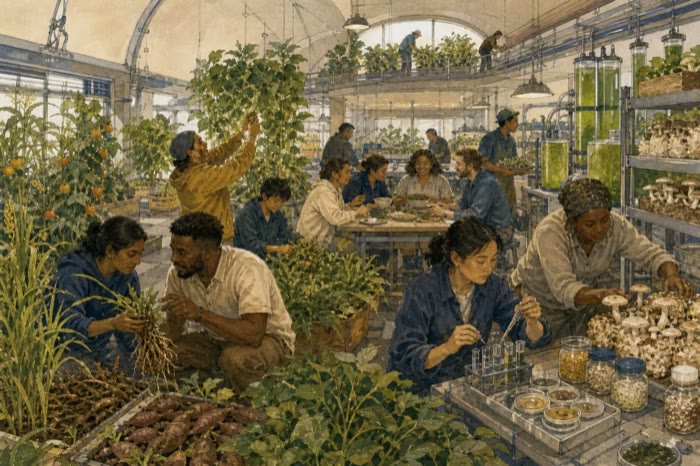
Editorial boundary: This public alpha is generated from version-controlled source without third-party application or build packages. It is not the reviewed 1.0 corpus: 60 Academy lessons are substantive editorial drafts, 0 remain foundation outlines, and independent domain review remains open.
Current state
- Crop chambers, microbial biomanufacturing experiments, controlled agriculture, and closed-ecology analogs provide distinct evidence at different scales, durations, environments, and achieved functions; they should not be treated as one demonstration class.
- ESA MELiSSA develops regenerative life-support compartments and progressive integration; it has not demonstrated a completed multigenerational closed ecology.
- Biosphere 2 and Lunar Palace report different, boundary-specific closure results and also expose chemical, material, operational, and microbial couplings.
Major unknowns
- A complete, nutritionally adequate, culturally acceptable diet has not been regenerated in space.
- Crop disease, pollinator loss, loss of required microbial function, pathogen increase, reduced diversity, instability, salt accumulation, and harmful genetic change can propagate across tightly coupled loops.
- Small chambers do not scale linearly to neighborhoods with children, animals, varied diets, and changing population.
Failure modes
- Crop disease, pollinator loss, nutrient imbalance, or genetic uniformity produces correlated food failure.
- The ecology meets calories but loses micronutrients, soil function, resilience, or acceptable food culture.
Useful precursors
- Controlled-environment agriculture, regenerative nutrient recovery, seed-bank, and distributed food-resilience programs.
- MELiSSA-class and other multi-trophic closed-ecology testbeds operated through several crop and microbial cycles.
Decision gate
Operate an integrated hybrid ecology through multi-season failures while measuring every essential element and publishing negative results.
Claim records
- A ship must cultivate calories, nutrients, microbial function, ecological resilience, and cultural meaning—not merely grow salad. (normative · major-scale-up · supported; two independent reviewers required for life-support-continuity, medical, governance; current review: pending-two-person-required)
- Crop chambers, microbial biomanufacturing experiments, controlled agriculture, and closed-ecology analogs provide distinct evidence at different scales, durations, environments, and achieved functions; they should not be treated as one demonstration class. (demonstrated · early-research · strong; 1 independent reviewer required; current review: pending)
- ESA MELiSSA develops regenerative life-support compartments and progressive integration; it has not demonstrated a completed multigenerational closed ecology. (demonstrated · early-research · strong; two independent reviewers required for life-support, medical, ecology, food-safety, materials; current review: pending-two-person-required)
- Biosphere 2 and Lunar Palace report different, boundary-specific closure results and also expose chemical, material, operational, and microbial couplings. (demonstrated · early-research · supported; two independent reviewers required for life-support, medical, ecology, food-safety, labor; current review: pending-two-person-required)
- A complete, nutritionally adequate, culturally acceptable diet has not been regenerated in space. (observed · major-scale-up · supported; two independent reviewers required for medical, life-support-continuity; current review: pending-two-person-required)
- Crop disease, pollinator loss, loss of required microbial function, pathogen increase, reduced diversity, instability, salt accumulation, and harmful genetic change can propagate across tightly coupled loops. (modeled · early-research · supported; two independent reviewers required for medical, life-support-continuity; current review: pending-two-person-required)
- Small chambers do not scale linearly to neighborhoods with children, animals, varied diets, and changing population. (modeled · major-scale-up · supported; two independent reviewers required for life-support, medical, child-rights, animal-welfare, food-safety, ecology; current review: pending-two-person-required)
- Controlled agriculture, microbial protein, circular nutrients, and resilient seed systems may improve food security when energy, labor, safety, and supply-chain burdens are also demonstrated. (proposed · major-scale-up · supported; two independent reviewers required for food-safety, life-support, medical, labor, ecology, governance; current review: pending-two-person-required)
- Ecological digital twins and transparent closure metrics can strengthen greenhouses and urban water-food systems. (proposed · early-research · tentative; two independent reviewers required for life-support, food-safety, cyber, privacy, governance, critical-infrastructure; current review: pending-two-person-required)
- Operate an integrated hybrid ecology through multi-season failures while measuring every essential element and publishing negative results. (normative · early-research · supported; two independent reviewers required for life-support-continuity, medical, governance; current review: pending-two-person-required)
Context sources—not claim citations
Foundation system synthesis · Linked claims editorially assessed · Independent system review pending · Suggest a correction