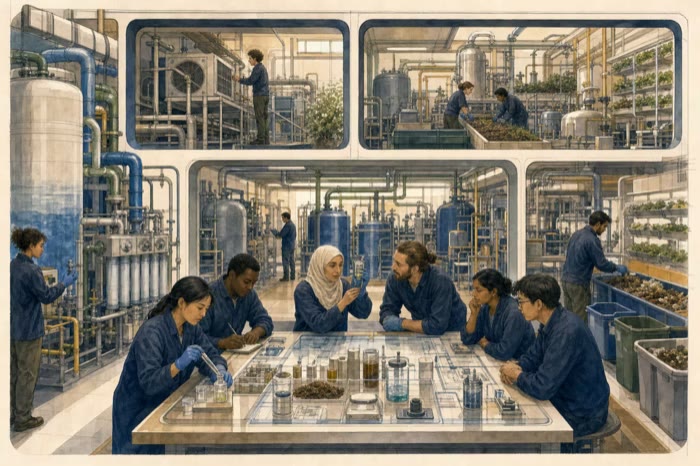
Editorial boundary: This public alpha is generated from version-controlled source without third-party application or build packages. It is not the reviewed 1.0 corpus: 60 Academy lessons are substantive editorial drafts, 0 remain foundation outlines, and independent domain review remains open.
Current state
- ISS systems recover much of crew water and manage oxygen and carbon dioxide, while still depending on resupply and venting material.
- NASA achieved roughly 98% water recovery in a specific 2023 configuration; that figure does not describe food, nutrients, solid waste, or total matter.
- Physicochemical systems offer fast control, while biological systems can produce food and oxygen and transform or recycle some nutrient compounds and useful materials; neither can regenerate lost elements or energy.
Major unknowns
- Element-by-element closure, contaminant sinks, pharmaceutical residues, salts, and inaccessible deposits remain poorly bounded over decades.
- Membranes, catalysts, seals, sensors, and sterilization media must be locally replaceable.
- This English-language foundation review found no public evidence of an integrated human habitat demonstrating multigenerational material closure and recovery from severe ecological faults; the search was not systematic.
Failure modes
- Trace contaminants, microbial fouling, salt accumulation, or sensor drift silently poisons a nominally closed loop.
- Closely coupled air, water, waste, and thermal loops share a common failure and cannot be isolated or restarted.
Useful precursors
- ISS environmental-control operations and increasingly closed terrestrial water, nutrient, and waste systems.
- Multi-year sealed-habitat trials with full mass balances, fault injection, local repair, and public negative results.
Decision gate
Demonstrate bounded material accounting with a declared system boundary, interval, inventories, flows, losses, maintenance media, and measurement uncertainty, plus independent emergency reserves, manual control, and recovery from contamination.
Claim records
- Generation-ship life support must become a materially accountable industrial ecology; high water recovery alone is not closure. (modeled · major-scale-up · strong; two independent reviewers required for life-support-continuity; current review: pending-two-person-required)
- ISS systems recover much of crew water and manage oxygen and carbon dioxide, while still depending on resupply and venting material. (observed · operational · strong; 1 independent reviewer required; current review: pending)
- NASA reported early estimates of 97–98% water recovered from urine after adding the ISS Brine Processor Assembly in a specific 2023 configuration; that figure is not total habitat-water or total-matter recovery. (demonstrated · operational · strong; two independent reviewers required for life-support-continuity; current review: pending-two-person-required)
- Physicochemical systems offer fast control, while biological systems can produce food and oxygen and transform or recycle some nutrient compounds and useful materials; neither can regenerate lost elements or energy. (demonstrated · major-scale-up · strong; two independent reviewers required for life-support, medical, ecology, materials, power; current review: pending-two-person-required)
- Element-by-element closure, contaminant sinks, pharmaceutical residues, salts, and inaccessible deposits remain poorly bounded over decades. (modeled · early-research · supported; 1 independent reviewer required; current review: pending)
- Membranes, catalysts, seals, sensors, and sterilization media must be locally replaceable. (normative · breakthrough-dependent · supported; two independent reviewers required for life-support, medical, materials, spacecraft-safety, labor; current review: pending-two-person-required)
- This English-language foundation review found no public evidence of an integrated human habitat demonstrating multigenerational material closure and recovery from severe ecological faults; the search was not systematic. (observed · no-known-path · strong; two independent reviewers required for life-support, medical, ecology, intergenerational-rights, materials; current review: pending-two-person-required)
- Water recovery, waste conversion, air monitoring, and nutrient recycling directly support drought resilience and remote communities. (proposed · major-scale-up · supported; two independent reviewers required for life-support, medical, water, ecology, labor, governance; current review: pending-two-person-required)
- Transparent mass-balance standards can improve claims across agriculture, buildings, and circular industry. (proposed · operational · supported; two independent reviewers required for materials, ecology, governance, labor; current review: pending-two-person-required)
- Demonstrate bounded material accounting with a declared system boundary, interval, inventories, flows, losses, maintenance media, and measurement uncertainty, plus independent emergency reserves, manual control, and recovery from contamination. (normative · operational · strong; two independent reviewers required for life-support-continuity, medical; current review: pending-two-person-required)
Context sources—not claim citations
Foundation system synthesis · Linked claims editorially assessed · Independent system review pending · Suggest a correction